


Along with Vikings and fermented shark, one of the most well-recognised icons of Iceland is its tiny horses.
As you drive around the country you’ll see beautiful Icelandic horses in the fields all along the side of the road. In fact there are an estimated 100,000 Icelandic horses in Iceland, so it’s no surprise that they’re easy to spot!
But the more I saw them, the more questions I had! So after I got home I looked up the answers, and now I’m sharing them with you.
Here’s everything you’ve ever wanted to know (and a few things you probably didn’t) about the beautiful Icelandic horse.

Why are Icelandic horses not ponies?
I learned almost straight away that you mustn’t call them ‘Icelandic ponies’ – Icelanders are very particular about that and I was told off for it!
I got confused by this as I thought a pony was just a small horse (shorter than 14.2 hands or 58 inches, fact fans!) – and the Icelandic wild horses are definitely small.
But I was told that ponies have proportionally shorter legs and wider bodies, whereas the Icelandic horses’ proportions are more horse-like.
Also apparently there is only one word in Icelandic for an animal of the equine persuasion, so they’ve gone with ‘horse’ as the translation. So now you know.

Are the horses in Iceland wild?
Well, sort of. The horses are all owned by someone, but they are sort of half wild – they’re not pets as we might keep horses in the UK, and they are often left to forage for themselves in the Icelandic highlands with little care or supervision.
The Icelandic horse is a special breed native to the country and they’re incredibly protective of it.
It’s the only breed of horse in Iceland, and to protect them from foreign horse diseases, Icelandic law forbids any horses from being imported into the country.
If you take your horse out of Iceland, you’re not allowed to bring it back!

What do they do with all the horses in Iceland?
Icelandic horses are mostly used for competition and leisure – there are many horse riding schools and competitions around the country.
In the highlands they’re also used to round up sheep – and sadly, they’re also bred for slaughter. Much of the meat is exported to Japan, though horse meat was on offer in a couple of the restaurants I ate in.
In the interests of research I did try a very tiny taste, but I thought the flavour was very weird and strong and I didn’t much like it.

Can you ride Icelandic horses? Are they good for beginners?
Yes, absolutely. Although they are small they are very strong, and there are loads of riding schools where you can learn to ride them.
And due to their gentle, friendly nature, and short stature, they’re actually great for beginners.
A ride on an Icelandic horse is a really great activity to do on your visit to Iceland.

Are Icelandic horses friendly?
Yes! If you hire a car in Iceland and drive around the country, all along the main road you see horses in the fields. I thought they were beautiful, and kept wanting to stop the car and get out to talk to them and photograph them.
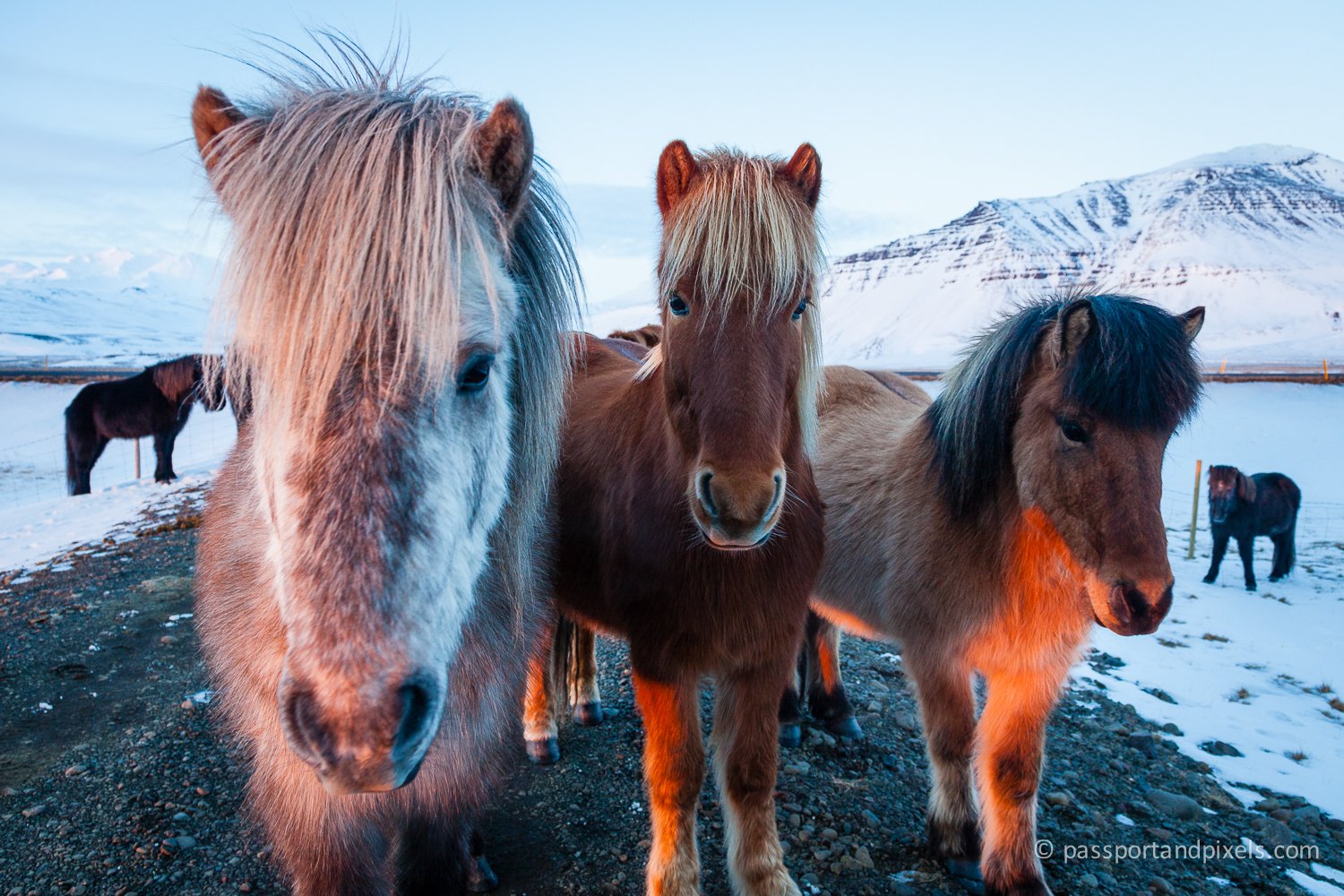
They’re incredibly curious and friendly, which is very endearing, but also annoying when you’re trying to take a photo and they keep coming over to say hello!
But if you’re travelling round Iceland with kids, this will definitely be one of the highlights for them!
The first few days of my Iceland road trip we were on a very tight schedule, so there wasn’t time to keep stopping.
And as you drive along Iceland’s ring road, often there is nowhere safe to pull over, as there’s no hard shoulder and few laybys, and traffic does come along the road pretty fast!
But on our third evening we were driving through the Snaefellsnes Peninsula and we passed this group of horses standing on a ridge with the setting sun behind them.
I spotted them as we passed and felt that full-body pull many photographers will recognise, when you just HAVE to photograph something or you will always regret it. So I turned the car around and went back.
There was no gate, only a cattle grid, so it was easy enough to walk right into the field and get the right position to capture the horses beautifully backlit with the sun behind them.
My colleague was a bit nervous at first – after all, we didn’t know how these animals might react to our being in their field – but he soon saw that they were very friendly and came to join me.

Icelandic horses in the wind
One other endearing trait I noticed was that, on windy days (and there are plenty of those!), all the horses line up like rows of soldiers with their bums facing into the wind!
I kept trying to photograph this but every time we stopped the car, the horses would immediately come over to say hello, so I could never get the shot!
You can see from the way their manes are being blown about how windy it was though.

But I did manage to get some sheep doing the windy bum thing!

Where to see Icelandic horses
To see Icelandic horses, head to the countryside just outside Reykjavík, where farms like Laxnes Horse Farm offer up-close encounters and riding tours.
The Golden Circle route is another hotspot – watch for horses grazing near Þingvellir and Gullfoss.
In the south, stables in Vik and Hella provide scenic rides along black sand beaches and lava fields.
For a cultural twist, check out horse shows at Fákasel Horse Park or events like Landsmót, Iceland’s national horse competition.
Another awesome way to see Icelandic horses would be to rent a campervan from Cozy Campers, and then drive around Iceland, stopping to admire the icy landscapes and adorable horses from the comfort of your heated campervan.
These unique horses roam free in herds across open pastures, so even a road trip often turns into a spontaneous photo opportunity. As you can see from my own photos!

Buy me a coffee
Did you enjoy this website or find it useful? If you did and fancy showing your appreciation, that would be amazing!
A small token of support helps keep Passport & Pixels going, so I can carry on creating free content for travellers like you. Also, it makes my day! Thank you!
LIked this post?
Social shares help support my hard work! You can share via the buttons at the bottom, or pin this handy Pinterest Pin. Thank you!

