


I visited Huesca Spain on a hosted trip in exchange for this review. All opinions are my own, honestly held and have not been written or edited by anyone apart from me (so apologies for any typos!). I don’t accept freebies or payment in exchange for positive reviews. This post contains some affiliate links.
If, like me, you love adventure, the great outdoors, history, and getting away from the crowds, and you’re looking for all of that within easy reach of the UK, then the Spanish province of Huesca could be the perfect place for you.
Never heard of Huesca before, and have no idea where it is? Nor had I before I visited.
And let me tell you, now I’ve found it, I’m not entirely sure I want to share.

Tucked away in the region of Aragón in Northern Spain, this province of dramatic mountain landscapes, turquoise lakes, charming historic villages, jagged canyons, ancient castles, adrenaline adventures, fascinating cities and incredible food is an honest-to-god ‘hidden gem’, and I don’t want to spoil it!
But the Spanish tourist board wants to spread the word and encourage people away from overcrowded areas like Barcelona and Malaga. And since they were kind enough to invite me to discover this beautiful place, the least I can do is share it with you, my lovely readers.
So if you’re looking for activity holidays in the Pyrenees, or adventure sports in Spain, or ideas for northern Spain holidays, Huesca – and this blog post – have got you covered.

About my visit to Huesca Province in Northern Spain
I spent four days in Huesca as a guest of the Spanish and Aragon Tourism boards, to experience some of the province’s top tourist attractions and things to do, and report back via social media and this blog.
Our trip was organised by Spain Natural Travel, who offer both group and private tours around the whole of Spain – and did a great job of looking after us.
What follows is my honest opinion of where we went and what we did. All the photos were taken by me (apart from the ones of me which were kindly taken by people in my group).
But it’s OK, because I genuinely thought Huesca was fantastic, which makes writing this post easy!

Introducing Huesca
Huesca is a beautiful and historic province in northeastern Spain. It’s one of three provinces that make up Aragón, one of Spain’s 17 regions.
Thanks to its multicultural history (about which more below), Aragón offers a fascinating mix of cultures and influences, clearly visible in its architecture, traditions, and cuisine.
But the area’s real magic lies in its dramatic landscapes. The mighty Pyrenees mountains skirt its northern border, offering stunning scenery and opportunities for outdoor activities.
In fact Huesca province was recently voted the top adventure destination in Europe at the World Travel Awards!
So if you love majestic scenery and outdoors adventures, but also enjoy history, culture, and amazing food and wine, you should definitely consider a visit to Aragon region in general, and Huesca in particular.

Where are Huesca and Aragon in Spain?
Aragón is a large region, made up of three provinces: Huesca, Zaragoza and Teruel. Huesca is the northernmost one which includes the Pyrenees mountain range, which runs along its northern border with France.
This dramatic mountain range of snow-capped peaks and plunging river gorges boasts some of the highest peaks in the Iberian Peninsula, including Aneto (3,404 metres) and Monte Perdido (3,355 metres).

Heading south away from the mountains, Huesca also enjoys fertile river valleys and rolling hills with vineyards and olive groves, where you can go wine tasting and enjoy locally-grown produce.
The region of Aragon also borders Catalonia to the east, Navarre and Castile y Leon to the west, and Castilla-La Mancha to the south, making it easy to reach by car or train from Barcelona, Madrid or Bilbao.
A brief history of Aragón region
In the early medieval period Aragon was a small independent kingdom. Over the centuries, the kings of Aragon expanded their territory southward through military conquests against the Moors (Muslims from North Africa) who invaded and occupied parts of Spain in the 11th and 12th centuries.
The city of Zaragoza, now the region’s capital, fell to Aragon in 1118. The kingdom’s power grew further through marriages of alliance, most notably the marriage of Ferdinand II of Aragon to Isabella I of Castile in 1469, which united the Spanish kingdoms, and later, the marriage of their youngest daughter, Katherine of Aragon, to Henry VIII of England.
Students of English history will remember Katherine as Henry’s first wife; the one he divorced in favour of Anne Boleyn. In fact, this was the only thing I knew about Aragón prior to visiting!
In the 15th century Aragon’s influence expanded further into Italy and the Mediterranean, making it a significant European power. But the region’s golden age declined in the 16th century, due in part to dynastic struggles and the wars with France under Henry VIII.
Today you can still see evidence of this rich history everywhere you go – in the perfectly-preserved medieval villages, impressive castles, soaring cathedrals and mixed Moorish and Christian architecture (known as Mujedar).

Top things to do in Huesca Spain
Have I managed to make this sound like somewhere you’d like to visit? Well, here are just some of the brilliant things there are to see and do during your visit to Huesca in Spain.
Adventure Activities in Huesca
1/ Go whitewater rafting on the River Gallego
Thanks to its towering peaks and plunging river valleys, Aragón is one of the best regions in Spain to go white water rafting.
There are numerous rafting opportunities, but we did our rafting adventure on the Gallego River, one of the major tributaries of the Ebro River which is the second longest river in Spain, and runs through Aragon.
The Gallego starts in the Pyrenees, and the cascading mountain snowmelt creates rapids ranging from class II to class IV, making it suitable for both experienced rafters and newbies.

The trip typically takes about two hours and covers about seven kilometres, providing a mix of calm floating through stunning scenery, and adrenaline-pumping moments as you navigate the river’s hair-raising whitewater sections.
How to go white water rafting in Huesca
We did our trip with UR Pirineos, who are based in the small town of Murillo de Gállego. Rafting costs from 48 euros for an adult, but they also offer other activities including kayaking, stand-up paddle boarding, and paintball.
Our two-hour rafting adventure included a guide and all equipment such as wetsuits, helmets, lifejackets and booties.

2/ Face your fear on the Columpio Valle de Tena canyon swing
Thrill-seekers visiting Aragon will love the stomach-dropping Valle de Tena canyon swing (columpio in Spanish).
This dramatic, adrenaline-pumping swing has been built out from a cliff face 150 metres above the stunning glacial blue waters of Lake Bubal reservoir.
This was my first ever canyon swing – I’m not much of an adrenaline lover – and I wasn’t going to do it at all! But then I saw how amazing it looked and FOMO got the better of me!
This is far from the first time this has happened!

The thing that convinced me to do this canyon swing was that you don’t have to jump or push yourself. They attach you safely to the swing, winch you up, and then release you. No self-pep-talk or nerves of steel required.
And of course, those views were incredible, making it a fantastic destination for nature lovers and probably the best thing to do in Huesca for adrenaline junkies!
How to do the canyon swing
Both the canyon swing and the zipline next door are operated from an office in the small village of Hoz de Jaca. Just turn up, buy a ticket, get fitted with a helmet and safety harness, and join the queue!
One ride on the swing costs 36 euros.

3/ Fly overhead on the Tirolina Valle de Tena zip line
If you’re not quite brave enough to try the swing, right next door is the Valle de Tena zip line (tirolina in Spanish).
This high-altitude zip line claims to be the longest double zip line in Europe, stretching an impressive 950 metres across the Tena valley with stunning views of the dramatic peak of Peña Blanca behind.

You’ll be securely harnessed and seated, flying 120 metres (394 feet) over the turquoise waters of the Búbal Reservoir at speeds of about 90 km (56 miles) per hour. Again, the views were amazing and I really enjoyed this one – unlike the canyon swing, I would happily have done it again!
How to do the Tirolina Valle de Tena
As with the swing, just turn up at the office and buy a ticket. A ride on the Valle de Tena zipline costs 22 euros.

4/ Go e-biking in Boltaña
Another (slightly less terrifying) adventure that’s on offer in Aragon region is e-biking. The area’s mountain trails and stunning scenery make it perfect for cycling around to enjoy the views, and e-bikes take away the hard slog, making the adventure that much more enjoyable for adventurers of all fitness levels.
Though serious mountain bikers who prefer to put in the hard graft are more than welcome too!
There are numerous biking trails you can do throughout the region, but our e-bike journey took us around Boltaña district in the foothills of the Pyrenees.

Our half-day guided tour took us alongside churning rivers and through the stunning historic village of Aínsa, officially recognised as one of the prettiest in Spain. We didn’t get much further than that, because we took too long stopping to take photos!
How to go biking in Huesca
Our tour was organised through Cinca Riders, based in the town of El Grado. They offer bike hire so you can ride your own route, as well as guided private tours. These cost about 100 euros for half a day or 130 euros for a full day.


5/ Explore the deep canyons of Sierra de Guara
With all its dramatic landscapes, it probably won’t surprise you to learn that another one of the great adventure activities to do in Aragon is canyoning.
While I was doing the e-biking, some of our group opted to do an abseiling and canyoning experience in the Basender canyon.
The Basender is a small river that flows into the River Vero. Over millennia, the passage of the river has carved out this spectacular canyon through the limestone rock, which you can explore with the help of experienced guides.
For most of the year the canyon is mainly dry, making it ideal for beginner abseilers and novice canyoners.
Landscapes and nature in Huesca Spain
6/ Admire (or climb) the Mallos de Riglo
You shouldn’t go rafting on the Gallego River or visit Murillo de Gállego without stopping to check out the dramatic Mallos de Riglos rock formation. The name means ‘giants of Riglos’, after the nearby town.
As you raft along the river or drive through the region, every bend or turn will offer you a dramatic view of this 1000-metre tall pair of red rocks, which look like giant gates leading to another galaxy. Some also say the one on the left looks like an elephant (I can sort of see what they mean, but I remain unconvinced).
Located near the town of Las Peñas de Riglos, the Mallos de Riglos are also a popular spot for rock climbing – I’m not a climber, but can imagine that scaling this face would offer some seriously dramatic views. If, like me, you prefer to keep your feet on the ground, there are hiking trails that weave through the surrounding foothills, offering views of the formations and the adjacent Pyrenean foothills.

7/ Take a 4×4 tour in Ordesa y Monte Perdido National Park
If you’re planning to visit Aragon for the dramatic mountain landscapes, it doesn’t get any better than Ordesa y Monte Perdido National Park.
This 16,000 hectare national park is located the Pyrenees area of Huesca. It’s a UNESCO World Heritage Site and Biosphere Reserve, home to four plunging valleys carved out by glaciers, towering snow-capped peaks, stunning canyons and waterfalls, and diverse flora and fauna.
Keep your eyes peeled for wildlife like marmots, wild boar, roe deer and mountain goats.

The park is dominated by the mighty Monte Perdido, the third-highest peak in the Pyrenees, reaching a height of 3,355 metres (11,007 ft). Ordesa Valley is also known for its dramatic cliffs rising over 800 metres (2,625 ft) on either side.
The park has a karstic landscape, a unique topography formed by the dissolving of limestone rock by water over millions of years. This results in caves, underground rivers and weird rock formations like these, known as the ‘penguins’.

How to visit Ordesa National Park
We took a half day guided tour of the five most stunning viewpoints in the park by 4WD vehicle. The tour was booked through Miradores de Ordesa, and cost 45 euros per person. They also do birding and wildlife tours, but their five viewpoints tour is the most popular (and I highly recommend it; it was probably my favourite of all the things we did in Aragón).
If you have more time, Ordesa y Monte Perdido National Park is also great for hiking, though note that wild camping in the park is banned. So you can only do a day trip, or stay in the one refuge, Refugio de Goriz. Reservation is essential and you need to book early to avoid disappointment!

History and architecture in Huesca province
8/ Stay in the gorgeous medieval town of Alquezar
One of my favourite places to visit in Aragon was the medieval village of Alquézar. Not only is this officially one of the prettiest towns in Spain, it’s also UNESCO listed and recognised as one of the prettiest towns in the whole world.
Perched dramatically on a rocky outcrop in the Sierra de Guara mountains of Huesca, Spain, overlooking the dramatic Vero River canyon, this unmissable town is a work of art, with delightful cobblestone streets lined with with traditional Aragonese houses, a majestic Romanesque church, a castle with breathtaking vistas, and a few cafes, bars and restaurants where you can enjoy a drink in the sunshine.

The name ‘Alquezar’ comes from the Moorish word for ‘fortress’, a clue that in the 8th century the village was under Moorish rule, before being conquered by the Christians in the 11th century. In the 1980s the town was restored, and now only 120 people live here – the rest is holiday accommodation.
It can get quite crowded in the summer, but when we visited in May there were very few other tourists there – another indication of how much of a hidden gem Aragon and Huesca still are.

9/ Hike the walkways of Alquezar
While you’re in Alquézar, you also shouldn’t miss exploring the Pasarelas del Vero walkways – a boardwalk trail that goes down into and along the Vero River canyon.
While there are some steep bits, overall this is a fairly easy walk along well-maintained boardwalks and metal walkways with safety railings, allowing you to explore the depths of the canyon and discover interesting rock formations, caves, the river, and waterfalls along the 2-kilometre route.

10/ Step back in time at Loarre Castle
I love a good castle, and I’ve rarely visited one as surprisingly brilliant as the little-known Loarre Castle – another genuine gem in Aragon region and one of the best-preserved Romanesque fortresses in Europe.
Loarre Castle dates to around 1020 CE, when it was built in a joint enterprise between the kings of Aragon and Pamplona, to defend the Christian areas of Spain from the Moors. The castle’s strategic location on the frontier between Christian and Muslim lands made it crucial for defence.

The castle served as a royal residence and a vital military outpost, but never actually saw battle. As the Christian rulers of Spain pushed back the Moors and expanded their territory, it was no longer on the frontier and became redundant, giving rise to the nickname, ‘The warrior who never went into battle’.
Later it was converted into a monastery, and thanks to the lack of major renovations and modifications, is still preserved in its original architectural style.
As you explore the castle, you’ll be impressed by its imposing towers, curtain walls, huge keep with several nooks and crannies to explore, and the remains of the Santa Maria Church. I especially loved walking along the battlements and taking in the panoramic views of the surrounding landscape.


11/ Discover San Juan de la Peña Monastery
Another fascinating place to visit in Aragon region is the San Juan de la Peña Monastery, a historic monastery near the town of Santa Cruz de la Serós. It was one of the most important monasteries in Aragon during the 10th-17th Centuries and was declared a National Monument in Spain in 1889.
The monastery is famed for being partially carved directly into the overhang of a large cliff, giving it its name, ‘Saint John of the Cliff’. Legend says that the Holy Grail, the chalice that Jesus Christ used during the Last Supper, was kept here for over 300 years between 1076 and 1399.
There are two sections – the Old Monastery and the New Monastery. The Old Monastery, the part built into the cliff face, offers a fascinating insight into the site’s early beginnings as a hermitage church in the 10th century. Sadly, a fire in 1675 caused significant damage.
The New Monastery, built in the Baroque style on nearby meadows, replaced the damaged sections of the Old Monastery. Today, the monks all live in the New Monastery, and the Old Monastery is open to visitors.

12/ Admire Jaca Citadel, the only surviving Spanish star fortress
Right in the middle of the town of Jaca, the Citadel is a stunning and well-preserved star-shaped fortress, surrounded by a moat.
Built in the late 16th century by King Philip II, it’s the only surviving example of a star-shaped fortress in Spain. This clever design, built in the shape of a five-pointed star, allowed defenders to see attackers approaching from any angle. It played a crucial role in defending the Spanish border against French forces for centuries.

As historic castles go this is right up there with the best, and you can completely imagine advancing armies attempting to breach the walls, while defenders fire arrows on them from above.
Jaca Citadel is open to the public year-round, with extended hours during the summer months. Explore the ramparts, wander through the former barracks, visit the on-site museum to learn about Spanish military history, and enjoy watching the herd of deer who now live in the moat.
In winter Jaca operates as a ski town, if skiing is more your thing.

13/ Visit Zaragoza
Even though it’s not in Huesca, you can’t visit Aragon region without spending a little time in the capital, Zaragoza!
Much less visited than other popular Spanish cities like Barcelona, Madrid and Seville, Zaragoza is nevertheless a lovely, under-appreciated (and much less crowded) city, bursting with typical Spanish charm and history, and plenty of shops, bars and restaurants.

It’s a vibrant city with a rich history, beautiful architecture, and a lively cultural scene. Don’t miss the city’s most iconic landmark, stunning Baroque Basilica of Nuestra Señora del Pilar, a major pilgrimage site and home to the venerated shrine of the Virgin of Pilar, the patron saint of Zaragoza.
There’s also a second cathedral, La Seo, the Moorish Aljafería palace, and the Zaragoza Museum houses a collection of Roman artifacts, Moorish ceramics, and paintings by the Spanish artist Goya.

Food and drink in northern Spain
14/ Try delicious Spanish wines at Sommos Winery
After all that exploring and adventure, you’re going to need some sustenance! Fortunately Aragon and Huesca have got you covered in that department as well!
Northern Spain is a top wine-producing area, with several state of the art wineries producing some of the best wines in Spain. Many of them offer tours and tastings.
The one we visited was Bodega Sommos (Sommos Winery) which is in the Somontano wine region of Spain.
Opened in 2014, the winery is known for its cutting-edge technology and impressive architecture – the building is designed to reflect the shape of the mountains behind, and stands 27 metres tall with another 27 metres below ground, so that the winemakers can harness the power of gravity and the natural cooling of the earth in the wine-making process.


Today they produce 24 different wines including Chardonnay, Gewürztraminer, Sauvignon Blanc, Garnacha (Grenache), Riesling, Cabernet Sauvignon, Merlot and more – totalling a massive 3.5 million bottles a year!
For 15 euros you can help them drink some of it on a 90-minute guided tour that includes a tour of the vineyard and production facilities, as well as a tasting session with three different wines. For an extra 5 euros you get Spanish snacks included too.

15/ Have lunch at Balcon del Pirineo
During our time in Aragón we were of course lucky to enjoy plenty of delicious Spanish food – fantastic tapas, cured or roasted meats, smoked cheeses, olives, fresh fruit and more.
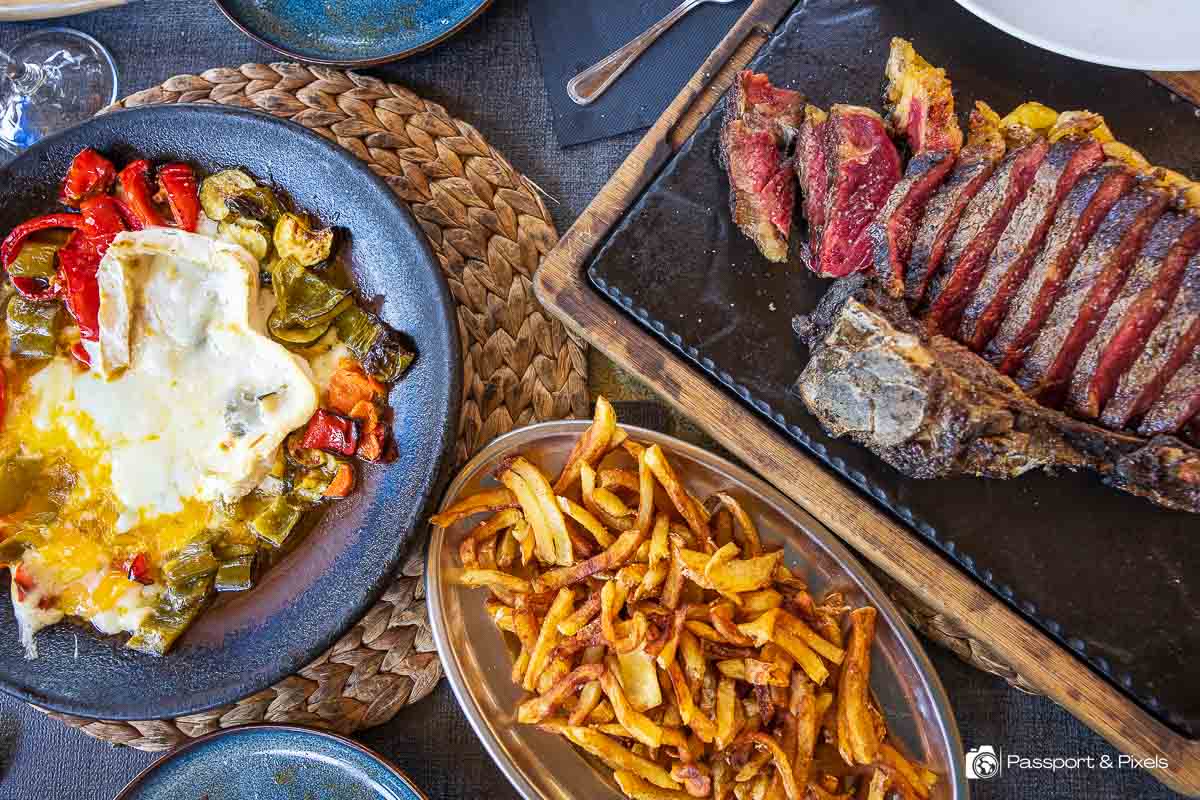
But my favourite meal of all was at Balcon del Pirineo Restaurant in the pretty village of Buesa. The restaurant is set on a hillside, with beautiful views of the mountains and landscape, and the food was an enormous spread of local treats including fried mushrooms, chorizo, salads, and some of the most incredible beef steak I’ve ever had, served pink and sizzling at the table.
It’s the sort of restaurant you make a special trip just to visit, and I highly recommend you do. They even have a robot waiter!

Where to stay in Huesca, Aragon
Where you stay depends on how long you have and what your priorities are, but here are the hotels we stayed in during our trip, all of which I would recommend.
Hotel Reina Felicia in Jaca: a modern hotel in a great location with comfortable rooms, a pretty decent restaurant, a gym and a pool (which was under renovations when we visited).
Hotel Monasterio de Boltaña: a beautiful historic former monastery with mountain views and a spa. The hotel is gorgeous but the dinner service in the restaurant was some of the worst I’ve ever experienced, so best avoided. However the breakfast buffet (self-service!) was amazing.
Hotel Villa de Alquezar: this historic hotel in the centre of Alquézar has very cute rooms and a pool. Some of the rooms have amazing views over the town and the gorge.
We didn’t stay here but for visiting Ordesa National Park, I’d recommend staying in either Torla-Ordesa or Broto, both very cute towns with a range of accommodation within easy reach of the park.
In Zaragoza we stayed in Hotel Alfonso, a smart, modern, and very centrally located hotel with a rooftop pool, just a short walk from most of the city’s main attractions.

Want to see more of my photography or travel writing? Have comments or questions? Come follow me on Instagram, Threads or Bluesky and share your thoughts!
My favourite travel tools and brands
To help you organise your trip, here’s a short list of some of the brands and tools I use over and over again when I’m planning my travels. You can see more on my Travel Resources page.
- Booking.com: A huge range of hotels to choose from, often with free cancellation. If you book hotels regularly you can earn discounts. I’m on Genius Level 3 which gets me 20% off!
- Expedia: Another great place to find hotels and Expedia also sell flights, car hire, and loads more all in one place.
- Skyscanner: The only place I ever go to search for flights and compare prices.
- Flight Centre: Booking a more complicated route? Let Flight Centre organise it for you (and deal with the drama when something goes wrong).
- Priority Pass: I love having access to 1600+ airport lounges when I fly, allowing me to enjoy my time at the airport. Buy through my link and you get up to 20% off!
- Airalo: Say goodbye to ridiculous mobile roaming charges. Did you know you can now buy ane-SIM, install it in your phone before you leave home, and then use data abroad at local prices? Game changer. Get US$3 credit with code BELLA5735.
- TourRadar: If you prefer group travel and organised tours, TourRadar has a huge range of fantastic tours from respected operators. They’re very helpful and have 4.5 stars on TrustPilot.
- Viator: Part of the TripAdvisor brand, Viator is another great place to search for group adventures and day trips.
- GetYourGuide: A great place to find local tours and day trips in your destination.
- Wex Photo Video: The UK’s best camera gear store.
- Ellis Brigham: Looking for good quality backpacks, travel clothes and other gear? Ellis Brigham is where I buy almost all of mine.
- Rentalcars.com: Part of the Booking.com family and the world’s largest online car rental service, with 24/7 customer service.
- World Nomads Travel Insurance: I never ever travel without travel insurance and nor should you!
Where to next?
If you enjoyed this post, why not try some of my other Spain and adventure posts?
- A Weekend In Palma de Mallorca: The Perfect City Break
- A day trip to Port de Sóller on the Palma Soller train, Mallorca
- Pollensa Mallorca: A Charming Day Trip From Palma
- Hiking In The Beautiful Knuckles Mountain Range, Sri Lanka
- Hiking Mount Nyiragongo: The World’s Largest Volcano Lava Lake
- Doing The Freezing Polar Plunge In Antarctica
Liked this Huesca Spain post?
Social shares help support my hard work! You can share via the buttons at the bottom, or pin this handy Pinterest Pin. Thank you!

