


Leaning over the balcony rail with my camera, I watched the tannery workers in the courtyard below.
Some of them were thigh-deep in vats of acid-bright liquid. Another heaved skins one by one, saturated and heavy, into a deep pool. A third looked curiously up at me as he took a breather in the fierce sun, his arms and legs stained dark with dye.
None of them seemed bothered by the pungent stink that reached me three floors above. I pressed the sprig of mint to my nose, breathed in, and took another photo.

This is Chouara Tannery (sometimes spelled Chouwara or Chaouwara), the largest, most popular, and most astonishingly photogenic of the three leather tanneries in Fes (aka. Fez).
It’s a popular place to visit for two main reasons: not only is it one of the most fascinating and eye-catching sights in Fes, but it’s also the best place in the whole of Morocco to buy Moroccan leather bags, Moroccan leather slippers, and every other type of leather goods you can think of, including jackets, poufs, footrests, skirts, shoes and belts.
I visited Chouara Tannery during a trip to Fes as part of a two-week tour of Morocco that also took in such delights as glamping in the Sahara Desert. The trip was full of highlights, but the visit to the tannery in Fes is something I’ll always remember.
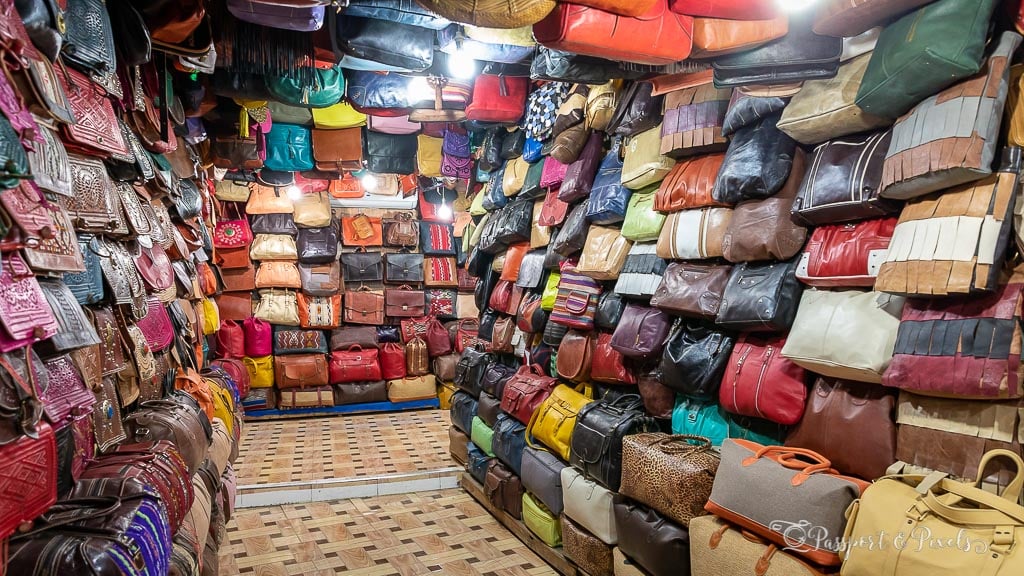
The leather made here is beautiful: buttery soft and top quality. Little wonder that Moroccan leather is highly prized and shipped all over the world.
So you’re thinking of visiting Fes, or looking for the best place to buy world-class leather in Morocco, this post is definitely for you.

What is a tannery?
A tannery is a facility where animal skins are cured and turned into leather. This process involves cleaning, treating with chemicals, drying the hides and then dying them.
Historically, tanneries had a strong odor due to traditional methods, and some Moroccan tanneries, particularly those in the Chouara Tannery in Fez, still use these methods. The vats of colorful dyes are a characteristic sight, but the smell takes a bit of getting used to!
The finished leather is used for a variety of purposes, from clothing and bags to furniture and car interiors.
How they make leather at Chouara Tannery
Now a UNESCO World Heritage site, Fes medina was founded in the 9th century and the leather tanneries inside the medina have been there since the very beginning. What’s more, the techniques they use today to cure and dye the leather are the same techniques they’ve been using for over 1000 years.
The stone pits you can see in the photos are filled with different chemicals. The white pits at the back are where they cure the leather, and the brown pits at the front are filled with different coloured dyes.

What is used to make Moroccan leather?
Moroccan leather can be made from the skins of camels, cows, sheep or goats. The hides are first cleaned and softened using a pretty sickening-sounding mixture of quicklime, salt, water, cow urine and pigeon shit (yes really!). Apparently the ammonia in the animal droppings helps soften the skins and prepare them to absorb the dye.
This pungent concoction, along with the presences of tonnes of dead animal skins, certainly explains the smell, and I have the utmost respect for anyone who can spend all day up to his waist in the stuff!

After curing and softening comes colouring. Only natural dyes are used, including indigo for blue, saffron for yellow, poppy flower for red and henna for orange. The dyes are poured into the stone pits and then workers get in with the dyes and massage the skins with their feet to make sure the colour is spread evenly.

I guess this explains why the workers in the white pits wear rubber waders to get in, while the workers in the dye pits are bare-legged. Even so, it’s definitely not a job I fancy having a go at.

The only colour they don’t do in the pits is yellow. Yellow dye is made from saffron, which is too expensive to waste, so the skins are carefully dyed by hand and then left out in the sun to dry.

The finished leather pieces are then sold to the designers and clothing makers, many of whom work in the buildings surrounding the tannery and are often related to the tanners in the pits below. The entire Moroccan leather production process involves no machinery, only manual labour, using skills and techniques virtually identical to those employed in medieval times

How do you get to Chouara Tannery?
Chouara Tannery is situated right in the heart of Fes Medina. As you can see in the photos, the tannery courtyard is surrounded on all four sides by buildings, most of which contain leather shops.
This means that if you want to see the tannery in action, you’ll have to pass through one of the many shops to do so.
Most of the shops have terraces offering excellent views out of the courtyard, though of course some are better than others, and if you want to get more than one angle you may have to visit several shops.
According to the Lonely Planet guide, the best views are from door no. 10 on Derb Chaouwara, though many of the others have similarly good views.

How to find the Morocco tanneries inside Fes Medina
To find the leather tanneries, head for Fes el Bali, the oldest medina quarter, near the Saffarin Madrasa. The easiest way is to follow a combination of your guidebook map, signs on the walls, and the helpful advice of locals.
Don’t be tricked into paying for a guide to take you there, however, as anything you buy will end up being more expensive to cover the cost of his commission.

There is no charge to walk in and look around, though if you come to look at the fes tannery and don’t buy anything you’ll be expected to pay a tip before you leave. You won’t need to leave much – a few dirhams (maybe 50p or so) will be plenty, and it’s definitely worth it for the view!
As you pass through the store on your way to the viewing balcony, salesmen will obviously try to attract your attention to the huge range of Moroccan leather bags, jackets and shoes on display, but I didn’t find them to be that pushy – a simple ‘no thank you’ as I passed through was enough.

How bad is the Fes tannery smell?
Reviews of Chouara Tannery on TripAdvisor suggest the smell is so disgusting as to make the place almost intolerable, but I wouldn’t say it was that bad. As you go in, you’ll be handed a sprig of mint to mask the stink, but I needed both hands free for my camera so I ended up discarding it and I was fine.
The Fes tannery smell a strong, pungent, sour smell, exactly as you might expect given where you are, but if you breathe through your mouth you’ll soon get used to it.
Note that while the gift of mint is technically free, you will be expected to pay for it in the form of a small tip after your visit to the Fes tanneries if you don’t end up buying anything. Consider it an entry fee, as you might pay at any other museum or attraction.

How to buy Moroccan Leather At Fes Tannery
Anything and everything that can be made from leather is sold at Chouara tanneries: purses, handbags, belts, Moroccan slippers, shoes, jackets, skirts, trousers, poufs, footstools, hats and more.
If there’s something you want and they don’t have it in your style or colour, they can make adjustments to something similar or even whip up a new one from scratch in 24 hours.
Buy from here and if you haggle well you’ll get the best quality Moroccan leather goods at a fraction of the price you’d pay in London or New York.

How to get the best Morocco leather jacket price
Here’s how to get the best price for your Moroccan leather bag, jacket, slippers, or whatever else takes your fancy.
1/ Do your research before you go
Decide what you want, either by looking online or, if you have time, by browsing in the souks. If you do the latter, you can also get an idea of what the traders in the souks are charging, which will help you with negotiations.
Whatever their starting price is, you should expect to pay no more than about half of that amount, (a) because they will always start high and (b) because when you buy direct from Chouara tannery you’ll be cutting out the middle man.
2/ Decide how much you want to pay
How much is the item worth to you?
For example, I wanted a leather jacket but I hadn’t been able to find one I liked in London. I knew that a good quality leather jacket would likely cost me £200-300 back home, and that if I saw my perfect one – a bright blue bomber jacket – in London, I’d pay that much for it or maybe even more.
So if I could find my dream leather jacket and pay less than £200 for it, I’d be more than happy.
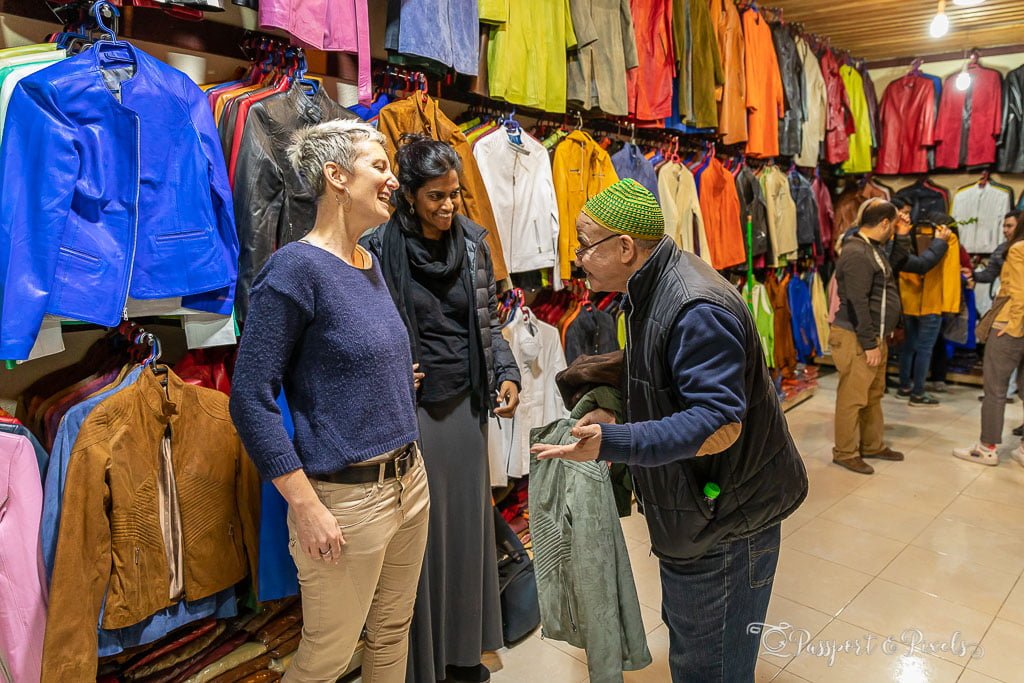
3/ Don’t be too keen
Browse in the Morocco tannery or leather store of your choice, find your item, but play it cool. You need to give the impression that you can take it or leave it; you’re not that desperate, and if the price is not good, you won’t buy it.
4/ Ask how much
This is where the fun starts. The basic game with haggling is that the salesman will ask for way more than he’s willing to accept, and you must offer much less than you’re willing to pay, and you meet in the middle.
With my leather jacket, for example, the salesman started the bidding at 4500 dirhams (about £360). I went in embarrassingly low, at 1000 (£80) and we worked our way up from there.
When he came down to 2000 (£160) he refused to go lower, but then I told him I didn’t want to pay more than £150, and he agreed. 1800 dirhams. Sold.
5/ Buy in bulk or with your friends
Buying several items or as group will get you better discounts.
One reason I got such a good price was that two other members of my group were also buying jackets at the same time so we were able to get even more of a bargain AND look stylish for our last night out in Marrakech.
Depending on when you visit, the fez leather jacket price may have increased – everything always seems to get more expensive all the time. So don’t be too disappointed if you don’t pay as little as I did (I had help from our guide too).

Is Chouara tannery Morocco worth it?
If you’re not in the market for anything made of leather, Chouara tannery in Fes is still very much worth a visit just for the experience.
Just go with a friendly smile, a firm tone, and a few small coins to hand over as an entry fee. I thought it was a fascinating place, and totally worth a visit to see a historic and colourful part of Moroccan culture still in action today.
And for me – I got a stunning, buttery-soft blue leather jacket for £150. Total bargain!
Want to see more of my photography or travel writing? Have comments or questions? Come follow me on Instagram, Threads or Bluesky and share your thoughts!

Where to stay near Fez tannery
Budget: Hôtel Royal Urban Concept
The budget-friendly Hotel Royal Urban Concept offers simple rooms with modern decor. It’s located near the Medina, making it a convenient base for getting to Chouara tannery and other places inside the Medina. The rooms are clean and comfortable, and the hotel provides a good breakfast, perfect for travellers looking for value for money. Booking.com rating: 8.3.
Mid-range: Fes Marriott Hotel Jnan Palace
Set in lush gardens, Fes Marriott Hotel Jnan Palace blends modern comfort with Moroccan style. The rooms are spacious and well-equipped, and the outdoor pool offers a relaxing retreat from the city. The on-site restaurants serve a variety of local and international dishes, making it an ideal mid-range choice. Booking.com rating: 8.4.
Mid-Range: Riad Tizwa
Another great boutique mid-range option is the very beautiful and welcoming Riad Tizwa. As well as being a gorgeous typical Moroccan riad located right inside the Medina and not too far from the Fes tanneries, it’s actually run by a guy I used to work with at the BBC so please tell him I sent you! Booking.com rating: 9.3.
Luxury: Hotel Sahrai
This is where I stayed. Hotel Sahrai is a luxury five star hotel, and was one of the nicest hotels I stayed in during the whole of my Morocco road trip.
Perched on a hill with stunning views over Fes, there’s an infinity pool, spa, and rooftop bar. The design combines traditional Moroccan touches with contemporary elegance, and the spacious rooms are perfect for unwinding after a day in the chaos of the Medina. Booking.com rating: 8.5.


Where to next?
If you liked this Morocco tanneries post why not read these ones…
Or explore some other destinations!
- 25 Spectacular Places To Visit For Travel Photography
- The Beautiful Leg-Rowing Inle Lake Fishermen, Myanmar
- Climbing The 8 Days Lemosho Route On Kilimanjaro
- Hiking Mount Nyiragongo: The World’s Largest Volcano Lava Lake
- 23 Best Places to Visit in Thailand
Liked this Morocco leather post?
Social shares help support my hard work! You can share via the buttons at the bottom, or pin this handy Pinterest Pin. Thank you!

Buy me a coffee
Did you enjoy this website or find it useful? If you did and fancy showing your appreciation, that would be amazing!
A small token of support helps keep Passport & Pixels going, so I can carry on creating free content for travellers like you. Also, it makes my day! Thank you!
My favourite travel tools and brands
To help you organise your trip, here’s a short list of some of the brands and tools I use over and over again when I’m planning my travels. You can see more on my Travel Resources page.
- Booking.com: A huge range of hotels to choose from, often with free cancellation. If you book hotels regularly you can earn discounts. I’m on Genius Level 3 which gets me 20% off!
- Expedia: Another great place to find hotels and Expedia also sell flights, car hire, and loads more all in one place.
- Skyscanner: The only place I ever go to search for flights and compare prices.
- Flight Centre: Booking a more complicated route? Let Flight Centre organise it for you (and deal with the drama when something goes wrong).
- Priority Pass: I love having access to 1600+ airport lounges when I fly, allowing me to enjoy my time at the airport. Buy through my link and you get up to 20% off!
- Airalo: Say goodbye to ridiculous mobile roaming charges. Did you know you can now buy ane-SIM, install it in your phone before you leave home, and then use data abroad at local prices? Game changer. Get US$3 credit with code BELLA5735.
- TourRadar: If you prefer group travel and organised tours, TourRadar has a huge range of fantastic tours from respected operators. They’re very helpful and have 4.5 stars on TrustPilot.
- Viator: Part of the TripAdvisor brand, Viator is another great place to search for group adventures and day trips.
- GetYourGuide: A great place to find local tours and day trips in your destination.
- Wex Photo Video: The UK’s best camera gear store.
- Ellis Brigham: Looking for good quality backpacks, travel clothes and other gear? Ellis Brigham is where I buy almost all of mine.
- Rentalcars.com: Part of the Booking.com family and the world’s largest online car rental service, with 24/7 customer service.
- World Nomads Travel Insurance: I never ever travel without travel insurance and nor should you!
