


If I ask you to think of places to visit related to World War Two, you’ll probably name the D-Day landing beaches of Normandy, France or the moving Holocaust memorials in Berlin or Poland. Right?
If you’re from North America, you might go for Pearl Harbor.
But there’s another location dramatically connected with the Second World War – and it’s not in Europe or the USA at all.
It’s on an idyllic tropical island in the South Pacific, and despite being the site of one of the war’s fiercest and bloodiest battles, most people haven’t even heard of it.
Its name is Peleliu, in the tiny country of Palau.

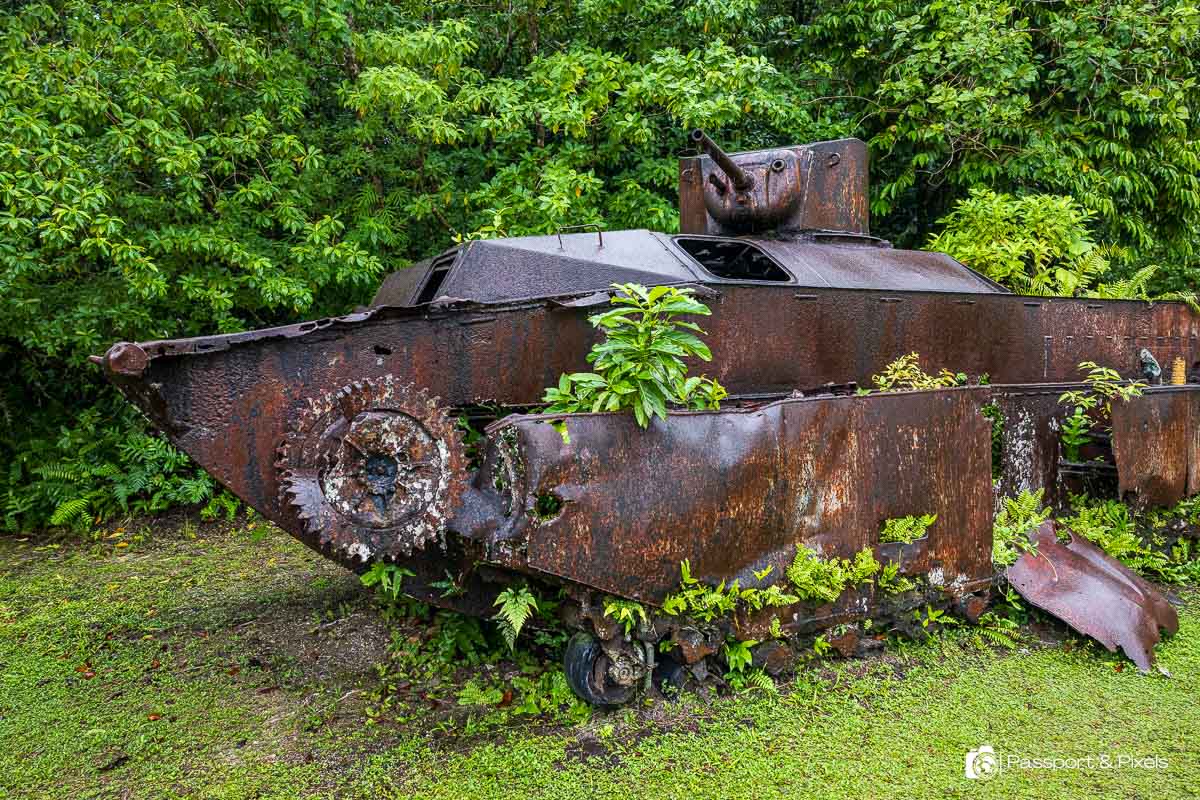
Here, more than 80 years since the end of the war, the remains and relics of that battle are still scattered around the island. Rusted tanks lie by the side of the road. Bombed-out buildings are being consumed by the jungle. Half-sunken landing craft are now inhabited by corals and fish.
Whether you’re a mega war history buff or not, it’s an eerie, moving, fascinating place, and well worth a visit.
In this post, I’ll reveal what there is to see and do there, how to visit, and explain why I think you should include Peleliu Island during your trip to Palau.

About my visit to Peleliu
I spent just over a week in Palau as a guest of the Palau Visitors’ Authority. I went on a travel writing and photography assignment for National Geographic Traveller Magazine, and during my trip I visited all the main highlights of Palau, including Peleliu.
I wasn’t required to write this blog post as part of the assignment, but I really wanted to tell the story of Peleliu because I thought it was such a fascinating and unique place. Very little has been written about it from a traveller’s perspective, so now I’m fixing that!
While in Palau I stayed at the Palau Pacific Resort on the main island of Koror. To get to Peleliu I took a full day World War Two tour by boat from Koror, organised by Paddling Palau.
This guide was entirely written by me, and all the photos are my own original photography, with no AI. To be honest, I’m not sure AI even knows that much about visiting Peleliu – like I said, it hasn’t been covered that much. Until now…
But anyway, here’s everything you need to know about visiting the World War 2 island of Peleliu.
Read more: Things to Do in Palau: An Idyllic 7-Day Island Itinerary

Where is Peleliu?
Peleliu is one of the 340-ish islands that make up the Republic of Palau, an archipelago in the western Pacific Ocean, roughly 500 miles east of the Philippines.
It forms part of the Rock Islands Southern Lagoon area and is about 50 km or an hour by boat south of Koror, the main population centre and transport hub.
Peleliu itself is low-lying and small, no more than a few miles across, and home to only around 400 people. It’s surrounded by mangroves, coral reefs, and tiny limestone islets – making the journey there worth the trip all by itself even if you’re not that into war history.
What does Palau have to do with World War 2?
Before I get into what happened on Peleliu Island during the Second World War, you’ll need a bit of historic context.
Before the First World War, Palau was under German rule, but when the war ended in 1914, control was formally granted to Japan by the League of Nations.
For the next 30 years, Japan occupied Palau and developed it into an economic outpost. They built infrastructure and businesses, and thousands of Japanese people moved to the islands. By the late 1930s they outnumbered the indigenous Palauan population several times over.
As tensions leading up to World War II grew, Palau became a major Japanese military base, with airfields, fortifications and naval facilities – making it a strategically vital location in the Pacific, and setting the stage for what happened next…

What happened during the Battle of Peleliu?
In 1944, the United States wanted to capture and control key Japanese territory in the Pacific.
They also planned to invade the Philippines, and Palau’s location in the Western Pacific made it strategically important. Peleliu in particular had an airfield that the Japanese could potentially use to disrupt General MacArthur’s invasion plans.
Capturing it was vital, so the Americans planned an attack. First, they bombed the island for three days. Then when they assumed most of the Japanese military would be destroyed, they came ashore to take control of Peleliu.
Military planners expected to overwhelm any remaining Japanese resistance in just a few days. But things did not go according to plan. At all.

Rather than being wiped out during the bombing, Japanese defenders retreated into elaborate tunnel systems, caves and fortified positions hidden in the hills – from where they were able to resist for more than two months.
The Americans were completely unprepared for this new form of defence, and Peleliu became one of the bloodiest battles of the Pacific relative to size of the battlefield. More than 10,000 Japanese and around 1,800 Americans were killed.
Japan finally surrendered in 1945, its rule over Palau ended and almost all Japanese civilians were sent home.
Today, many of the bunkers, caves, tanks and other relics can be seen dotted across the island, while dozens of Japanese ships sunk by US air raids still lie in the shallow waters.
Japan’s influence is still very visible in the islands’ infrastructure and culture – there are plenty of Japanese restaurants, many Palauans have Japanese ancestry, and Japan is now one of Palau’s closest diplomatic partners and an important source of visitors.

What is there to see on Peleliu
I’m interested in historic sites, though I’m not a massive war buff. So apologies if you’re an expert and you spot errors in this post!
But even for someone only mildly interested like me, what made Peleliu so incredible is how untouched it feels.
There are bits of rusting machinery all over the place, you can explore caves where you’ll still find signs of human occupation from 1944, and abandoned buildings still bear the scars of machine gun fire, even as they are slowly consumed by strangler fig vines.
Much of the island has never been cleaned up or curated for tourists, giving it a far rawer atmosphere than other battlefield sites around the world.
Just remember, even though it might be tempting to touch stuff or even slip something in your pocket, please don’t. You know the rule: leave everything as you found it, take only photos, leave only footprints.
And besides, on Peleliu, that thing you prod with your foot might genuinely be an unexploded mortar. So don’t!
Here are the main World War II sites to visit and things to see on Peleliu, Palau.
1/ White Beach and the northern landing sites
Our tour followed the battle chronologically, beginning at White Beach on Peleliu’s northern coast where some of the first American landing craft came ashore on 15 September 1944.
The name is a bit misleading: White Beach is less tropical paradise and more jagged coral shoreline fringed by dense jungle – making it immediately obvious why invading was so challenging.
The day I visited was rainy, which added to the eerie, mournful sense. Heavy droplets plopped from the trees and glistening red land crabs scurried to hide under fallen logs as we walked past shattered artillery positions partly hidden among the vegetation.
Today the island is thick with greenery, but during the battle almost every tree was destroyed by bombardment and fire.
According to Sean Kilcullen, my guide and a self-described World War Two nerd, the oldest surviving tree on Peleliu is only around 80 years old because virtually the entire island was flattened during the fighting.

2/ Orange Beach and cemetery
Further south lies Orange Beach, where American troops came ashore while Japanese forces fired from concealed positions hidden inland.
Many of the gun emplacements have still never been located, swallowed entirely by the jungle over the decades since the war ended.
Nearby is Orange Beach Cemetery, which was established shortly after the invasion to bury American soldiers killed in the fighting.
After the war their remains were exhumed and either returned to the United States or reinterred at permanent military cemeteries, so the site is now a memorial.


3/ Peleliu airfield
The next stop on our tour was the airfield itself – the reason for all this carnage. The runway is still there today, stretching across the centre of the island.
“This is where the B29 Flying Fortresses would have been able to take off from,” says Sean. “This is what all those men died for.”
It really doesn’t look like much, but you do get a sense of how strategically important this tiny island once was.
Nearby you can even see an example of the sort of open-topped amphibious landing vehicles used during the invasion, each one carrying up to 40 men.
Standing in front of it, you can viscerally imagine the fear and chaos as the American soldiers ploughed through the surf, while being directly shot at.

4/ Japanese airfield headquarters
For me the most atmospheric site on the island was the abandoned Japanese airfield headquarters.
Captured by American forces after fierce close-quarters fighting inside the building, it became the US command centre for the remainder of the battle, before later being completely stripped bare and abandoned.
Today the structure is being reclaimed by the jungle. Strangler fig roots climb the walls, rain drips through the collapsed roof and twisted steel bars protrude from broken concrete.
Bullet holes are still visible in the stairwell and at the front of the building someone has even gathered a few rusted bits of machinery.
Walking through the ruined corridors, it’s difficult to imagine the building as the clean military office it once was before the island was destroyed by war and tropical weather.
Even on a rainy day, it was incredibly eerie and photogenic.


5/ Rusting tanks and abandoned military relics
As you drive around, you’ll spot stuff everywhere. There was so much we didn’t stop for most of it.
Artillery pieces remain where they were abandoned and a Japanese Mitsubishi tank sits rusting, with plants growing out of its turret.
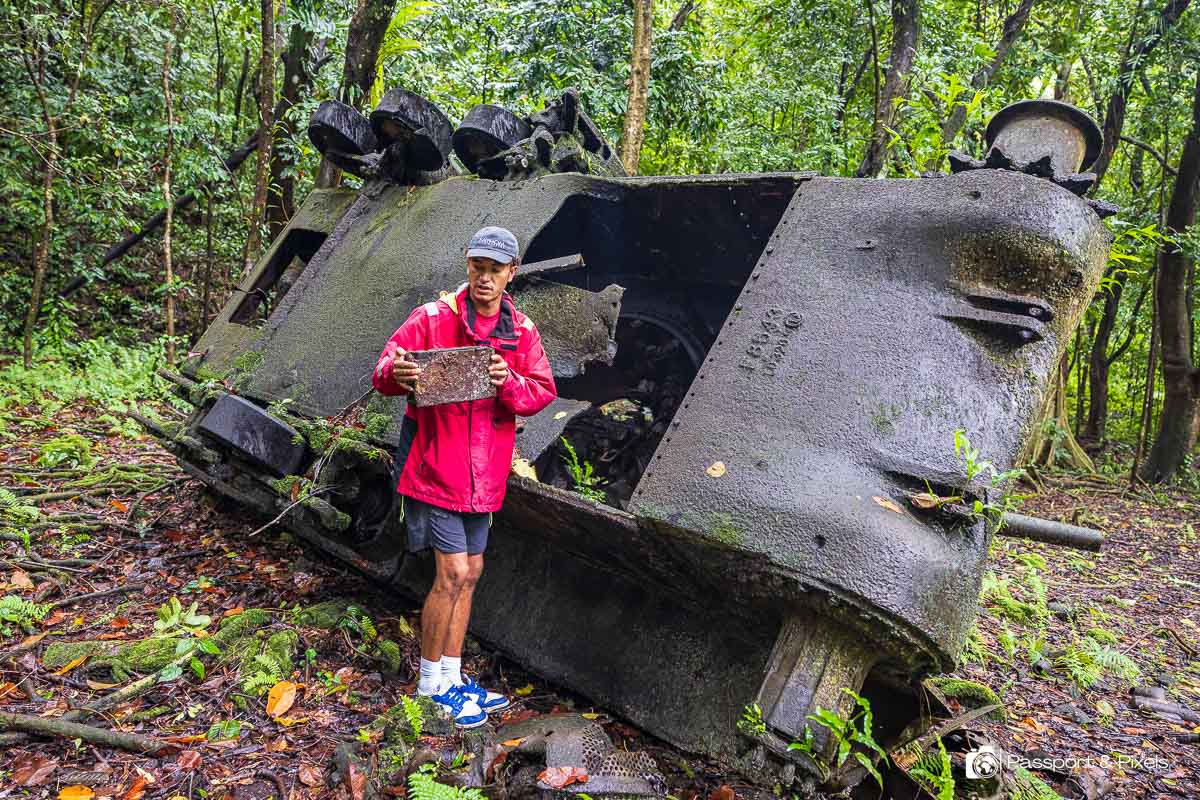
One of the most moving was a Sherman tank, upside down with a massive hole in its underside, in the forest at the back of someone’s house.
We said hello to the family and they allowed us to walk round and look at it. There’s a memorial to the four crew – Otto Hesselbarth, Michael Valentino, George Lopes and Howard Dahms – who died in October 1944 when the tank hit a land mine.

6/ 200 mm anti-ship guns
Our next stop took us to coral cave housing a 200 mm Japanese anti-ship gun capable of firing four miles out to sea. This – and three more like it – were still being positioned and set up when the American invasion began, so were never used.
According to Sean, if the guns had been ready in time, the outcome of the battle might have looked very different.
A small cave behind the gun once housed the four soldiers responsible for operating it, giving a sense of how tough life would have been during the battle.

7/ Ceison cave and the hidden tank bunker
Another memorable location on Peleliu is Ceison Cave, a large cavern where Japanese forces hid 18 tanks to protect them from the bombing.
Their story became one of the battle’s many ‘what ifs’: the tanks hidden here were supposed to counterattack immediately after the invasion began, before the Americans could get their superior Sherman tanks ashore.
But after communication lines were cut, the order to deploy arrived hours too late. By the time they emerged, the Shermans were already ashore.
Today, the cave is a dark and rather creepy place. Water drips constantly from the ceiling – over time it’s already started to form mini stalagmites around the rusting machinery.
Weirdly, there are things living in here – light brown cave crickets cover the walls and spiders wait among the shadows – so perhaps one to avoid if you’re squeamish about bugs!

8/ 1000-Man Cave
1000-Man Cave is more than just a cave – it’s a labyrinth of 284 metres of man-made tunnels with 33 side rooms. It was used to shelter medics and non-combat personnel during the fighting, as well as treat the wounded.
They hid here for many weeks, but eventually American forces discovered them and attacked the caves using tank guns and flamethrowers. Still, some defenders managed to hold out for several months.
I’m a bit claustrophobic in small underground spaces, so I didn’t go too far in, but I was told that if you explore deeper you come to living spaces where you can still find discarded drinks bottles and food wrappers from 1944.

9/ WWII wrecks around Peleliu
Peleliu also offers a fascinating and eerie opportunity to get close to sunken World War Two vessels. And since the water around the island is so shallow, many of them are easily accessible for snorkellers or beginner scuba divers.
During the American bombardment in 1944, many smaller civilian and military boats attempted to take shelter in hidden channels and lagoons among the islands. Unfortunately, some were sunk and remain underwater today, where they’ve been turned into new homes by beautiful corals and colourful tropical fish.
Today there are more than 30 designated WWII wreck dive sites around Palau, including the IJN Iro, a seven-deck, 470-foot Japanese fuel tanker.
After our land-based history tour, we got back in the boat and headed to another one of them: a sunken Japanese fishing vessel.
It was both spooky and incredibly cool to snorkel above and around it as it lay in its final resting place on the seabed – the huge lump of metal in stark contrast to the turquoise waters and darting fishes.

Are there still new things to find on Peleliu today?
Today, the forest has reclaimed the island, and thick tropical jungle covers almost everything. That means that there are still many relics of this terrible battle still lost in the jungle.
Sean told me that in his spare time he likes to wander off into the jungle looking for stuff – though I don’t recommend you do this as you may stumble over an unexploded bomb and you will definitely get lost.
But Sean (who does know what he’s doing) has found helmets, rifles, rounds of ammunition, shrapnel, unexploded grenades, and even (sadly) human remains. Of course he always reports everything – and again, a reminder that if you do find anything, please leave it where you found it.
Today, both Japanese and American recovery organisations still work on Peleliu searching for missing soldiers.
Only a few years ago, Project Recover – which uses sonar and other cool technology to scan the seabed and find and repatriate Americans MIA (missing in action) from World War II – located a crashed aircraft sunk in the harbour. It still held the body of its pilot, complete with his ID tags.

Is Peleliu worth visiting?
Many visitors to Palau only go for the beaches and diving, and while I get that, I also think a visit to Peleliu should be part of everyone’s itinerary.
I’ve been to many places, but this was unlike anywhere I’d ever been before – a moving and fascinating juxtaposition of dark history and stunning scenery.
Here’s why you’ll love it…
Why history fans will love Peleliu
So why should you visit Peleliu if you’re a history lover? Well if it isn’t already obvious, it’s because this is one of those very rare places where everything is pretty much left as it was.
Nothing has been curated, arranged, or put behind glass. The island hasn’t become a touristy destination, and its remoteness has left much of the 1944 battlefield largely undisturbed.
Rusted tanks, artillery pieces, and aircraft wreckage remain scattered through the jungle, often with no barrier or signs separating you from the objects themselves.
You can still go into the caves and tunnels where Japanese defenders held out for weeks, giving you a real sense of what it must have been like and why the battle dragged on for as long as it did.
If you have a serious interest in the Pacific war, that combination of authenticity and access without the crowds is difficult to find anywhere else.

Why you should visit Peleliu even if you’re not a war history buff
I’m not one either, by the way – but I found it fascinating, and it’s a place that’s stayed with me long after the memory of other places has faded.
I didn’t need any prior knowledge – my guide Sean was excellent and his fascination was infectious. I soon found myself getting drawn into the stories.
Aside from the history, Peleliu is among the quietest and most untouched parts of Palau, pretty much free of the tour groups that gather around Koror and the Rock Islands.
Its waters offer strong snorkelling and diving, with healthy coral and marine life that draws far fewer visitors than better-known sites nearby – as well as those fascinating wrecks of course.

How to visit Peleliu
The only way to get to Peleliu is by boat from Koror, a journey of around an hour across the Rock Islands Southern Lagoon.
I did a day tour with Paddling Palau, but other local operators also run day trips, which usually combine a tour of the island’s battle sites with time for snorkelling or a beach stop.
Trips can be arranged through hotels and tour agencies in Koror, and will also include transport around the island, lunch, and a guide who can point out wreckage and key locations that would otherwise be easy to miss.
Don’t miss my Palau itinerary post if you want to know more about what else to do in Palau.

Want to see more of my photography or travel writing? Have comments or questions? Come follow me on Instagram, Threads or Bluesky and share your thoughts!
Important things to know before visiting Peleliu
You need a permit to visit Peleliu
While you get get it yourself from the office on the island, the easiest way is to book through a local tour operator who will sort the permit for you.
There is little tourism infrastructure
Peleliu has no large hotels, only a few small local restaurants, and almost no shops. If you think you might want to spend money, bring cash, as cards may not be accepted.
Accommodation is limited
If you want to stay longer, it is possible to stay the night, but there are only a few small guesthouses. Make sure you book in advance.
Personally I thought a day trip was enough. I stayed on Palau’s main island, Koror, in the Palau Pacific Resort – which was a great base from which to explore all the different islands.
Some sites require a guide
Caves and tunnels in the Umurbrogol ridges can be unstable, and several areas remain unmarked. A local guide is strongly recommended for anyone wanting to explore beyond the main battle sites.

Don’t touch anything – especially if it might be a bomb!
Peleliu was heavily bombarded during the war, and unexploded ordnance is still occasionally found. Avoid handling any objects you find in the jungle and make sure you stick to established paths where possible.
Please be respectful
This may be a tropical holiday island, but it’s also a place where thousands of people died. I’m sure you don’t need me to tell you to behave accordingly.
The climate is hot and humid
Heat was a major challenge during the battle, and it still is today. Sun protection, sensible footwear, and plenty of water are essential.
Mobile signal is limited
Don’t expect reliable internet access once away from Koror – again, another good reason to go with a guide.

And that’s it. Thanks for reading. Again, apologies to any war experts and historians if I got something wrong – please feel free to get in touch to correct my mistakes if you spot any.
Buy me a coffee
Did you enjoy this website or find it useful? If you did and fancy showing your appreciation, that would be amazing!
A small token of support helps keep Passport & Pixels going, so I can carry on creating free content for travellers like you. Also, it makes my day! Thank you!
Where to next?
If you liked this post about visiting Peleliu Island, why not try one of my other history-related posts?
- In Photos: Where To Discover Real Dinosaur Fossils In Canada
- Tikal Guatemala: My Essential Guide To The Iconic Maya Ruins
- I Spent 22 Days On The Douglas Mawson Ship: My Full Review
- Wadi Al Hitan: How To Visit Egypt’s Valley Of The Whales
- Gordion in Turkey: City of King Midas and the Golden Touch
- In Photos: The 9 Best Tombs In Egypt (Ranked By Wow Factor)
- The Best Ancient Ruins In Turkey And Where To See Them
- An Unhelpful Guide To… Aztec Ruins In Mexico
- The Fantastic Falkland Islands: 20 Frequently Asked Questions
- The Ruins Of Troy Turkey: How To Visit Homer’s Ancient City
My favourite travel tools and brands
To help you organise your trip, here’s a short list of some of the brands and tools I use over and over again when I’m planning my travels. You can see more on my Travel Resources page.
- Booking.com: A huge range of hotels to choose from, often with free cancellation. If you book hotels regularly you can earn discounts. I’m on Genius Level 3 which gets me 20% off!
- Expedia: Another great place to find hotels and Expedia also sell flights, car hire, and loads more all in one place.
- Skyscanner: The only place I ever go to search for flights and compare prices.
- Flight Centre: Booking a more complicated route? Let Flight Centre organise it for you (and deal with the drama when something goes wrong).
- Priority Pass: I love having access to 1600+ airport lounges when I fly, allowing me to enjoy my time at the airport. Buy through my link and you get up to 20% off!
- Airalo: Say goodbye to ridiculous mobile roaming charges. Did you know you can now buy ane-SIM, install it in your phone before you leave home, and then use data abroad at local prices? Game changer. Get US$3 credit with code BELLA5735.
- TourRadar: If you prefer group travel and organised tours, TourRadar has a huge range of fantastic tours from respected operators. They’re very helpful and have 4.5 stars on TrustPilot.
- Viator: Part of the TripAdvisor brand, Viator is another great place to search for group adventures and day trips.
- GetYourGuide: A great place to find local tours and day trips in your destination.
- Wex Photo Video: The UK’s best camera gear store.
- Ellis Brigham: Looking for good quality backpacks, travel clothes and other gear? Ellis Brigham is where I buy almost all of mine.
- Rentalcars.com: Part of the Booking.com family and the world’s largest online car rental service, with 24/7 customer service.
- World Nomads Travel Insurance: I never ever travel without travel insurance and nor should you!
Liked this post?
Social shares help support my hard work! You can share via the buttons at the bottom, or pin this handy Pinterest Pin. Thank you!

