


I recently spent a week exploring and photographing the gorgeous Italian region of Umbria. Click here for a look at Todi and Orvieto.
Of course no trip to Umbria is complete without a visit to Assisi, the jewel in the region’s crown and a UNESCO World Heritage site. It’s definitely somewhere that you should consider putting on your Italy itinerary. Just look at it!
This stunning medieval hillside town is the birth- and death-place of St Francis of Assisi, one of the most well-known and venerated religious figures in history. Everywhere you go you’ll see St Francis-related stuff for sale: t-shirts, fridge magnets, posters, books. In Assisi, it’s all about St Francis.

St Francis of Assisi was a wealthy young man who began life like many of his class: enjoying his privileged status in every way possible. But after a religious epiphany he renounced his previous lifestyle, gave up all his wealth and possessions and became a preacher.
He lived a life of poverty, travelling around and spreading the Christian message, and founded the Franciscan order of friars. Legends tell of him healing the sick and talking to animals. He died in Assisi in 1226 and was made a saint just two years later.

What to do in Assisi: Basilica of St Francis
The absolute must-see on any day trip to Assisi is the Basilica of St Francis. It’s one of the most important places of Christian pilgrimage in Italy, and unsurprisingly we saw plenty of monks and nuns who had come to worship.
The frescoes that adorn the walls and ceiling are some of the finest examples of Italian Renaissance art and depict scenes from the life of St. Francis.
Take your time as you explore the basilica and admire the intricate details of the stained glass windows, sculptures, and frescoes. And don’t miss the opportunity to climb to the top of the basilica for panoramic views of the town and surrounding countryside.

Just like the Buddhist monks I saw on my trip to Myanmar, I thought the nuns in their habits really added to the beauty of the place. Though it’s always a challenge trying to capture them without causing offence.

The complex has two churches – the Upper and Lower Basilicas. Both are covered with gorgeous frescoes on the walls and ceiling, mostly depicting the life of St Francis.
You are actually not allowed to take photos inside either of the Basilicas, a rule that I always find intensely frustrating. Historic sites do it for two reasons: (1) to protect the precious artworks from thousands of flashes going off, and (2) to preserve the dignity of the place and prevent it just becoming a sea of tourists with cameras pressed to their faces.
I do respect their reasons, but I also think it’s OK to take one or two photos, so long as you do it unobtrusively, and don’t use a flash.
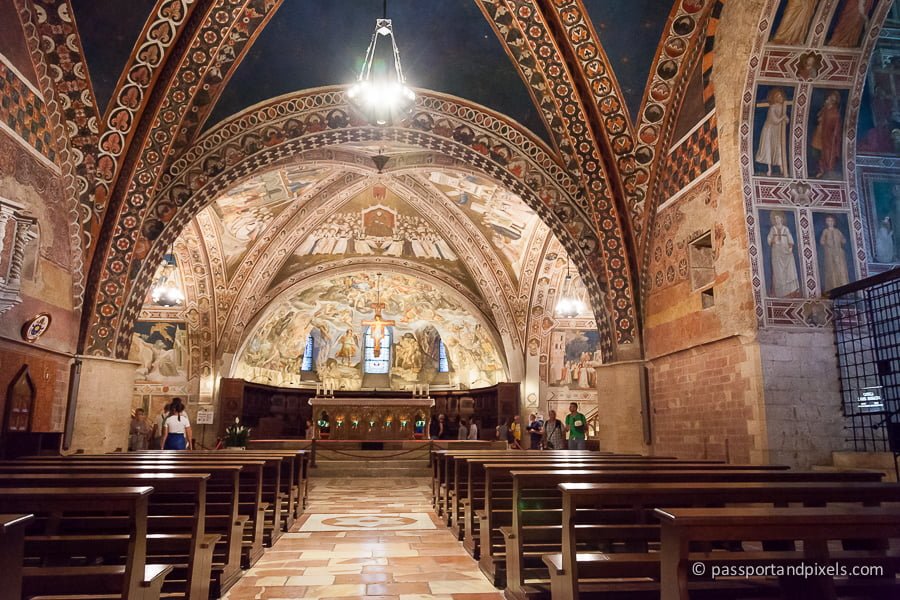
So these are the only photographs I took inside, shooting from the hip to avoid causing offence. My Canon 5D doesn’t even have a flash, so there are no worries there.

In 1997 Assisi was hit by an earthquake measuring 6 on the Richter scale. The irreplaceable frescoes were devastated, and many thought they could never be recovered.
But as you can see, art restorers and conservators have done such a fantastic job that you really would have a hard time knowing there had ever been an earthquake at all. I don’t know if they look different from how they did before, certainly to an amateur like me they looked just perfect.

What to do in Assisi: Basilica of Santa Maria degli Angeli
If you’re making your own St Francis pilgrimage, the other must-see place is the Basilica of Santa Maria degli Angeli (Saint Mary of the Angels), situated just outside the main part of Assisi.

According to legend, it was on the site of this church that St Francis had his religious conversion, deciding to renounce the world and live in poverty.

Since it’s such an important Christian site, of course it’s no surprise that I spotted several more nuns worshipping here.

In St Francis’ time, there was of course no great cathedral on this site. Instead, there was just a small, simple church, called the Porzunciola. It was in this lowly place of worship that St Francis received his calling.

After his death in 1226, pilgrims began flocking to the site. Eventually, the Basilica was built around the original church. The Porzunciola now stands inside the main building. It’s been restored and decorated, but it’s still the original structure, which dates back to the 9th century.

What to do in Assisi: Rocca Maggiore
After two churches it was time to see something different, so we took a walk through the narrow back streets of the town to the top of the hill on which Assisi sits.

The walk took about 20 minutes, uphill all the way, and in July’s 35 degree heat with very little shade it was pretty challenging.
The streets were absolutely pristine, and with not a brick, or lick of paint out of place. It was all just a little too perfect – it felt like we were at Disneyland, or on a film set. We only saw one car, and even that was so in keeping with the surroundings it could have been stage-managed. I wouldn’t have been very surprised if the buildings turned out to be just fronts, held up at the back by scaffolding.

The top of the hill is crowned by the Rocca Maggiore, an imposing fortress that has stood guard over Assisi for over 800 years. This medieval castle offers panoramic views of the surrounding countryside and is a perfect spot to watch the sunset.
If you are interested in history, take a guided tour of the castle to learn about its rich past, including its use as a prison in the 14th century. The castle also features a museum with exhibits showcasing the history and culture of the region.

Once you’ve paid your entry fee (just a few euros), you’re free to wander through the network of staircases and rooms, some of which contain mock-ups of scenes of life inside the castle.
Most of these scenes, complete with mannequins in costume, fake food and so on, were typical of this kind of poorly-funded historic visitor attraction, and I didn’t much bother with them (nor, as it turns out, did I bother taking any photographs).

Even so, it’s an excellent castle: a proper castle, complete with turrets, crenellations, an imposing tower, and plenty of nooks and crannies to explore. If Assisi, like many of Umbria’s hilltowns, has been copied straight from the pages of storybook, then the Rocca Maggiore is definitely home to the wicked King, or the bullying black-hearted Baron.
And even if you’re not much moved by castles, it’s definitely worth the walk for the views alone, looking out over the town across the plain beyond.

Parco del Monte Subasio
If you’re interested in nature, a trip to the Parco del Monte Subasio could be just the thing for you. This beautiful park is located just a short drive from Assisi and is home to a variety of wildlife, including deer, foxes, and birds of prey.
Take a hike along one of the many trails, stop to picnic by one of the streams, or simply relax and take in the stunning views. And if you’re lucky, you might even spot the park’s most famous resident, the black truffle, which grows in the woods surrounding the park.

Shopping and eating in Assisi
In the evening, make your way to one of the many trattorias or ristorantes in town for a delicious meal of authentic Umbrian cuisine. Try dishes like strangozzi all’ umbra, a type of spaghetti made with flour, water and salt, or porchetta, a roasted pork dish that is a staple of Umbrian cuisine. And of course, wash it all down with a glass of locally produced wine, such as Sagrantino di Montefalco.
And for those who love to shop, you will find plenty of opportunities in Assisi. The town is home to loads of pretty boutiques and shops that sell handcrafted ceramics, textiles, and artisanal food products. One of the best places to shop is the weekly market, held in the town square on Saturdays, where you can find everything from fresh produce to handmade jewellery.
Art and culture in Assisi
If you are interested in art and culture, Assisi has plenty of museums, including the Museo Civico, which features a collection of medieval art and artefacts. And for those who love the performing arts, the Teatro Clareno, a beautiful theatre built in the 18th century, offers concerts, operas, and ballets throughout the year.
All of which also makes Assisi a brilliant option for a day trip from Florence too.

Where to next?
If you liked this post, why not try some of my other Europe posts?
- South Bohemia: The Gorgeous Czech Republic Region You Need To Visit
- Four Days in Valli Giudicarie in Trentino Italy
- A day trip to Port de Sóller on the Palma Soller train, Mallorca
- Palma De Mallorca: The Surprisingly Perfect City Break Destination
- A Neilson Activity Holidays Review – Messini Beach Club in Greece
