


You’ve probably heard of the Valley of the Kings, the legendary burial ground of pharaohs and nobles near Luxor in Egypt that’s filled with lavish tombs and priceless treasures from antiquity.
But did you know Egypt also has a Valley of the Whales?
In Arabic its name is Wadi al Hitan or Wadi Hitan, which translates to Valley of the Whales or Whale Valley.
Much less known or visited than the Pyramids at Giza or the Valley of the Kings, it’s a vast, eerie place in the middle of nowhere in the Egyptian desert, that holds incredible secrets from a time long before humans even existed.
You might be wondering what on earth the desert has to do with whales, and why you should visit this bizarre place.
Happily for you, this post will explain everything you need to know, including why Wadi Hitan is so interesting, what there is to see, and how to get there.

About my visit to Wadi al-Hitan, the Valley of the Whales
Regular readers of this blog will know that as well as writing Passport & Pixels, I’m a documentary director specialising in archaeology and palaeontology.
Last year I directed a film about the evolution of whales, and how they came to be the ocean giants we know and love today.
For reasons that will become clear as you read on, I spent a week filming at the Valley of the Whales in Egypt, uncovering the secrets of whale evolution.
We had an incredible time exploring the desert and learning all about evolution from top Egyptian palaeontologists, so you could say I’m now something of an expert on whales in general, and Wadi al-Hitan in particular.
So I thought I’d share that knowledge with you so you can learn all about this amazing site, and plan your own visit.

Where to see my whale evolution documentary
The documentary aired on NOVA on PBS under the title ‘When Whales Could Walk’, and if you’re in the USA you may be able to watch it on catch up here.
Meanwhile in Canada it was the first episode of the new season of the Nature of Things with Sarika Cullis-Suzuki, and you may still be able to watch it on CBC if you have a subscription.
I’ve also written a few posts about my other documentary work, if you’d like to find out more about that.
And now, on with the post.

Introducing Wadi al Hitan or Whale Valley
Wadi al-Hitan, also referred to as Wadi Hitan or Wadi el Hitan, is a UNESCO World Heritage Site in Egypt’s Western Desert.
The Western Desert is part of the Sahara Desert. It’s a desolate place with nothing but sand in every direction, where the wind blasts across the open landscape and sculpts the rocks into weird formations.
Here, buried by the literal sands of time, scientists discovered an astonishing collection of fossils of ancient sea creatures – from tiny organisms like molluscs and disc-shaped things called nummulites, to turtles, sharks and manatees, and yes – you guessed it – whales.
They’ve found over 1000 whale fossils here, making this the largest whale graveyard on earth and one of the most important places in the world for palaeontology. Many of the fossils are incredibly well-preserved when you consider how old they are.
Today as you walk around the site you can see some of these amazing fossils laid out like dinosaurs in an open-air natural history museum. It’s fascinating and eerie to come face to face with long-dead creatures that lived so many millions of years ago.
Read more: 8 Must-See Ancient Egyptian Temples (Ranked By Wow Factor)

Where is the Valley of the Whales?
Whale Valley is located in the vast expanse of Egypt’s Western Desert, about 150 kilometres (or about 2-3 hours’ drive) southwest of Cairo.
It lies within the boundaries of the Wadi El-Rayan Protected Area, a nature reserve best known for its waterfalls and lakes.
The nearest town or point of interest is the oasis of Faiyum (also spelled Fayoum), a region known for its natural beauty, agriculture, and history. If you’re planning to stay overnight, Faiyum is the place to go. I’ve popped some Faiyum hotel suggestions later on in the post.
How old is Wadi Hitan?
The fossils found at Wadi Hitan date back about 40 to 50 million years to the Eocene period.
This was a time when much of Egypt was underwater, long before the Nile carved its way through the region and humans first evolved.
The land has since dried and shifted, but the remains of that ancient ocean are still visible in the fossils scattered across the desert.
They offer an extraordinary glimpse into a world that was completely unrecognisable from how it looks today.

Why are there whale fossils at Wadi el Hitan?
Over 40 million years ago, the land that now makes up North Africa was covered by a vast, shallow sea called the Tethys Ocean, which was full of whales and other marine creatures which swam through its warm waters.
Later, tectonic activity caused the sea to retreat, the animals living there died out, and the ocean floor gradually rose to form what we now know as the Sahara Desert.
As the water receded, the skeletons of these prehistoric whales and other animals were buried under layers of sediment.
The dry, arid conditions of the desert helped preserve these fossils, and as the fierce desert winds eroded the landscape over time, these ancient bones were exposed for palaeontologists to find.
What is there to see at Wadi Hitan?
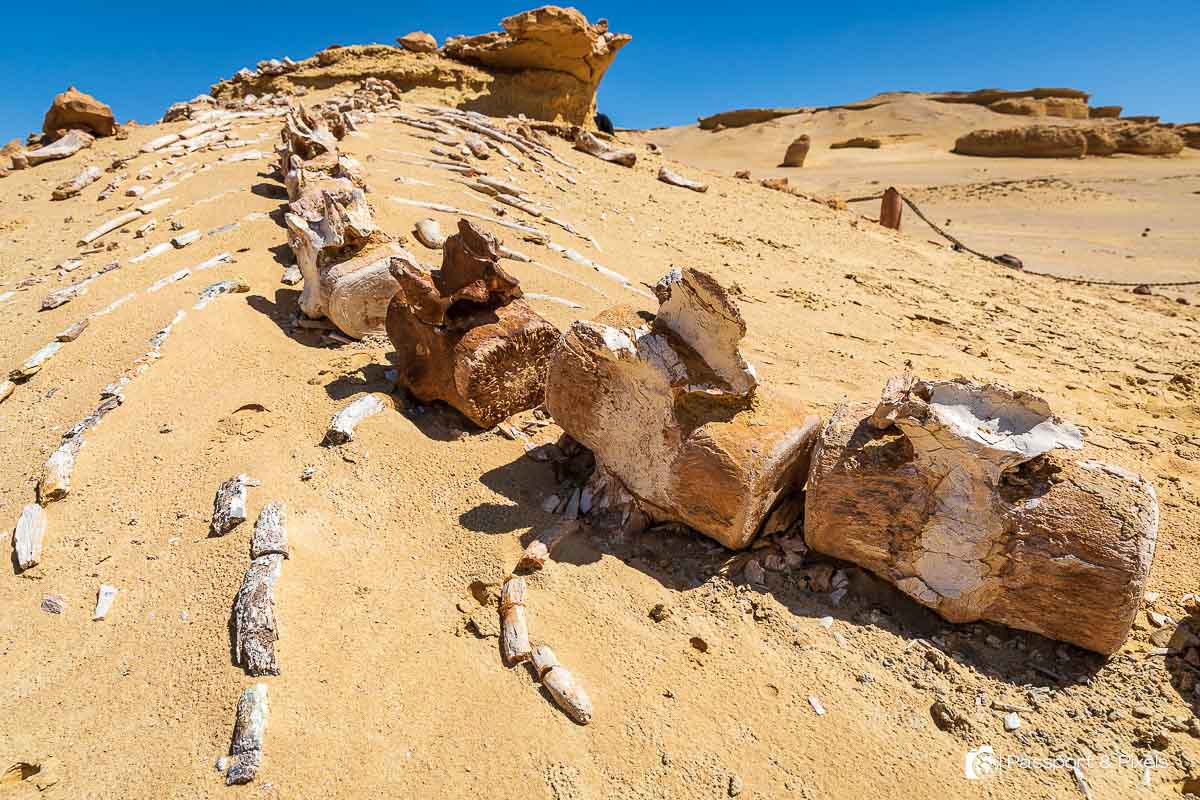
The main attraction is the stunning array of fossilised whale skeletons that are laid out across the landscape.
These have been carefully excavated by teams of palaeontologists, cleaned up in a lab, and then put back together in the right order so you can see how they would have looked.
Visitors can follow marked trails that lead to the most significant finds, including the massive remains of a type of ancient whale called Basilosaurus, which grew up to 20 metres long, alongside another smaller whale called Dorudon.
Along the way, you’ll also encounter fossils of other ancient marine creatures, including turtles and manatees, their bones still remarkably well preserved in the desert’s dry conditions.

What is Basilosaurus?
The most commonly found fossil here is Basilosaurus, a prehistoric whale that lived about 40 million years ago. They’ve found around 600 of them in the Wadi Hitan area.
When the first one was discovered in 1902, scientists thought it was a giant marine reptile, and so they named it Basilosaurus, which means ‘King Lizard’.
It was only later that they realised it’s not actually a lizard or a dinosaur, but a marine mammal – a whale. It’s one of the earliest known ancestors of modern whales.
Read more: In Photos: The 9 Best Tombs In Egypt (Ranked By Wow Factor)

Basilosaurus had a long, serpentine body that could reach about 20 metres long, and a mouth crammed with sharp teeth. It was the top predator of its time, hunting fish and other marine creatures, and its fossils have been found in several locations around the world including in the USA and Jordan.
But the thing that makes Basilosaurus so special is that it has a very surprising anatomical feature… hind legs!
That’s right, this whale had legs.
It couldn’t walk. Its legs are puny, only about the size of a human arm, and could never have supported the weight of this 6-7 tonne whale on land.
As top Wadi Hitan palaeontologist Hesham Sallam likes to say, they’re ‘just like T-rex arms’.
But they’re hugely important because they’re clear evidence of how whales evolved.

How did whales evolve?
We learn in school that whales are mammals. They are like cats, and cows, and us. They breathe air and give birth to live young, which they suckle with milk.
So what on earth are they doing living in the oceans? It makes no sense.
If you remember your evolution lessons from school, you’ll know that life is generally thought to have started in the oceans.
Over many millions of years, tiny organisms evolved into fish, and at some point some fish crawled out onto the land and evolved into everything else: dinosaurs, reptiles, mammals, birds, and eventually humans.
But around 50 million years ago, some land-dwelling mammals went BACK into the water.

These early ancestors of modern whales were likely medium-sized, four-legged creatures distantly related to modern deer or cows. They lived near the water’s edge, using their limbs to both walk on land and paddle through shallow waters, searching for food or escaping from predators.
Over time, as they adapted more to life in the water, their bodies changed dramatically.
Limbs became flippers, their hind legs shrank away to nothing, their tails grew more powerful and developed flukes, and their nostrils moved from the tip of their nose to become a blowhole on the top of their heads.
Eventually they diversified into the many species of whales and dolphins we know today – collectively called cetaceans.
Surprisingly, the closest relative of whales and dolphins still alive today is actually the hippo!

What is important about the fossils at Wadi Hitan Egypt
Fossils from places like Wadi al-Hitan show this evolutionary journey in stunning detail.
Species like Basilosaurus could be described as a ‘missing link’ between those early four-legged land mammals that walked on land, and today’s fully aquatic whales.
Finding a whale that still has vestigial hind legs that are too small to be used for walking, is a critical piece of the puzzle that shows that fascinating journey of evolution from land to sea.

Other things to see at the Valley of the Whales in Egypt
Fossilised mangroves
As you walk around the site, you’ll come to an area where there are some bizarre formations along the side of the path.
They’re like nothing you’ve ever seen before – intricate, twisted and tangled, like petrified spaghetti.
Opinions vary on what they are. Some experts think they’re the fossilised roots of mangrove plants from millions of years ago, when this area was a shallow sea and may have been full of mangroves.
Others think they could be the fossilised burrows of small crustaceans that lived in the soft sand.
No one knows for sure, but they are very cool to look at and provide more evidence that this desert was once underwater.

Wadi Hitan Museum
As well as the fossils, Wadi Hitan also has a small on-site museum, in a new building half submerged in the desert and carefully designed to blend in with the landscape.
Inside there are more fossils including casts of Basilosaurus’s remarkable legs and two huge Basilosaurus skulls that bring home what a huge predator it was.
One of the highlights is the full skeleton of a Basilosaurus, laid out in all its glory for you to admire up close.
The museum also features displays about the fossils found in the area, the story of whale evolution and the ancient environment that once existed here, helping to put the discoveries into context.
While the fossils themselves are the main thing to see at Wadi el Hitan, the museum provides useful background that helps you understand what you see as you walk around.


Sahara Desert landscapes
Besides the fossils, the stark beauty of the surrounding desert is really stunning, with sand dunes, alien rock formations, and endless skies creating a dramatic backdrop for the ancient bones.
If you’re a photography lover like me, the colours and shapes of the landscape, contrasted with the bizarre skeletons lying all around, make for wonderful photo opportunities.

Visitor centre
There’s a small visitor centre and toilets by the car park. The visitor centre has a shady seating area and a small shop selling drinks and snacks.

How long should you spend at Wadi al Hitan Egypt?
I spent a week there, but for most people that might be a bit excessive!
The amount of time you spend depends on your level of interest, but most visitors find that 2-4 hours is enough to explore the main fossil sites, walk the trails, and visit the museum.
If you’re keen on photography or want to take in the desert’s quiet atmosphere, you might want to allow a bit more time.
Paths are clearly marked and easy to follow and the site is relatively compact, but there’s a lot to learn, so don’t rush.
Keep in mind that the desert heat can be intense, so visiting early in the morning or later in the afternoon can make for a more comfortable experience.

Can you find fossils at Wadi Hitan?
There are fossils everywhere at Wadi Hitan, and with the wind exposing new layers every day, the eagle-eyed may spot something interesting just lying on the sand.
However, to protect the fossils and the landscape, leaving the path and wandering off into the desert is strictly prohibited. Please do not leave the path at any time, even if you see something that looks interesting.
If you walk off the path, you might end up crushing some priceless prehistoric creature under your feet, and do you want that on your conscience?

Can you keep the fossils from Wadi al Hitan?
The Valley of the Whales is a protected area, and removing fossils or any other natural objects is strictly prohibited.
In Egypt all ancient heritage is protected, and smuggling any items out of the country is illegal. If you get caught with a fossil in your bag, you could be liable for a fine or even a prison sentence.
It might seem frustrating when fossils are everywhere, and who is going to miss one little shark tooth or a small piece of bone?
But just imagine if every visitor who came here did the same thing? Millions of people over time just taking one thing away? Soon there’d be nothing left!
So tempting though it might be, please follow the rule: take only photos, and leave only footprints (but only on the path, please!)

New whale species discovered at Wadi Hitan
In the past decade, several exciting new discoveries have been made at Wadi al-Hitan, adding to its status as one of the world’s most important fossil sites.
In 2021, palaeontologists uncovered the remains of a previously unknown species of semi-aquatic whale, which we were lucky enough to get to film as part of our documentary.
They named it Phiomicetus Anubis – ‘cetus’ is the word for whale (think cetacean), Phiomi because it was found in the Faiyum region, and Anubis, after the Egyptian God of Death, because it was a huge ocean predator.
It’s older than Basilosaurus, and the fossils of Phiomicetus Anubis revealed that it had bigger, sturdier legs, so it was probably capable of walking on land.
This is a big deal, because it suggests that it was still in the early stages of becoming fully aquatic and is another important link in the whale’s journey from land mammal to ocean giant.

Wadi Hitan entry cost
Entry to the site is US $15 for foreign visitors and 35EP for Egyptians.
If you take a day tour from Cairo your site entry fee is not usually included in the tour price.

How to get to the Valley of the Whales
Wadi al Hitan is not the easiest place to reach, but that’s part of what makes it so special.
The site is about a 2-3 hour drive from Cairo, and while the journey starts on paved roads, the last stretch involves navigating unpaved desert tracks with little to no signage.
Because of this, if you’re going to go by car, I strongly recommend you hire a 4×4 vehicle, ideally with a knowledgeable driver or guide familiar with the area.
Bring plenty of water and don’t just rely on having phone signal in case you run out of battery or the signal drops. Allow plenty of time so you don’t end up driving in the dark.
Wadi al Hitan tours
A much easier and safer way is to book a day tour from Cairo. These often include other stops around Wadi El-Rayan and Faiyum. Here are a couple to choose from:
It’s a long journey, so these day tours make for a long day, sometimes 10-12 hours.
If you’d like to do an overnight tour with a night in Faiyum, there aren’t any regular group tours that do this. If you’re not confident driving yourself, my recommendation is that you hire a private car and driver to drive you and bring you back, or arrange a private tour.
There are loads of Wadi Hitan tour options on Viator here. Choose one that has good reviews and is more or less what you want to do, and then contact the company and ask if they can create you a bespoke tour with an overnight stay, or recommend a driver to take you.
If you click into each tour and scroll down to Additional Information it gives you the name of the supplier; then if you click on the name it gives you an email address and/or a phone number so you can contact them via WhatsApp (or you can search the company name to find their website and go from there).

Hotels near Wadi el Hitan
There are no hotels directly at Wadi al-Hitan, but you’ll find several options in the nearby city of Fayoum, which is about an hour’s drive away.
Fayoum offers a range of accommodation, from basic guesthouses to more comfortable hotels, depending on your budget. Here are a few suggestions.
Top Pick: Kom El Dikka Agri Lodge
This one was recommended by the Egyptian fixer I worked with on the documentary – he says it’s now where he takes any film crews he works with if they’re staying in that area. Kom El Dikka is a traditional style Egyptian lodge with a pool and private beach, conveniently located in Tunis Village. Booking.com rating: 8.5.


Lake House by Tunisia Green
This is where we stayed during our filming at Wadi al Hitan, driving from here every day to the site and back. Rooms at Lake House were clean and comfortable, there’s a nice garden with a pool (which we never had time to use) and staff were friendly and helpful. Meals were organised separately for our crew, so I can’t comment on what the food is like. Booking.com rating: 8.4


Tzila Lodge, Tunis Village
Tzila Lodge is in Tunis Village close to Lake Qaroun. The rooms are minimalist but beautiful, with a cool desert vibe. There’s an outdoor pool and free parking. With pottery workshops nearby, this spot is great for getting to Wadi Hitan as well as exploring the local crafts and culture. Booking.com rating: 8.4.


Lazib Inn Resort & Spa
Overlooking Lake Qaroun, Lazib Inn Resort & Spa is a 5* hotel that blends luxury with stunning natural surroundings. The suites are beautifully designed, with personalised service and a superb restaurant serving delicious Oriental cuisine. Ideal for a peaceful escape in elegant surroundings, with a fantastic spa to complete the experience. Booking.com rating: 9.4.


Want to see more of my photography or travel writing? Have comments or questions? Come follow me on Instagram, Threads or Bluesky and share your thoughts!
Other things to see near Wadi Hitan
Apart from Wadi al-Hitan, the Fayoum region offers several other attractions worth exploring if you have time.
Jebel Qatrani
Jebel Qatrani is another fascinating geological and paleontological site dating back to the late Eocene and early Oligocene periods. Like at Wadi Hitan, the landscape here was once underwater, and there are open air displays of fossils like manatees and other marine creatures.
Later, when the sea dried up, a forest grew, and you can see fascinating fossilised or petrified wood that looks like freshly cut trees but is actually 34 million year old fossils.
Jebel Qatrani is particularly famous for fossils that help trace the evolution of early primates and other species that once inhabited these ancient forests.

Wadi El-Rayan waterfalls
Formed by the diversion of excess agricultural drainage into the two connected lakes, Wadi El-Rayan Waterfalls are Egypt’s largest waterfalls and a rare sight in the desert landscape. The area is also rich in biodiversity, offering opportunities for bird watching, picnicking, and exploring nearby sand dunes and springs.
Lake Qarun
Lake Qarun is one of the country’s largest natural lakes and has a rich historical significance dating back to the time of the pharaohs. It’s known for its biodiversity, including various fish species and migratory birds, making it a popular spot for birdwatching. Nearby are the crumbling ruins of the Temple of Dionysias, an ancient Roman structure dedicated to Dionysus, the god of wine and festivity.
Tunis Village
Not far from Fayoum, Tunis Village is known for its artisanal pottery and scenic views of Lake Qaroun. It has become a hub for artists and travellers looking for peace away from the hubbub of Cairo, and there are workshops, guesthouses, traditional Egyptian restaurants and locally crafted pottery lining the village streets.
Desert adventures
The desert around Whale Valley and Faiyum also offers opportunities for dune bashing, sandboarding, and 4×4 adventures.

Is Wadi el Hitan worth visiting?
I might be biased because I made a whole film about it, but I thought the Valley of the Whales was beautiful and fascinating.
While the country is best known for its pyramids and tombs, Wadi el Hitan offers a completely different kind of historical experience. The chance to walk among the fossils of ancient whales, set against the stunning backdrop of the Western Desert, is truly unforgettable.
If you’re into dinosaurs and palaeontology you’ll love it. But I’d argue that even if you’re not, you can still learn so much and have a fascinating time here if you just have a sense of adventure and curiosity about the natural world.
Admittedly it’s not as glamorous as the tombs of Ancient Egypt, and it is a little bit of a mission to get there, but it’s worth the effort. On the plus side, very few visitors go there, so it will be a calm relief after the chaos of Cairo.

Where to stay in Cairo before your trip to Wadi Hitan
Top Pick: The St Regis Cairo
The St Regis Cairo is the Cairo hotel dreams are made of, offering five star luxury right on the banks of the Nile. With elegant rooms featuring plush interiors and panoramic views of the river or city skyline, it’s a peaceful retreat amidst Cairo’s energy. The hotel’s standout features include its indulgent Iridium Spa and a variety of fine dining options. Booking.com rating 9.1.


Comfort: Steigenberger Hotel El Tahrir
We spent a few night here before and after our filming at Wadi Hitan. The Steigenberger Cairo is a great, modern business hotel, with huge comfortable, rooms, a fantastic breakfast buffet, rooftop pool and fitness centre (neither of which I had time to use). Its location is perfect for sightseeing in Cairo as it’s just a short walk from Tahrir Square and the Egyptian Museum. Booking.com rating: 9.2.


Affordable: Victory Downtown Boutique Hotel
Victory Downtown Boutique Hotel offers cosy rooms in central Cairo. Situated within walking distance of Tahrir Square and local restaurants, this boutique hotel features fresh, modern interiors in a historic building. For a small, well-located option with charm and warmth, it’s an excellent choice. Booking.com rating: 9.5.


Where to next?
If you enjoyed this post about Egypt Whale Valley, why not try some of my other posts about ancient sites?
- The Ruins Of Troy Turkey: How To Visit Homer’s Ancient City
- How To Visit Perge Ancient City Ruins In Antalya, Turkey
- Yaxha Guatemala: The Magical Mayan Ruins You Need To Visit
- An Unhelpful Guide to… Herculaneum Ruins
- An Unhelpful Guide to… Tepoztlan Mexico
- Aspendos Ruins And Theatre In Turkey: The Essential Guide
- The Best Ancient Ruins In Turkey And Where To See Them
- Gordion in Turkey: City of King Midas and the Golden Touch
- Todi Italy: A Quick Guide To This Historic Town In Umbria
Liked this post?
Social shares help support my hard work! You can share via the buttons at the bottom, or pin this handy Pinterest Pin. Thank you!

Buy me a coffee
Did you enjoy this website or find it useful? If you did and fancy showing your appreciation, that would be amazing!
A small token of support helps keep Passport & Pixels going, so I can carry on creating free content for travellers like you. Also, it makes my day! Thank you!
My favourite travel tools and brands
To help you organise your trip, here’s a short list of some of the brands and tools I use over and over again when I’m planning my travels. You can see more on my Travel Resources page.
- Booking.com: A huge range of hotels to choose from, often with free cancellation. If you book hotels regularly you can earn discounts. I’m on Genius Level 3 which gets me 20% off!
- Expedia: Another great place to find hotels and Expedia also sell flights, car hire, and loads more all in one place.
- Skyscanner: The only place I ever go to search for flights and compare prices.
- Flight Centre: Booking a more complicated route? Let Flight Centre organise it for you (and deal with the drama when something goes wrong).
- Priority Pass: I love having access to 1600+ airport lounges when I fly, allowing me to enjoy my time at the airport. Buy through my link and you get up to 20% off!
- Airalo: Say goodbye to ridiculous mobile roaming charges. Did you know you can now buy ane-SIM, install it in your phone before you leave home, and then use data abroad at local prices? Game changer. Get US$3 credit with code BELLA5735.
- TourRadar: If you prefer group travel and organised tours, TourRadar has a huge range of fantastic tours from respected operators. They’re very helpful and have 4.5 stars on TrustPilot.
- Viator: Part of the TripAdvisor brand, Viator is another great place to search for group adventures and day trips.
- GetYourGuide: A great place to find local tours and day trips in your destination.
- Wex Photo Video: The UK’s best camera gear store.
- Ellis Brigham: Looking for good quality backpacks, travel clothes and other gear? Ellis Brigham is where I buy almost all of mine.
- Rentalcars.com: Part of the Booking.com family and the world’s largest online car rental service, with 24/7 customer service.
- World Nomads Travel Insurance: I never ever travel without travel insurance and nor should you!
