

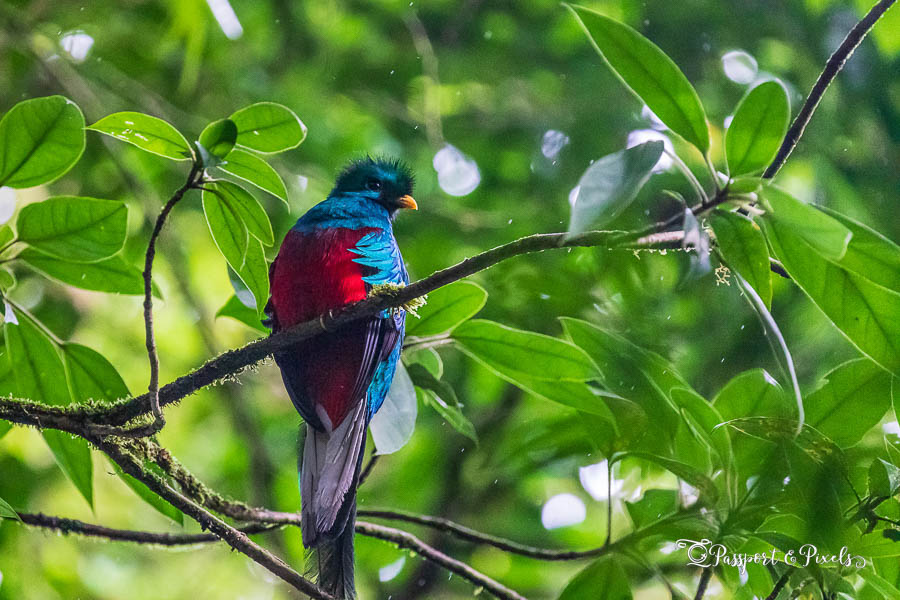
This story about my experience searching for a resplendent quetzal bird in Guatemala was inspired by an article I wrote for BBC Wildlife Magazine. If you’re looking for tips on where to go and how to spot a Guatemalan quetzal, scroll down to the bottom.
No AI was involved in the writing of this post, so any errors you spot are mine and mine alone!
The sneeze begins as a tickle in my right nostril. Almost imperceptible: a mosquito landing delicately on your arm, ready to strike. A minuscule irritation that swells into my sinuses until it demands to be released into the quiet jungle.
And for the record, I am not a quiet sneezer. Some people hiccup gently into a tissue or emit a delicate squeak, but not me. My sneezes are window-shattering blasts that reverberate into next month.
Of course, this wouldn’t be a problem, except that Alfredo thinks he’s just seen a resplendent quetzal. And any sudden noise will certainly scare it away.

Searching for the resplendent quetzal bird in Guatemala
I’ve come to the Mirador Rey Tepepul preserve just outside Santiago Atitlán, for one reason only: to try to spot the elusive resplendent quetzal.
This gorgeous bird, with its iridescent green head and wings, spiky green crest, red breast, and twin tail plumes that can grow up to 1 metre long, is an icon of Guatemala, and no trip to the country is complete without seeing one in the flesh. Or should that be ‘feathers’?
I’ve heard that this nature reserve near the beautiful Lake Atitlan is one of the best places in Guatemala to spot resplendent quetzals, so I’ve booked an early morning birdwatching hike with Birding Atitlán Expeditions, and my guide Alfredo is going to try to find one for me.
Read more: Lake Atitlan For Beginners: How To Visit Guatemala’s #1 Spot

“It’s not really the season to spot quetzals right now,” he tells me as we set off, following a narrow path that slopes steeply upwards into the jungle, damp and vivid green after last night’s heavy rainfall. “The best time to come is during nesting season.
If we know where the nests are, we can take visitors right to them, and then you just have to wait for the parents to come back.”
Alfredo pulls out his phone and in a ‘look what you could have won’ moment of torture, shows me several stunning photos of parent quetzals diving in and out of an exposed tree stump. “Here are some I took recently.”
Gorgeous to look at, but not really helpful for my FOMO.

The quetzal: national bird of Guatemala
As you travel around Guatemala, you’ll see quetzals everywhere. Quetzals woven into scarves and blankets. Varnished wooden quetzal toys, painted quetzal hanging mobiles, beaded quetzal keyrings. Quetzals in street art and painted onto tuk-tuks.
There’s a resplendent quetzal on the national flag and on all the bank notes – the currency of Guatemala is called the Quetzal. And the city I’m staying in, in the highlands, is called Quetzaltenango.
In fact the resplendent quetzal is even the Guatemala national bird, which is hardly surprising when you see it. Not only is it one of the most beautiful birds in the world, but with its cute yellow beak and bright black eye giving it a lively expression, it’s charismatic too.
Read more: A Perfect Guatemala Itinerary In 10 Days, 2 Weeks Or 3 Weeks


Some resplendent quetzal facts
The resplendent quetzal (Pharomachrus mocinno) is one of six species of quetzal that also includes the crested quetzal, golden-headed quetzal, white-tipped quetzal, eared quetzal and Pavonine quetzal.
Experts estimate there are only about 20-50,000 resplendent quetzals left in the world, making them Near Threatened due to deforestation and habitat loss.
Where do quetzal birds live?
Quetzals live in the tropical mountain forests of Central America including Guatemala, Costa Rica, Panama and parts of Mexico, where they eat mostly fruit from the laurel and wild avocado trees, as well as wasps, insects, frogs, lizards and snails.
Only the male has the gorgeous plumage with the shaggy crest and long tail, females are also green, but less vividly so, with a brown head and breast.


What is special about the quetzal bird?
But its vivid plumage is not the only reason why the resplendent quetzal is Guatemala’s national bird. It’s also deeply intertwined with the country’s history and Maya mythology.
The Ancient Maya saw the quetzal as a sacred bird, associated with the snake god Quetzalcoatl and with freedom and light.
Kings and nobility adorned themselves with headdresses made of quetzal feathers, which were highly prized and considered extremely valuable. But the Maya made sure they only took the tail feathers and did not harm the bird – in fact killing a quetzal was punishable by death.
Legend says that when Tecun Uman, one of the last Maya rulers and a national hero of Guatemala, went into battle against the Spanish conquistadores, he was adorned with resplendent quetzal feathers and accompanied by a spirit protector in the form of a quetzal.
But Uman was fatally wounded, so his grieving companion flew down and bathed in his blood, turning its breast forever red in honour of the fallen hero.

Do quetzal birds still exist?
Although the quetzal bird features in several Maya myths and legends, it is actually a real bird and not just a made up fantasy (unlike its namesake Quetzalcoatl, the feathered serpent – which unfortunately is just a fictional creature).
And although their numbers have declined due to habitat loss and predation by rodents and birds of prey, they do still exist – and you can see them in Guatemala! At least, I was hoping I would see one. If you want to find out if I had any luck, keep reading!
Are quetzals endangered?
The Resplendent Quetzal (Pharomachrus mocinno) is classified as Near Threatened on the IUCN Red List, meaning it’s close to qualifying for a higher threat category like Vulnerable. While not yet endangered, they face several threats, such as habitat loss and climate change, that could push them towards endangerment if not addressed.

How many quetzals are left in the world?
Estimating the exact number of quetzals left in the world is challenging due to their elusive nature and difficulty in getting to where they live. However, the official estimate by the IUCN Red List is that there may be about 20,000-49,999 quetzals left, based on data from various sources and considering the birds’ range and habitat.
How rare is it to see a quetzal bird?
Not actually as rare as you might think. Of course there’s no guarantee you will spot one, but if you head to one of the main quetzal bird habitats in Guatemala (there’s more information about those below), and go with a good guide who knows where they hang out and how to spot them, your odds are pretty good.
At least, that’s what I was hoping, as set my alarm before dawn for my quetzal birdwatching trip…

Hiking to see a quetzal bird in the Guatemalan jungle
And so it is that Alfredo picks me up at 6 am from my hostel in Santiago Atitlán and we set off – at the wrong time of year – in search of a quetzal.
Our destination is the Mirador Rey Tepepul Preserve on the foothills of Volcán de Atitlán, an area of dense jungle that I’m told is home to up to 300 species of birds including, of course, the elusive quetzal.
I’ve got my Canon 5D Mark IV and a 100-400 mm lens, and Alfredo has brought his special birdwatching telescope. One look at my camera and the hopeful look on my face tells Alfredo that the pressure’s on, and I can see he’s a bit anxious. He knows I’ve come all this way just to see a quetzal, and he wants to deliver.
On the way up to the trailhead we stop briefly at the Mirador Rey Tepepul, a gorgeous viewpoint overlooking the town and Lake Atitlán on one side, and with views all the way to the Pacific Coast on the other.
It’s rainy season and for the last few days we’ve had near constant torrential downpours, but this morning is miraculously bright – the first bluebird sky I’ve seen in over a month.
Read more: Yaxha Guatemala: The Magical Mayan Ruins You Need To Visit

“If we don’t see a quetzal we should just get back in the car and head to the beach,” I only half joke.
But where we’re headed is the exact opposite of the beach. We park the car and strike out into the dense jungle, along a narrow, forest path that’s still slick from last night’s rain. It slopes steeply downhill, until we reach a small river fed by a trickling waterfall, and then back up the other side.
I’m far too busy watching where I’m putting my feet and trying not to slip over to look for birds, but suddenly Alfredo pulls up short. “Look! Over there!” he whispers in excitement.
I look at where he’s pointing, but all I can see is green.

He sets up his telescope and uses a small green laser to pinpoint the area I’m supposed to be looking at. With the naked eye I still have no idea what he’s so excited about, but when I look through the viewfinder I see it: a tiny emerald toucanet, sitting quietly on a branch.
I have absolutely no idea how Alfredo managed to spot this green bird amongst a huge expanse of green trees from at least 100 metres away, but that’s the skill of a good guide.
We’re far too far away for me to be able to get any kind of decent photo with my zoom lens, but Alfredo has another trick up his sleeve – a very simple plastic adaptor that lets him attach my iPhone to his telescope.
Suddenly instead of a tiny little dark green shape amongst the bright green leaves, I’m looking at a crisp image of the diminutive toucanet as it shuffles and preens on its perch.
Read more: Santa Catarina Palopo: The Colourful Painted Town In Guatemala


Protecting Guatemala’s national bird
This birdwatching skill is being put to the test more and more as resplendent quetzal numbers decline. They fall victim to eagles and hawks, or to squirrels and rats, which climb the trees and raid their nests.
“One conservation area tried to encourage breeding by creating nesting sites,” Alfredo tells me as we walk. “For a while it worked, but then the new nests started attracting squirrels, which ate the eggs, and now they have fewer quetzals and a squirrel problem.” He shakes his head. “You shouldn’t mess around with nature.”

But predators are not the only challenge the quetzal faces. The biggest threat is habitat destruction caused by logging and farming. Even in our remote corner of the nature reserve, we pass several groups of workmen and hear frequent chainsaws, audible evidence of the quetzal’s home being chipped away.
It’s something that bird lovers like Alfredo are continually campaigning to prevent. “We need more support for projects that encourage people to protect the forest and not cut it down,” he says. “But there is hope. We have some private reserves and protected areas. And more people are starting to come for birdwatching tours, which generate work for local people. In fact, thanks to wildlife tourism, we’ve even found new quetzals we didn’t know about.”
Read more: Backpacking in Guatemala: All You Need To Know Before You Go

Finding a Guatemalan quetzal bird
Where are they? After three hours of hiking my optimism is starting to drain, and soon it will be time to start the long walk back to the car. But Alfredo has just one more feeding spot he wants to try. We trudge up another hill, when suddenly he stops. Behind him, I stop too.
“Shhh!” he breathes sharply, his eyes gleaming with victory. “Do you hear that? A quetzal!” He peers excitedly into the undergrowth, trying to see. But the foliage is too dense. We need to get closer.
It’s at this point that my sneeze begins, a light tingle that quickly builds to a crescendo. Terrified of scaring away the bird, I bury my face in my sleeve and try to muffle the explosion as best I can. If there’s a quetzal nearby, I just have to hope it isn’t paying attention.

Alfredo is too distracted to notice. He plunges off the side of the path, slip-sliding downhill between tangled trunks, following the sound. I chase after him, trying to see where he’s pointing, and not make any more noise.
Alfredo’s unorthodox shortcut soon brings us to a sunlit, open area that overlooks another cluster of trees. Under his breath, he instructs me to stay in the shadows, to avoid being spotted. Then he raises his binoculars and looks again.
“I see them! A pair, male and female!” he whispers with delight. “Look! Get your camera ready!” I inch closer to him, peering into the foliage, trying to work out where he’s pointing.
Read more: Visiting San Andres Xecul, Guatemala: Home Of The Famous Yellow Church

And then I see them: the female perched high up, a less vivid green with a brown breast and belly, and the male, sitting a few branches below. Now that breeding season is over it has shed its gorgeous tail plumes, but it still looks as resplendent as its name suggests, with its vibrant green feathers iridescent in the sunlight, and its large black eye and cute yellow beak giving it a lively, quizzical expression.
I train my lens on the male and manage to fire off just three shots, and then, perhaps disturbed by our presence, it vanishes.
It’s over in seconds, but it’s enough. I’ve come to photograph a quetzal, and that’s what I’ve done. And when I look at Alfredo, and see him shining with relief that he’s been able to grant my wish, that’s almost more gratifying than the sighting itself.
Read more: Is Guatemala Safe? 60+ Practical Tips For Safe Travel In Guatemala

Where to see quetzal in Guatemala
Quetzal birds are extremely shy and elusive, so spotting one can be a challenge. For your best chance of seeing a quetzal in Guatemala, head to one of these places:
1/ El Refugio del Quetzal, San Rafael Pie De la Cuesta
The Refugio del Quetzal is a small cloud forest reserve near the town of San Marcos, about two hours’ drive west of Guatemala’s second city, Quetzaltenango. It has a few well-marked trails and is dotted with small springs and waterfalls. It’s one of the best places to see quetzals in Guatemala.

2/ Biotopo Mario Dary Rivera (aka Biotopo del Quetzal), Coban
As the nickname suggests, this nature reserve in the lush cloud forest in the centre of Guatemala is a great place to try to spot quetzals. Located about halfway between Coban & Guatemala City, this 1000-hectare reserve was specifically set up to protect the birds’ natural habitat and quetzals can sometimes even be seen in the gardens of the nearby hotels.
The Biotopo del Quetzal has a shop and visitors’ centre, and two trails – the Sendero losHelechos (Fern Trail) which runs for just under 2 km, and the longer Sendero los Musgos (Moss Trail) which is about 3.5 km.
Several tour operators offer tours that will pick you up from your accommodation in Coban; you can also take longer day drips from Guatemala City or Antigua.
However, it may be a bit harder to see one now than in previous years. Alfredo told me that rangers at the Biotopo del Quetzal set up man-made nesting sites to encourage more quetzals to the area. For a while it worked, but more nests attracted more squirrels, which run up the trees and eat the quetzal eggs, causing numbers to drop even more than before.
Side fact: Mario Dary, after whom the preserve is officially named, was an environmentalist who campaigned to create a safe habitat for the quetzal in the face of strong opposition from logging companies. He was murdered in 1981.

3/ Municipal Ecological Park of Santiago Atitlán / Mirador Rey Tepepul Preserve
Located just outside the town of Santiago Atitlán on the southern shore of Lake Atitlán, the Mirador Rey Tepepul preserve – where I did my quetzal birding experience – is another excellent place to try to spot Guatemala’s most beloved bird.
This is a protected area with a sacred history – the name refers to the Maya king Tz’utujil Tepepul and the site is considered a sacred place where Maya people still come to perform ceremonies.
Located just ten minutes’ drive from Santiago Atitlán on the foothills of Volcán de Atitlan, the preserve is a fabulous expanse of dense cloud forest, home to 300 species of birds including several species of hummingbirds, toucans, guans, flycatchers, motmots, and of course the fabulous quetzal.

On your way up there you’ll also get to stop at the Mirador itself, which boasts glorious views overlooking the town, the lake, and the towering peak of Volcán San Pedro.
The trails are not clearly marked, so to avoid getting lost – or possibly robbed – you’ll need to go with a guide.
Birding Atitlán Expeditions – who I went with – offer early morning, half, full-day and custom tours to suit all your needs and their guides are professionally-trained birding experts certified by the Guatemalan Institute of Tourism (INGUAT) and the National Audubon bird-watching Society of Guatemala.

4/ Sierra de las Minas Biosphere Reserve
Another option – though much harder to get to, is the Sierra de las Minas mountain range and wildlife reserve in the east of the country. This park contains roughly 60% of the remaining cloud forest in Guatemala and is the world’s largest quetzal habitat, as well as being home to howler monkeys, toucans, hummingbirds, white-tailed deer and coyotes.
However, the reserve is hard to get to, off the beaten tourist trail and with limited access roads or marked trails. If you go without an experienced guide you stand a good chance of getting lost. However it’s possible to organise guided hikes ranging from a few hours to multi-day adventures, from the nearby city of Salamá, or from the Sierra de las Minas’ main tourism office in San Rafael Chilascó.

When is the best time to spot the quetzal bird in Guatemala?
The best time to do a birdwatching trip to see quetzals is during breeding and nesting season, which is between late February or March, and the end of June. At this time, the males grow their spectacularly long twin tail plumes to attract a mate, and if you’re lucky you may even get to see several males all together as they fight and compete for the best females.
Quetzals nest in holes in dead tree trunks, so once the guides know where the nests are they can also be fairly easy to spot, since the dead trees have no foliage to block your view. The guides can simply take to to the nest, and then it’s a matter of waiting quietly as the birds come and go to feed their young.
If you happen to be in Guatemala outside breeding season your chances will be slimmer, but it’s not impossible to see a quetzal bird. They tend to have their preferred feeding spots and again, a good guide will know where these are.
The best time of day to see a quetzal is in the early morning. Most guided birding tours start at dawn when the birds are most active. By mid-morning when the sun is fully up, the quetzals will have hidden away.

How much does a quetzal birdwatching trip cost?
I paid Q325 (about £33.50 or USD 42) for about four hours with my private guide Alfredo, which included a pickup from my hostel and transport to the reserve and back. I had to bring my own packed breakfast.
Of course other companies’ prices may vary and the cost may go up in peak quetzal-spotting season. If you’re travelling with a partner or in a group, the price per person will be less.
Read more: 30 Beautiful Pictures Of Guatemala And The Stories Behind Them

What to take to go birdwatching in Guatemala
You’ll be hiking up and down steep and possibly muddy paths though the jungle, so here are the things I would recommend you bring with you for your trip to see quetzal birds in Guatemala:
- Sportswear or comfortable hiking clothes
- Long trousers
- Suncream
- Hat
- Waterproof or raincoat
- Insect repellent
- Hiking or trail running shoes, or trainers that you don’t mind getting wet or muddy.
- Camera and/or binoculars
- Water
- Breakfast and/or snacks

Want to see more of my photography or travel writing? Have comments or questions? Come follow me on Instagram, Threads or Bluesky and share your thoughts!
Where to next?
I hope you enjoyed this post all about the resplendent quetzal. If you’re planning a trip to Guatemala, why not check out some of my other posts?
- Livingston Guatemala: A Photo Guide To This Quirky Caribbean Town
- 28 Tried And Tested Things To Do In Antigua Guatemala
- Alfombras In Guatemala: A Guide To The Colourful Sawdust Carpets
- Cerro Quemado in Guatemala: The Volcano Where People Talk To The Gods
- Crater Azul: Is Guatemala’s Gorgeous Blue Crater Overhyped?
Liked this post about the resplendent quetzal?
Social shares help support my hard work! You can share via the buttons at the bottom, or pin this handy Pinterest Pin. Thank you!

