


** Note: This post was first written in 2020, long before AI had a chance to ruin everything. I’ve just updated it in 2026. So you know it’s (a) written by a real human and (b) still fresh and relevant! **
Before I travelled to Antarctica for the first time, I spent ages researching the best camera gear for Antarctic photography.
I’m an experienced travel and wildlife photographer, but I’d never taken photos in the polar regions before.
I wanted to make sure I got advice from the experts not only on the best photography equipment to take, but also how to look after it in the challenging weather of Antarctica.
I read photography websites, gear packing lists from Antarctica expedition companies and travel blogs to get as much information possible about what camera, lenses and photography accessories I needed to make sure I was ready for whatever Antarctica might throw at me.
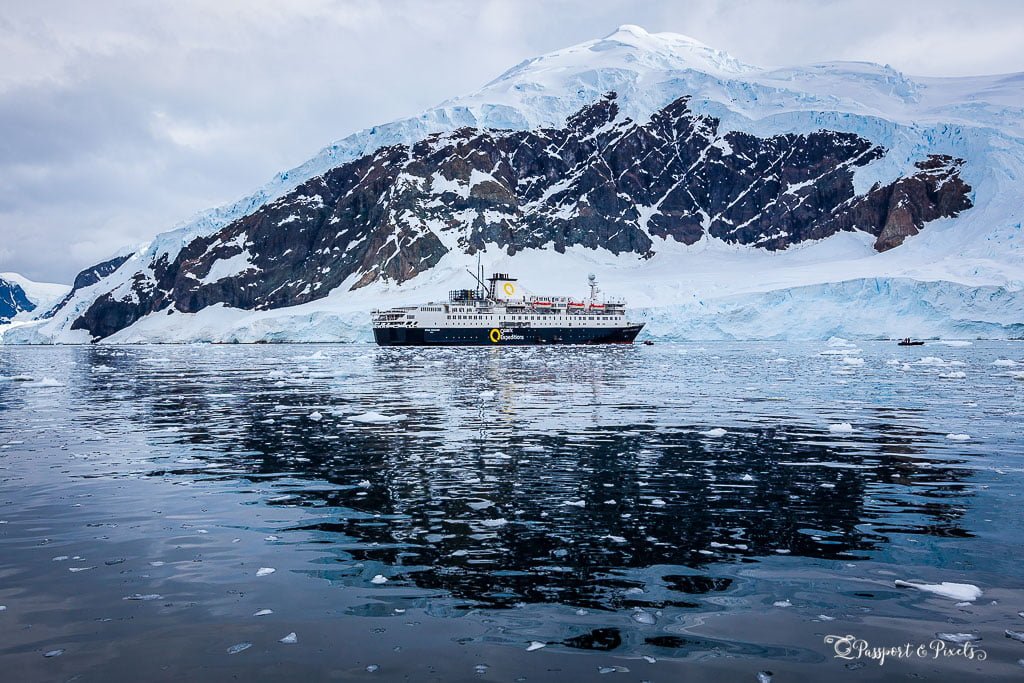
And then I went. And actually took photos in actual Antarctica.
I discovered what gear I really needed, what I’d brought that I could have left at home, and what the websites had failed to tell me that I really wished I’d known before I came.
So here, with the benefit of my experience, is a complete list of what camera gear I think you should take on your Antarctic photography trip.
I’ve been a Canon user my whole life, so most of the camera gear I’m recommending here is Canon because that’s what I know. Of course Sony, Nikon, Fuji and other brands also do great equivalents too.
Note: Some of the links you will see in this post are affiliate links. This means that if you click through and make a purchase, I will earn a small commission at no additional cost to you. If you’ve found this post useful and enjoyed my recommendations, I’d really appreciate it if you use my links. Thank you!

A quick note about my Antarctica photography experience
I’ve been to Antarctica twice. The first time was in 2020 on a 19-day expedition to the Falklands, South Georgia and the Antarctic Peninsula. You can find masses of posts about that trip here.
More recently, I’ve just got back from my second visit, this time on a 22-day voyage to East Antarctica and the Australian and New Zealand subantarctic with Aurora Expeditions. There are a couple of posts about that on the way, and I’m also using that experience to update all my existing posts – including this one!
I’ve also been to the Arctic twice – once to Svalbard, and once to Churchill in the Canadian Arctic. Conditions and the photography experience is pretty similar here too.
My Antarctic and Arctic photographs have been published in Adventure.com, BBC Travel and Selling Travel among others, and there are more on the way.
All of which is to say, I know what I’m talking about!

Which is the best camera for Antarctica?
They say the best camera is the one you know how to use. There’s no point in investing in a super fancy professional camera if you stick it on auto or are too terrified to get it out of the bag.
So what is the best camera for Antarctic photography?
Plenty of people travel to Antarctica or South Georgia with compact cameras or just their smartphones and still manage to get some really fantastic photos. And if you’re a beginner in Antarctica, that’s probably enough.
Just go for it, enjoy yourself, and maybe read my 60+ Awesome Antarctic Photography Tips to learn how make the most of your time shooting in Antarctica.
But if you really want to get the best photos there’s no getting away from it – you’ll need a DSLR or mirrorless camera with interchangeable lenses.

DSLR or mirrorless?
While mirrorless cameras definitely have some advantages over DSLRs, people have been photographing in Antarctica for years and coming back with great results with a DSLR.
When I first visited, I took two DSLRs: a Canon EOS 5D Mark IV and a Mark II as a second body, and they were great. All the photos on my Falklands, South Georgia and Antarctica posts were taken on DSLR.
Mirrorless cameras are more and more popular these days as they can offer similar or better quality but in a smaller and lighter package. The Sony A7S range is particularly popular.
Most pro DSLRs and mirrorless are weather-sealed – something I definitely appreciated on a couple of rainy days in the subantarctic!
Now I have a Canon R5 mirrorless and an R6 Mark II as my second body, so that’s what I took on my most recent trip. Both are incredible cameras and brilliant for wildlife photography, especially with the amazing animal eye tracking focus.
So, while it just depends on what you have and what your budget is, if you’re looking to buy a new camera for your Antarctica trip, I’d recommend going mirrorless.
But whatever you have, whether DSLR or mirrorless, just make sure you watch some online tutorials and get familiar with the controls before you travel!
Read more: My Camera Equipment List: What’s In My Gear Bag?

Cropped sensor or full frame?
When it comes to the best camera for Antarctica, should you go full frame or is a cropped sensor OK?

The jury’s out on this one. Wildlife photographers often prefer a cropped sensor, something like the Canon R7, while landscape photographers tend to go for a full frame camera like the Canon R5 Mark II.
If you have a cropped sensor camera you’ll gain in the amount of zoom you get, but you may lose resolution or image quality. It’s up to you to decide what’s most important to you.
Some higher-end mirrorless cameras like my Canon R5 now give you the option to crop in-camera, giving you the best of both worlds.
In general I prefer having a higher-resolution full frame camera, so that I have plenty of room to crop later if I need to.
Bring two camera bodies
If you can, it’s a really good idea to bring TWO bodies.
In the cold, wet and windy polar regions, changing lenses is not only a massive hassle, you’ll also risk getting something blown onto your sensor or damaging your equipment.
Plus, if one stops working or you accidentally drop it in the sea, you’ll still have the other. So if you can, I highly recommend bringing two bodies.
The first time I visited Antarctica, both mine were full-frame Canon 5Ds, and I did regret not having the extra zoom advantage of a cropped sensor on one of them. In hindsight, it would have been better to swap out one of the full frames for a cropped sensor body.
But now that I have my Canon R5 mirrorless, which allows you to convert to a crop in-camera, I can choose whether I want full frame or cropped. Definitely a feature I’d recommend if you’re looking for a new camera.
Read my full review here! Using The Canon R5 For Wildlife Photography

Prime or zoom lenses?
While prime lenses can give you really stunning image quality, Antarctica isn’t really the place for them. When it comes to the best lens for Antarctica, what you need is versatility.
Things can change all the time – one moment you can be on a wide angle photographing a huge iceberg, and then suddenly a penguin can pop up right next to your zodiac. Plus as I mentioned above you really don’t want to be changing lenses all the time if you can help it.
So when it comes to the best camera lens for Antarctica, long range zooms are definitely your friends.
Read more: 60+ Awesome Antarctica Photography Tips
Which are the best lenses for Antarctica photography?
1/ Wide lens
You’ll definitely want a wide lens to capture all those stunning landscapes. Something like the Canon RF 24-70 f/2.8 L or Canon EF 24-105mm f4L would be ideal.
If you’ve got space for two, you could also think about taking an extra wide lens, like an 8-15 mm fisheye or the Canon EF 16-35 f/2.8 L. I did use my wide lens occasionally for Antarctica landscape photography like big ice and iceberg shots, though I think I could have lived without it.

2/ Zoom lens

You’ll definitely need a big zoom for close up shots of all that wonderful wildlife – and honestly the bigger the better.
In fact I was surprised at how much zoom I needed, because I thought the wildlife would get so close that too much zoom would end up being an issue.
And it’s true, the wildlife does sometimes get close, but if it does, you can usually just step back or grab your wide angle lens. But most of the time things were still pretty far away and I wasn’t always able to get the intimate close ups I would have liked.
On my first visit I took a Canon EF 70-200mm f2.8 L and a Canon EF 2x III Extender, meaning I could get up to 400 mm if I wanted but also have the benefit of the gorgeously fast f/2.8 on the 70-200. But in the end I almost never took the extender off.
When I bought my new Canon R5 I also treated myself to the RF 100-500 L lens, so that’s what I took on my recent visit.
So I’d recommend either the above set up, or something like the Canon EF 100-400mm f4.5-5.6 L or even the Tamron 150-600mm f5-6.3 for all the zoom power!
Ultimately you have to balance having as much zoom as possible, with being able to carry the weight! More about how to manage that, coming up…
3/ All-rounder lens
Of course taking all these lenses is a lot of weight to lug around, and some people don’t like doing that. If you’re one of them, consider a lens with more versatility.
You can get lenses with fantastic reach, all the way from wide to extreme zoom – like the Tamron 18-400mm f3.5-6.3 or even the Canon RF 200-800. You do lose some image quality with a lens like this, but you gain massively in flexibility and portability.
If you’re only taking one camera body to Antarctica, a lens like this is ideal to prevent you having to change lenses all the time.
Did you know I have a monthly (ish!) newsletter? It's packed with photography tips, travel inspiration and updates. Sign up here and get 5 free phone wallpaper downloads!

Do I need super fast lenses in Antarctica?
Photographers talk a lot about the importance of fast lenses – ones that have a large maximum aperture.
These are great because they allow you to shoot in low light conditions or get fantastically shallow depth of field, creating lovely soft backgrounds – but they do tend to be heavier and more expensive.
I don’t think you need a super fast lens in Antarctica. You’ll be travelling in summer when there are more than 18 hours of daylight and the light is usually bright with lots of ice and snow to reflect it.
When you shoot landscapes it’s generally better to use a narrow aperture anyway to get more of the scene in focus.
As for wildlife, I find something like f/4 or f/5.6 is wide enough to give that soft background while getting more of the animal in focus.
There were a few dull, wet days in the subantarctic when I wished I had a wider aperture, but I was able to increase my ISO to compensate.

Should I take an extender?
If you only have a 70-200, then yes. It hardly takes up any room in the bag and will double your zoom range to 400. On my first visit to Antarctica I took my Canon EF 2x III Extender and almost never took it off.
With longer lenses, you have to balance the need for zoom with the fact that an extender will reduce your maximum aperture. On my RF 100-500 at 500 mm I already only get f/7.1. If I added an extender I would lose another 1-2 stops, which in my view makes the lens pretty much unusable.
Can I take a drone to Antarctica?
Unless you are a scientist doing special research with special permits, then no. Recreational drones are banned in Antarctica.
Do I need a tripod for Antarctic photography?
The generally accepted advice is no.
I didn’t, and I didn’t miss it at all. I took a gorilla pod just in case and while this is a great bit of kit to have in your travel camera bag, I didn’t take it out of my suitcase the entire time.
IAATO rules state that you’re not allowed to put anything down, but tripods are treated like walking poles – you are allowed them. You just have to wash and disinfect the feet between landings.
But while they are allowed, in my experience a tripod is rarely that useful in Antarctica.
You’ll be moving around a lot, carrying gear, getting on and off zodiacs, and frankly a tripod will just get in the way. Unless you want to do lots of long-exposure shots or bracketing with filters, or you’re shooting video, you probably won’t miss it.

Get a decent strap
This is something I didn’t know the first time I went, but wish I had.
When you land on Antarctica or South Georgia you will often end up walking around for two hours or more, wearing a padded parka, often a life jacket, and carrying your backpack.
IAATO rules state that, to help prevent transmission of bird flu, you’re not allowed to put your bag down and even if you could, you wouldn’t want to as the ground is often covered with dirt and guano.
If you’re carrying a heavy camera body with a big zoom lens – or worse, TWO! – round your neck, you’ll get tired pretty quickly. I also found the straps often got tangled which was really annoying.
My favourite camera strap
If you’re only taking one camera, a nice padded strap like the Op Tech Pro strap will help. I have one of these and it’s much more comfortable than the strap that comes with the camera. 
However, as someone who likes to put the camera down or swap cameras over, I find having a strap permanently attached pretty annoying as it flaps around and gets in the way when you’re not using it.
To solve that, I’ve switched to the very brilliant and popular Peak Design system, which gives you two little buttons to attach to your camera and then various options for neck and wrist straps that you can easily clip on and take off.

Try a harness for two cameras
If you’re taking two bodies, I recommend having a dual camera harness like the BlackRapid Breathe double harness. On my first photography trip to Antarctica I didn’t have one, and I struggled, so I bought one for my trip to the Arctic and it was a vast improvement.
A harness will support the weight of your cameras across your shoulders and ease the pressure on your neck. Some can be quite pricey but it’s important to get a good one – you don’t want it breaking!
Here’s what I didn’t like about the harness: your cameras are still swinging from straps either side, so if you’re walking a long way or bending or crouching a lot, it can get annoying. This happened a lot when I used it while chimpanzee trekking in Uganda.
Speed shoot with a holster
So for my most recent trip I switched to the SpiderPro dual holster belt instead. And it was game-changing.
You get plates to screw onto each camera, which click and lock into slots on an adjustable belt. It was so much easier to walk around and swap camera with this. Plus I think it made me look incredibly cool! 🙂
However do note four important things:
- You have no strap. When you’re holding your camera, be careful not to drop it! Especially with cold hands or thick gloves.
- The camera can fall out if you don’t remember to lock it into the belt when you put it back. Ask me how I know…
- Salt spray can get in the locking mechanism and jam it up so make sure you give your belt a very good clean and soak between landings. Again, ask me how I know!
- The belt involves a lot of velcro – which is a nightmare for biosecurity in Antarctica. If you’re using one of these, you’ll need to be extra thorough and vigilant with your biosecurity cleaning.

How many batteries for Antarctica?
I took four, and that was plenty. Excursions and shore landings tended to last no more than 3-4 hours and one battery per camera was enough – though you may need more if you’re shooting lots of video or if you’re using a mirrorless camera which tends to have shorter battery life.
Nowadays, if I’m taking two mirrorless cameras, I take at least two batteries per camera and two battery chargers.
I charged them after every excursion. Remember that in the cold your batteries may run down faster than usual – so put them in an inner pocket to keep them warm. The usual advice is always to take more than you think you’ll need just in case.
Read more: Types Of Penguins In Antarctica: A Photo Guide
Do I need filters in Antarctica?
While filters certainly aren’t vital, it’s a good idea to protect your lenses from scratches with a good-quality UV filter.
While some people say this slightly degrades image quality, I don’t notice all that much difference and since I’m so bad at using lens caps, for me the tradeoff is worth it.
A circular polariser (CPL) is also worth taking. They’re good for bringing out the blues in the sky and icebergs, and if you’re photographing an iceberg or a whale in the water, a polariser can help cut reflections so you can see more of the part that’s under the surface. Make sure you buy the right diameter to fit your lens.
If you are bringing a tripod and shooting long exposures, you’ll need to chuck in a range of ND filters or a variable ND (which is what I have). Urth have a range that are decent quality and not stupidly expensive.

How many memory cards do I need?
As with batteries, more than you think you’ll need!
On my first visit, using DSLRs, I had a 32GB CF card in each camera, and two spares.
My mirrorless cameras have two card slots. In the R5 I use one 128 GB CF Express Type B and one 128 GB Lexar SDHC card – and two more of those in the R6.
I downloaded and backed up my images at the end of every day and then erased the cards, so that was enough for me. If you’re not planning to back up every day, or you’re shooting a lot of video, then obviously you’ll need more.
There are two important rules with cards:

- You need your cards to be fast. There’s no point having an expensive camera and then scrimping on a cheap, slow card. In Antarctica the writing speed of your card is really important because you want to be able to shoot high-speed bursts of jumping penguins or diving whales without the camera buffering after a few seconds.

Should I bring a laptop to Antarctica?
This depends on whether you want to back up or edit your images as you go along. You’ll have plenty of time on sea days to do it.
Personally I never travel without mine, and having it enabled me to sort, backup and edit all my images before I got home which meant that for once I didn’t get home with 5000 images to wade through!
Do you need a monitor for Antarctica?
I’ve heard some wildlife photographers recommend bringing a small monitor for taking photos in Antarctica. That’s because with the new, much stricter rules due to bird flu, you’re no longer allowed to lie down, sit or even crouch to get eye level shots of your subjects.
Some photographers recommend getting a small monitor like the Atomos Shinobi Go, which you can mount on the cold shoe of your camera. It means that when you’re bending forward and holding the camera low, you have a bigger screen to look at than the tiny flip-out one.
I did experiment with this setup at home but in the end I decided against it. For me, the flip-out screen on my R5 is good enough, and while a bigger screen would help, the added size and weight of a monitor on top of everything else I need to carry, was just too annoying.
Out in the wind and rain like in the photo below, I was very glad I didn’t have to worry about it.
But if your camera doesn’t have a flippable screen it’s worth considering since it’s now impossible to look through the viewfinder while taking photos at a low level.

What about hard drives?

If you’re going to back up as you go along, make sure you don’t forget hard drives.
You’ll need at least two – one main one and a backup in case the first gets lost or damaged – and make sure they’re big enough to hold all the images you’re going to take!
I recommend something like the Seagate 2TB portable hard drive or the more rugged Lacie 2TB portable drive.
For something extra fast and lightweight, I have this SanDisk 2TB Portable SSD.
Read more: 32 Awesome Animals In Antarctica (And Birds Too!)

What is the best camera backpack for Antarctica?
It’s essential that you take a waterproof or at least water-resistant backpack to carry your gear in. You’ll be taking daily trips in a small zodiac boat, exposed to the wind, rain, and the waves that may slosh over the side.
You’ll need to put your backpack on the floor of the zodiac which will almost certainly be wet. So having good protection for that expensive camera gear is vital!

For my first trip, after a great deal of research I bought a Mindshift Gear Backlight 26L backpack which was an OK size to hold my two bodies and three lenses but in hindsight a little on the small side for that much gear.
However, on about the third day the waterproof cover blew into the sea and sank which was mortifying! So here’s my top tip: make sure your bag has a waterproof cover that actually stays on!
After I got home I noticed that the zips on my bag had become really sticky from all the salty spray – and it’s never really recovered. I strongly recommend cleaning off the salt as soon as you can, and then giving the whole thing a proper clean when you get home, to prevent the same thing happening to you.
For my second trip I took my Tamrac Anvil which is a great size and well-padded for all my gear – but sadly only available in the USA. If that’s where you live (or you don’t mind shipping from America!) I really recommend this bag – it’s the closest I’ve personally found to the perfect backpack.
Do I need a proper dry bag?
My main backpack is not fully waterproof, so I only used this for travel. For landings and zodiac excursions I have a fantastic roll-top drybag backpack. Mine was a branded freebie but it’s very similar to this one.
Most days I found that a water-resistant backpack with a cover on it would have been enough. We rarely went out on the zodiacs in really bad weather, and the waterproof cover on my backpack protected my gear from spray and splashes.
However, there were a couple of times when we did get pretty wet, and I was grateful for my drybag. It was also good for being able quickly get a camera in and out if I wanted to take a photo while in the zodiac. So overall I would definitely recommend taking one.
As my drybag is not padded, I put my cameras loose in the bag, wrapped in a towel borrowed from my room or a camera wrap (these come in handy all the time!). I then very carefully carried them ashore, where I could take them out and walk around with them, before putting them back for the return journey.

Think about a camera rain cover
Some people had rain covers for their cameras. If yours is not fully weather-sealed, this is a must.
Try something simple like an Op/Tech rainsleeve or a more durable rainsleeve for Antarctic photography emergencies. But if you take a plastic raincover, be very careful not to let it blow away and pollute the pristine landscape!
My pro cameras are weatherproof and came to no harm, though there were a couple of very wet days when I wished I’d had one – and some people’s cameras did suffer.
Read more: Going to Antarctica: 30 Common Questions Answered
What about condensation?
I worried a bit about moving between the cold outdoors and the warmth of the ship, and whether condensation might damage my camera gear. To prevent this I took several large plastic bags to put my cameras in when I returned to the ship each time – but I never used them.
Although the ship was warm, I rarely wanted to take photos immediately after returning from an excursion. And the weather sealing is pretty good protection anyway.
The only time condensation was a bother was when I went out on deck to take photos in the cold, went back inside to warm up for a bit, and then went back out. It did get foggy then, and I’d have to wait a bit for it to clear. But it was no major drama.
Don’t forget chargers and plug adapters

With so many devices, and especially if you’re sharing a cabin, socket space will be at a premium so make sure you also take a 4-way plug extender. One with USB as well as regular plug sockets is ideal, like this extension lead with USB or this handy plug adapter cube.

How deep are your pockets?
It’s always handy to have instant access to the things you use a lot, like lens cloths, batteries, sunglasses, your phone and so on.
Make sure your parka has lots of big pockets to put this stuff in, or bring a small waterproof waist pack or front-loading camera bag as well. When you’re carrying 1-2 cameras, wearing a puffy parka and a lifejacket, and standing on muddy ground, it’s really best to avoid having to keep taking your backpack off to get things out of it.
Read more: South Georgia and Antarctica: What Is It Really Like?
Bring a cleaning kit
Wind, dust, snow, sand, salt spray… there are all sorts of things that can get in your camera, so it’s a good idea to take cleaning equipment with you like microfibre cleaning cloths and maybe a lens pen.
I always had least three or four microfibre cleaning cloths and quick drying towels in every pocket and used them frequently to get rid of splashes and smears.
I also took a Lens pen DSLR cleaning kit and an air blower. The latter was a lifesaver when I got sand all over my camera!
You’ll need a good pair of sunglasses
Remember you’ll be staring at ice and snow for hours, and there may be a lot of glare. Cheap sunglasses really aren’t the thing here – mine were pretty rubbish and they annoyed the hell out of me.
If I ever get to go to Antarctica again I will definitely invest in a properly good pair of sunglasses. Some people even took ski goggles, which is great for the glare but may make looking through your viewfinder tricky.
Read more: An Antarctica Clothing List: What to Pack

What are the best photography gloves for Antarctica?
It’s really important to have good gloves in Antarctica! You’ll be walking around outside for several hours, and you’ll have no fun at all if your hands are cold and wet.
For Antarctic photography you’ll need gloves that are warm but still allow you some dexterity – which are actually really hard to find.
I shopped around for ages, and have bought and given up on several pairs, but after my most recent trip I think I’ve finally cracked it…
Photography gloves
For my first trip I bought some Vallerret photography gloves which have a removable flap on the forefinger and thumb so you can keep your hands warm while still having full dexterity and control of your camera. They’re quite expensive and pretty good, but I didn’t think they were very warm.
Alternatively there are lots of options for cheaper fishing or cycling gloves, which might work just as well for you.
I also took a thinner pair North Face E-tip gloves which allow you to use your phone without having to take your gloves off. These are obviously vital if you’re shooting with your phone, but weren’t warm enough for the coldest days.
Heat company gloves
On my second visit I splashed out on two pairs of gloves from the Heat Company: these warm mittens with removable fingertips, and these Heat Company polartec touch screen gloves.
I could wear either pair separately or both together, and they were much warmer than my previous gloves.
These are the ones I’ll take if I ever go back to Antarctica again.
Waterproof gloves

BUT… while all these gloves were useful when we were on land, they weren’t great on the zodiac because none are fully waterproof.
It’s basically impossible to get waterproof photography gloves because you need removable fingertips which let water in!
If you suffer from cold fingers, I recommend getting some proper waterproof cycling gloves to wear on the zodiac and then another pair which you can keep dry for when you’re on deck or on land.
You could also getting some rechargeable hand warmers to put in your pockets – but make sure you put them in your hand luggage on the plane.
I found that if I kept my core really warm, I could usually get away with thinner or no gloves. Often on the zodiac I didn’t wear gloves at all.
What video camera should I take to Antarctica?

Although I shoot video for work, when I travel I prefer to focus on stills photography. In Antarctica, however, I did wonder if I shouldn’t also try to shoot some moving footage too.
Photos of penguins are beautiful, but nothing can really capture the noisy extravagance of a colony full of hundreds of thousands of penguins like video footage.
I also knew that there might be times on the zodiac where I couldn’t get my camera out, and I wanted something small and rugged that I could just grab and use if something unexpected suddenly happened.
After much dithering between a DJI Osmo Pocket and a GoPro Hero, I opted for the GoPro because it’s waterproof.

That said, I have seen other people’s videos and also kind of wish I’d shot more! So if you think you might want to shoot videos of Antarctica I’d recommend taking one.
If you do, make sure you take a waterproof pole 

My full updated camera kit bag for 2026
So after all that, here’s a complete, fully updated list of all the gear I packed for my most recent Antarctica photography trip.
- Canon R5 body
- Canon R6 Mark II body. If you can’t afford a new pro mirrorless camera then I highly recommend getting one second hand from somewhere like Wex Photo Video.
- Canon RF 24-70 f/2.8L lens
- Canon RF 100-500 L lens
- Canon EF 16-35 f/2.8 L MKII lens
- EF to RF adapter for using older lenses on my new mirrorless cameras
- 77 mm and 82 mm UV filters for my lenses
- 77 mm and 82 mm circular polarisers
- Variable ND filter – but I didn’t use this
- SpiderPro dual camera holster belt
- Peak Design Slide camera strap
- Peak Design Cuff wrist strap
- Microfibre cleaning cloths
- Quick drying pocket towels
- Camera wrap
- Lens pen DSLR cleaning kit
- Air/dust blower
- Waterproof camera cover
- Heat Company fingerless mittens
- Heat Company Polartec touch screen gloves
- GoPro with head strap and selfie stick, spare battery and 2x 32 GB memory cards.
- 4 Canon batteries
- 3 x 128 GB Lexar SDHC cards and 1 Lexar CF Express card
- Charger, adapters, plug extender
- My Macbook pro laptop
- 2 x 2TB portable hard drives
I buy most of my gear either new or second hand from Wex Photo Video– who have a huge range, great customer service, and the best prices. And even better – if you tell them I referred you using my full name – BELLA FALK – you’ll get £20 off your first order!

And that, my friends, is everything I think you should take on your Antarctica photography trip!
I hope you found it helpful; if you did (or didn’t), or if you think I’ve missed something, please let me know!
Want to see more of my photography or travel writing? Have comments or questions? Come follow me on Instagram, Threads or Bluesky and share your thoughts!
Buy me a coffee
Did you enjoy this website or find it useful? If you did and fancy showing your appreciation, that would be amazing!
A small token of support helps keep Passport & Pixels going, so I can carry on creating free content for travellers like you. Also, it makes my day! Thank you!
Where to next?
- My 60+ Awesome Antarctica Photography Tips post contains loads more advice to help you improve your Antarctica photography.
- If you want to know more about what it’s like on a cruise to Antarctica, have a read of South Georgia and Antarctica: What Is It Really Like?
- Or to find out where we went and what we got up to, head over to The Falklands, South Georgia & Antarctica: Our Itinerary
- If you want to know what to wear in Antarctica, head over to An Antarctica Clothing List: What to Pack
- Want to know more about South Georgia? Try Visit the Magical South Georgia Island: 22 FAQs or 70+ Stunning South Georgia Photography Tips
- Interested in the Falklands? Click on The Fantastic Falkland Islands: 20 Frequently Asked Questions or A Falkland Islands Cruise: A Magical Wildlife Adventure
- Thinking of doing the polar plunge? Find out what it’s like in Doing The Freezing Polar Plunge In Antarctica
- Want to know what you’ll see? 32 Awesome Animals In Antarctica (And Birds Too!) and The 8 Types Of Penguins In Antarctica: A Photo Guide have the answers.
- Torn between the Arctic or Antarctica? Read Arctic vs Antarctic Expedition Cruise: Which Should You Pick?
- What’s it like inside an expedition ship? I Spent 22 Days On The Douglas Mawson Ship: My Full Review has you covered.
- And there’s loads more in my Antarctica posts section!

Liked this best camera for Antarctica post?
Social shares help support my hard work! You can share via the buttons at the bottom, or pin this handy Pinterest Pin. Thank you!

