


If you’re just getting into wildlife photography, or you’ve booked your first wildlife photography trip, welcome to the start of a lifelong passion.
I cannot think of anything I’d rather do, which is why I keep going back. Once you’ve been on a safari, or photographed wildlife in some gorgeous national park, you’re hooked!
Unfortunately, if you’re serious about taking great wildlife photos, you can’t just rock up with your smartphone.
I know they say that ‘the best camera is the one you have with you’ – but the hard truth is you’re probably not going to get images you want to hang on your walls with an iPhone.
So, what’s the best camera for wildlife photography? What lenses and accessories should you bring to make sure your once-in-a-lifetime experience results in more than just a collection of far-off blobs and tail shots?

About my wildlife photography experience
I’ve been lucky enough to photograph wildlife in many spectacular locations, from safaris in Kenya, Tanzania, Botswana and Uganda, to polar bears in Canada, blue whales in Sri Lanka, and puffins and gannets right here in the UK.
I’ve spent hours bumping along red-dirt African roads with my camera in my lap, camping out in hides, getting lashed by rain in the jungle, and bouncing on a zodiac in the freezing winds of Antarctica.
I’ve worked with big travel companies and safari operators, and my wildlife photos have been published in Travel Africa, BBC Wildlife Magazine, Digital Photographer, Selling Travel and many more.
Over the years, I’ve upgraded my kit from clunky bodies and slow lenses to a setup that does the job well while still being portable enough to carry on small planes, boats, and long hikes.
I’ve tested a range of gear in real conditions and learned exactly what works for me and what doesn’t.
Of course, today, there are loads of camera gear brands and the top ones are all pretty much equal. I’ve been a Canon user my whole life, but if you prefer Sony, Nikon, Fuji or OM-systems, they’re great too.
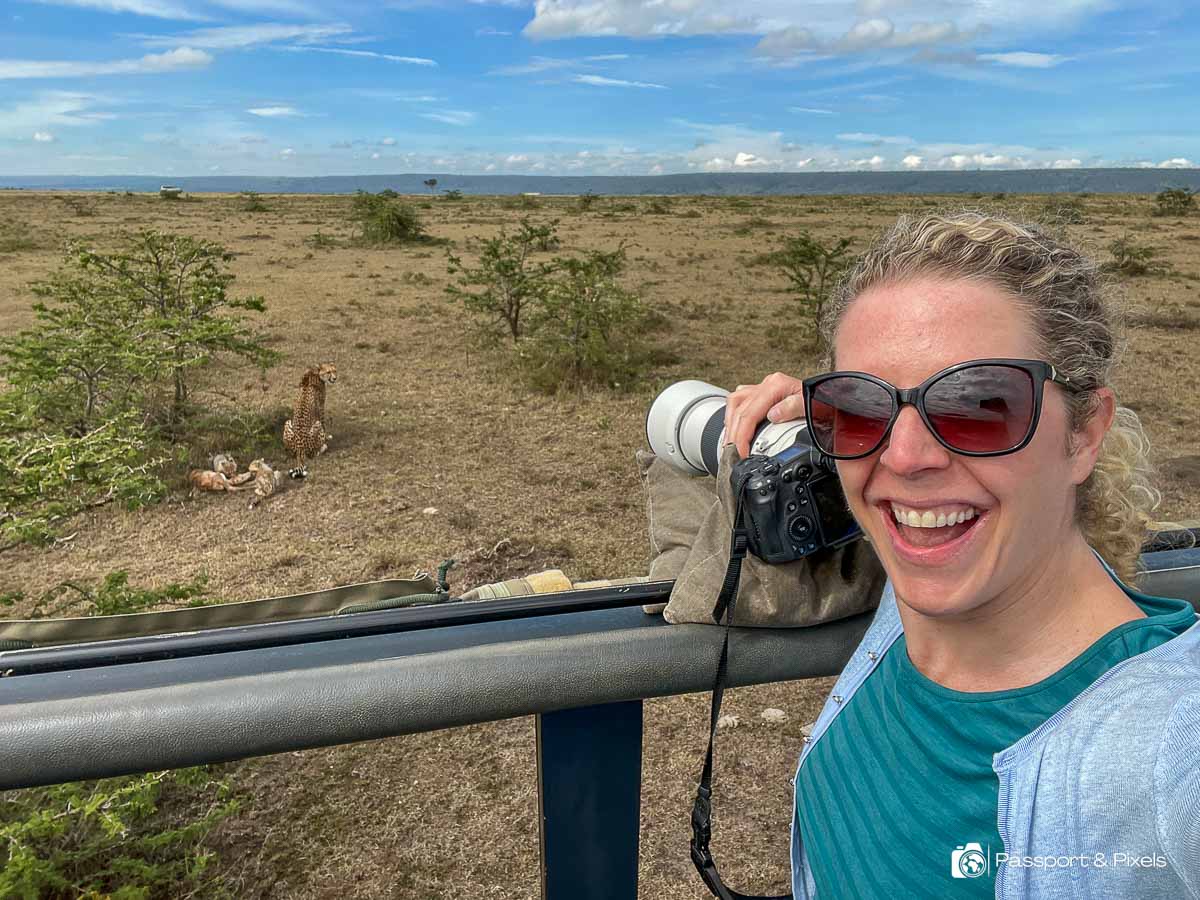
The challenges of wildlife photography
Photographing wildlife can be challenging, whether you’re on a game drive in Kenya or spying on seals in the Falkland Islands.
Animals are unpredictable. The light and weather change constantly. You might be shooting from a bumpy vehicle, a moving boat, or in the middle of the jungle.
In hot, dry places like a Botswana safari in dry season, the dust is relentless. In cold places, batteries drain fast and fingers freeze.
You may only get one shot, so your gear needs to work fast and flawlessly.
You’ll also need to manage power and memory carefully, especially in remote locations with no electricity or bad WiFi.
And then there’s packing: balancing weight and size with functionality, particularly on bush flights or expedition ships.
But it can be done!
Here are my tips for how to choose the best camera for wildlife photography, as well as what lenses and accessories to pack for your next amazing wildlife adventure!

Best wildlife photography camera body
While bridge and compact cameras are OK (and much more affordable), to really take the best wildlife shots you’ll need a separate DSLR or mirrorless camera body with interchangeable lenses.
Older DSLR models can be rugged, have longer battery life, and offer great quality. Plus many of them are extremely affordable now.
Meanwhile, the new mirrorless cameras can shoot in fast bursts and have incredible autofocus. If you can, get a newer model with animal eye detection – it’s pretty great!
My main camera is a Canon R5 Mark I, but the newer Mark II has been getting rave reviews.
Mirrorless cameras like the Canon R6 Mark II are also popular choices for their compact size and excellent autofocus. If you’re a Nikon user, the Nikon Z8 handles wildlife beautifully.

Best budget camera for wildlife photography
The ones I’ve mentioned above are all top of the range, high-end pro cameras, but the brands also do more affordable versions that have fewer features while still being good, solid cameras. For example, you can pick up a Sony A7 III for half the price of the Sony A7 IV.
The Canon EOS R10, the Sony A6400A or the Nikon Z50 II are all very decent entry-level mirrorless cameras costing less than £1000 (body only).
You can also get great second-hand deals at places like Wex Photo Video and MPB.com.
On the DSLR side, the Canon 5D Mark IV (which I used to have) or the Nikon D850 are tried-and-tested wildlife favourites. You can pick up a used Canon 5D IV for just a few hundred pounds.
Read more: Using The Canon R5 For Wildlife Photography: A Full Review

What to look for in a wildlife photography camera
When choosing a camera for wildlife photography, there are a few key features to look out for beyond just brand or megapixels.
1. Sensor size: full frame vs crop sensor (APS-C)
Full-frame sensors tend to perform better in low light, offering less noise and more dynamic range, which is great for those early morning or late evening moments.
You’ll also get creamier background blur (bokeh), which helps isolate your subject.
However, APS-C sensors give you a 1.5x (or 1.6x for Canon) crop factor, so a 400mm lens behaves more like a 600mm, giving you extra reach without needing a monster lens.
If you’re photographing small or distant things like birds, that’s a huge win. Plus, APS-C bodies are often smaller and more affordable, which makes them a good choice for travel.
2. Frame rate (FPS – frames per second)
This is how many photos your camera can take per second when you hold the shutter down.
The higher the number, the better your chances of capturing that fast action, exact wing position or perfect pounce.
For serious wildlife work, aim for at least 10 fps – though some newer mirrorless cameras can do a lightning-fast 20 fps or more with the electronic shutter.
That said, you’ll need a fast memory card to handle those bursts without slowing down.

3. Autofocus system
Autofocus (AF) is critical for wildlife, especially for moving subjects.
Look for cameras with subject tracking and animal eye detection. This tech, which you can find on newer mirrorless cameras, is a game-changer, locking onto the animal’s eye even as it moves, runs, or flies.
While it can struggle with some animals such as elephants and rhinos, it’s great at many other species and is especially good at birds.
The number and type of AF points also matters. More points (and more spread across the frame) give you better flexibility for composition.
Some systems let you switch quickly between AF modes (single point, zone, wide), which is helpful when your subject goes from sitting still to bolting into the bushes.

4. Pre-recording
Some newer cameras (like the OM System OM-1 or certain Nikon and Canon models) can actually record a few seconds of images before you fully press the shutter.
That means if a bird takes off or a whale breaches by surprise, your camera might still catch it. Though be warned – it does eat memory card space and battery life, so use sparingly.
It’s especially useful for fast-moving, unpredictable subjects, and it’s becoming more common in mirrorless bodies. I don’t have it on my Canon R5 Mark I, but it’s on the R5 Mark II and the R6 Mark II.

5. Customisable buttons & controls
In wildlife photography, speed matters, and being able to switch settings quickly can mean the difference between nailing a shot and capturing an empty frame.
Custom buttons let you assign key functions, like turning on back button focus, toggling between AF modes, or activating animal eye detection, so you don’t need to hunt in the menu in the heat of the moment.
Look for a camera that lets you customise at least a few buttons and ideally has a dedicated joystick for moving your focus point. It’s all about muscle memory when things start happening fast.

6. Image stabilisation (IBIS or In-Lens IS)
Image stabilisation is your best friend when you’re shooting handheld – which in wildlife photography is most of the time!
If you’re in a vehicle, on a zodiac, or out hiking, you’re not going to be able to have a tripod set up.
Many cameras offer in-body image stabilisation (IBIS), which works with any lens and helps reduce blur from camera shake – which can be an issue if you’re trying to hand hold a heavy lens and shoot at slower shutter speeds.
Other cameras rely on lens-based IS, which is still great, especially for longer telephoto lenses.
Having good IS means you can shoot at slower shutter speeds without blur, perfect for those dim dawn and dusk moments when you want to shoot at 500 mm but the light just isn’t enough to allow for a fast shutter speed.

Should you bring a second body?
I always take a second body when I’m photographing wildlife, and I recommend you do the same if you can afford it. I have a Canon R6 Mark II as my backup.
Having a second body means you can have one camera for your long telephoto lens, and another for a wider lens. This saves time swapping lenses and reduces the risk of getting dust or rain on your sensor.
You don’t want to be fumbling with gear when a cheetah hunt suddenly comes towards you.
And of course it means that if you accidentally drop your camera in the sea, you’ll still have a spare!

How to choose the best camera for wildlife photography
If all this is already confusing you, my best advice is to contact your local camera store.
Even the best blog in the world (like this one!) can’t give you all the options, or know your specific needs or budget.
In the UK, Wex Photo Video and Park Cameras are both great and have super helpful, UK based call centres – but there are plenty of others. Find one near you, phone them up, tell them your budget, needs and skill level, and they’ll be delighted to advise you.
If you buy online from Wex, you can quote my name – Bella Falk – to get £20 off your first purchase.

Best lenses for wildlife photography
Ok, so now you’ve chosen your body, the next question is – which is the best lens for wildlife photography? What types of lenses should you not leave home without?
Well, as usual, you have options! But here are the main things I think you should be looking for.
Telephoto lens
The most important wildlife photography lens is a good telephoto – with minimum 200 mm reach and ideally a whole lot more.
I don’t go anywhere without my Canon RF 100-500 L lens, which is brilliant for its reach and versatility. The only downside is that at the long end, 500 mm, the maximum aperture is f/7.1, which can be limiting in low light.
The Canon 70-200 f/2.8 is beautiful and has the advantage of that wide 2.8 aperture which is a godsend at the end of the day when you’re losing the light – but it lacks the reach of the 100-500, so it’s a bit of a tradeoff.
For non-Canon users, the Sony 200-600mm f/5.6-6.3, or Tamron 150-500mm f/5-6.7 are great options.
Lenses like these allow you get lovely closeups and beautiful blurry backgrounds.

Mid-range lens
A second lens, such as a 24-70mm or 24-105mm, is vital both for wider shots, showing the animals in their environment, and also for when the animals get really close – which does happen!
You don’t want to be stuck on 500 mm when a herd of elephants comes right up alongside your safari jeep.
For this I take my Canon RF 24-70, but the Sony 24-70 f/2.8 or the Tamron 28-75 f/2.8 are great too.

Do I need a wide lens for wildlife photography?
You don’t need a wide lens for wildlife photography, but it can great to have depending on your interests.
A wide lens earns its keep when you want to capture dramatic landscapes, sweeping tundras, vast African skies or vibrant sunrises.
It’s also your best friend for night photography, for example if you want to shoot auroras in the Arctic or the Milky Way over the savanna.
So while it’s not top priority, a wide-angle lens can definitely round out your wildlife story beautifully.
Read more: A Canadian Safari Review: See Canada’s Big Five In Manitoba

What about prime lenses for wildlife photography?
Prime lenses offer superb image quality and excellent low-light capabilities.
The Canon 600mm f/4 in the photo below, that I was lucky enough to borrow on my recent Botswana photo safari, delivered me some truly stunning bird images.
However, lenses like this are extremely expensive, heavy, and far less versatile than zooms. That 600 mm lens weighs over 4 kg and will set you back more than £10,000 second hand!
And while it’s great for bird species, I’d argue that 600 mm is actually too big for safari as the animals often come much closer.
So unless money is no object and you’ve got someone to help carry your gear, I’d stick with a high-quality zoom.
Read more: What Happens On An African Photo Safari: Are They Any Good?

Best memory cards for wildlife photography
You’re going to take a lot of photos. I’ve been known to shoot over 2,000 images in a single morning on safari!
Bring multiple high-speed SD or CFexpress cards, depending on your camera.
Look for UHS-II or V90 cards for fast write speeds – that superfast burst mode will be useless if your card can’t keep up. Brands like SanDisk Extreme Pro or Lexar Professional are reliable.
And of course, don’t forget to bring the right card reader!
Read more: How to See and Photograph Puffins in the UK: 20 FAQs

Backup and storage
Download, back up and organise your images daily if you can, either to a laptop or a portable SSD like the SanDisk Extreme Portable SSD (I have the 2TB one and it’s fantastic).
I always take my laptop with me and back up to both the internal drive and a second portable hard drive that I keep separately. If your laptop and camera go missing, at least your images survive.
You don’t want to lose everything because one card failed – or because you accidentally formatted the wrong one (ask me how I know…)
Read more: Travel Photography On The Road – My Photo Editing Workflow Tips

Batteries and chargers
Power isn’t always guaranteed when you’re in the field, especially in remote camps or wilderness lodges.
Bring at least two or even three camera batteries per body, and a second charger if possible.
I take one charger per camera because there’s usually not enough time between morning and afternoon shoots to fully recharge all my batteries if you do them one at a time.
A high-capacity power bank with USB-C output is also a smart investment, especially for mirrorless cameras which eat batteries faster.
Some safari vehicles have sockets to charge on the move, but don’t count on it.
Read more: Seeing Gannets at the Incredible Bass Rock in Scotland

Plug adapters
Make sure you have the right adapter for your destination. Safari-going Brits are lucky in Kenya, Tanzania, Uganda and Botswana, which mostly use the UK’s 3-pin Type G plug. Americans will need a US to UK Type G adapter.
For other countries, make sure you check before you travel and bring an adapter. I always carry a universal adapter, just in case. In South Africa and Namibia, you’ll usually need Type M – the big 3 round pins. Botswana sometimes use this too, so it’s handy to have one.
This has saved me more than once during layovers in Johannesburg – where I’ve managed to sneak in some emergency editing in one of the airport lounges, thanks to my Priority Pass and having the right plug adapter.

Best camera bag for wildlife photography
A good camera bag is crucial. You want something that protects your gear from dust, bumps, and the odd downpour – but also gives you quick access.
Bags with configurable interiors are ideal, and make sure yours includes a rain cover. You don’t want to be caught in a storm or lashed by a surprise wave.
I use a Tamrac Anvil 23 (sadly no longer sold in the UK), and also have a Mindshift BackLight and a Shimoda Action X40. The X40 is quite big though, so you might want to look at the 30L version if you’re worried about size and weight.
For flights, especially small bush planes, find the smallest backpack that still fits your gear.

Tripod, monopod or beanbag?
Holding a heavy lens all day gets exhausting fast, so you’ll need some kind of support.
Tripods are rarely practical in safari vehicles, on zodiacs or when hiking. But I do always bring a lightweight travel tripod for sunrise shots, night skies, or the occasional self-portrait.
If you’re on a larger boat cruise – something like a Nile river safari – a tripod can be helpful for supporting the weight of your lens, but does anchor you unhelpfully in one spot, which I don’t like.
Monopods offer a nice balance of support and flexibility. If you’re brave enough you can even use yours to lower your camera out of the safari jeep window for creative low-angle shots.
For long lenses, a beanbag is king. Rest it on a car windowsill or the edge of a hide and you’re golden.
Some safari companies provide beanbags, or have padded armrests in the jeep, and some hides are fitted with gimbals or mounts – but check first. If not, bring an empty beanbag or even just a small cushion cover, and fill it with rice or beans when you arrive.

Other useful wildlife photography accessories
Here are some other bits and bobs you should throw in the bag before you head off for your safari or wildlife photography adventure.
- Microfibre cloths – you’ll constantly be wiping dust or condensation.
- Dust blower – gets rid of the fine stuff without scratching lenses.
- Lens wipes – for stubborn smudges.
- Lens hoods – cut glare and offer a bit of impact protection.
- Rain cover – even a cheap one is better than none in a sudden downpour or against sea spray.
- Strap or harness – get a comfy one, especially if carrying two bodies.
- Waist belt with holster – for walking around with your gear. This was game-changing in Antarctica.
- Spare caps – lens and rear caps are always going walkabout.
- Variable ND filter – handy for sunrise and bright daylight.
- Polarising filter – brings out skies, cuts reflections, makes colours pop.

Bush planes and weight limits
Packing for bush planes is a delicate balance between looking light and being light.
These tiny aircraft usually have strict limits – typically 15–20 kg total per person, including hold and hand luggage.
There are no overhead bins, so your backpack must fit at the back of the cabin and be something you can carry easily.
In theory you might be charged excess baggage fees if you go over. But so far (touch wood) I’ve always been fine. As long as it’s one single backpack that you can lift in and out of the plane, you’ll probably be fine.

What to bring for hide phototography
Photographing from a hide is a whole different game. You’ll need to be quiet, patient, and ready for long stretches of not much happening followed by a frantic burst of action.
Bring a tripod or monopod for stability, as movement is restricted. A beanbag can also work well on a window ledge.
Snacks, water, and extra batteries are essential, as you might be there for hours.
And if you’re staying overnight, earplugs and an eyemask might help you catch some sleep when nothing’s happening.
Read more: Wildlife Hide Photography Tips For Safari Photos Like A Pro

Arctic, Antarctica & boats
Photographing wildlife from boats, particularly in polar regions, presents new challenges.
- Cold drains batteries fast, so keep spares close to your body.
- Wear gloves you can still operate a camera with.
- Condensation can be an issue when coming in from the cold, so give your gear time to adjust.
- Stabilisation is key when shooting from a moving boat – a fast shutter speed and image-stabilised lens will help you capture great images of whales, seals and penguins.
- Dry bags or waterproof covers are a must, and a telephoto zoom like a 100-500mm is ideal.
- On zodiac landings, you’ll have to carry your own gear and you won’t be allowed to put it down, so keep it light and weatherproof.
Read more: The Best Camera Gear For Antarctic Photography

Want to see more of my photography or travel writing? Have comments or questions? Come follow me on Instagram, Threads or Bluesky and share your thoughts!
What’s in my camera bag?
If you’d like to see my full list of gear, check out my full camera kit list here.
Top tips for wildlife photography
I’ve written two super helpful wildlife photography tips posts – one general wildlife photography tips for beginners, and one more specifically about safari photography.
And if you’re heading to the polar regions, you should check out my Antarctica photography tips and South Georgia photo tips!
What to wear on your wildlife photography trip?
I’ve that covered too – check out my clothing and packing guide for safari here, and my packing list for Antarctica and the polar regions here.

Thanks for reading! I hope you enjoyed this best camera for wildlife photography post. Have fun on your next photography adventure!
Buy me a coffee
Did you enjoy this website or find it useful? If you did and fancy showing your appreciation, that would be amazing!
A small token of support helps keep Passport & Pixels going, so I can carry on creating free content for travellers like you. Also, it makes my day! Thank you!
My favourite travel tools and brands
To help you organise your trip, here’s a short list of some of the brands and tools I use over and over again when I’m planning my travels. You can see more on my Travel Resources page.
- Booking.com: A huge range of hotels to choose from, often with free cancellation. If you book hotels regularly you can earn discounts. I’m on Genius Level 3 which gets me 20% off!
- Expedia: Another great place to find hotels and Expedia also sell flights, car hire, and loads more all in one place.
- Skyscanner: The only place I ever go to search for flights and compare prices.
- Flight Centre: Booking a more complicated route? Let Flight Centre organise it for you (and deal with the drama when something goes wrong).
- Priority Pass: I love having access to 1600+ airport lounges when I fly, allowing me to enjoy my time at the airport. Buy through my link and you get up to 20% off!
- Airalo: Say goodbye to ridiculous mobile roaming charges. Did you know you can now buy ane-SIM, install it in your phone before you leave home, and then use data abroad at local prices? Game changer. Get US$3 credit with code BELLA5735.
- TourRadar: If you prefer group travel and organised tours, TourRadar has a huge range of fantastic tours from respected operators. They’re very helpful and have 4.5 stars on TrustPilot.
- Viator: Part of the TripAdvisor brand, Viator is another great place to search for group adventures and day trips.
- GetYourGuide: A great place to find local tours and day trips in your destination.
- Wex Photo Video: The UK’s best camera gear store.
- Ellis Brigham: Looking for good quality backpacks, travel clothes and other gear? Ellis Brigham is where I buy almost all of mine.
- Rentalcars.com: Part of the Booking.com family and the world’s largest online car rental service, with 24/7 customer service.
- World Nomads Travel Insurance: I never ever travel without travel insurance and nor should you!
Where to next?
If you enjoyed this wildlife photography cameras post, why not try some of these?
- 25 Brilliant Tips For Travel Photography
- 30 Top Travel Photography Blogs for 2025
- Stunning Photography on the Streets of Cuba
- A Falkland Islands Cruise: A Magical Wildlife Adventure
- Ethical Travel Photography: How To Capture With A Conscience
- An Epic Uganda Itinerary In 2 Weeks
- Murchison Falls National Park Uganda: A Complete Photo Guide
- Botswana Rainy Season: Here’s Why It’s A Great Time To Visit
- Is Cardamom House In Vipingo The Best Beach Hotel In Kenya?
Liked this post?
Social shares help support my hard work! You can share via the buttons at the bottom, or pin this handy Pinterest Pin. Thank you!

