


This is a sponsored post supported by Desert & Delta Safaris, who hosted me for three nights at Leroo La Tau Lodge in Botswana. I have not been told what to write; all opinions are my own and honestly held. I do not accept freebies or payment in exchange for positive reviews. This post was written by my own fair hand, so any errors are mine alone.
As any writer or blogger does, when I travel, I make notes. If I have time, I record detailed thoughts with a pen in my trusty hard-backed notebook, but more often than not I’m in a bit of a rush and have my hands full of camera gear, so I just jot down a few words in the notes app on my phone, to remind me later.
I could start this review of Leroo La Tau safari lodge in Botswana with a lyrical description inspired by those words, but frankly I think there’s no better way to begin than to simply give you the raw notes themselves, recorded in my phone about an hour after I’d arrived:
“Sitting on my veranda while elephants, zebras and 7 giraffes stroll by. Barking of zebras. Utterly magical. I may just be tired after the early start but I feel so emotional to be here. Hide is sensational. Want to stay longer.”

I’ve been very fortunate that I’ve been to many incredible places – from Antarctica and South Georgia to Guatemala, Sri Lanka and Uganda – and seen more extraordinary things than I can remember.
But as you can tell from those notes, my time in Botswana, and especially at Leroo La Tau, was up there with the best of them.
Why? Well grab a cuppa, get comfy, and I’ll tell you.

Introducing Leroo La Tau Lodge
Leroo La Tau is a 4* safari lodge run by Desert & Delta Safaris, one of Botswana’s leading safari companies.
The lodge – whose name means ‘footprint of the lion’ or ‘lion’s paw’ in Setswana – is situated on the bank of the Boteti River, just on the edge of the Makgadikgadi Pans National Park in the northeast-of-centre part of the country, about a two-hour drive from Maun.
Here the landscape is different from what you might have seen in Chobe or the Okavango Delta – the Makgadikgadi Pans (pronounced Ma-caddy-caddy) lead into the Kalahari Desert, so the area is much flatter, less green and more desert-like, with pale sandy terrain covered with medium sized shrubs and smaller trees.
The animals are different too: there are fewer wetland birds and animals like waterbuck or kingfishers, and instead you’ll see more wildlife that likes dry environments, like oryx and springbok.
Since Leroo La Tau is located away from the main hotspots of the Okavango Delta and Chobe National Park, it’s not as well-trodden by tourists, meaning that when you go on a game drive, you won’t see many other cars.

Introducing Desert & Delta Safaris
Desert & Delta Safaris have nine luxury properties in some of Botswana’s top locations, including two in the beautiful Moremi Game Reserve, two in Chobe National Park, and three in the heart of the world-famous Okavango Delta.
I spent 10 nights with Desert & Delta, and as well as spending three nights at Leroo La Tau, I also stayed at Camp Moremi, Xugana Island Lodge and Chobe Game Lodge. I also visited two more properties: Camp Okavango and Camp Xakanaxa, so I got a good sense of the company and what they do.
As well as offering incredible wildlife viewing opportunities across Botswana’s diverse landscapes, Desert & Delta are also a lovely bunch of brilliant, kind and welcoming people who are committed to sustainable and responsible tourism, supporting their staff and the local communities, and preserving Botswana’s ecosystems for future generations.
If you’re looking for a brilliant Botswana safari experience that’s luxurious without being quite as bank-breaking as some of the other options out there, Desert & Delta are The One.
And no, they didn’t pay me to say that!

Seeing wildlife at Leroo La Tau
Leroo La Tau occupies a dramatic spot on the western bank of the Boteti River, about 10 metres above the riverbed. On the opposite side of the river is Makgadikgadi Pans National Park – the river forms the boundary between the park on one side, and community land and the lodge’s private land on the other.
When I visited, the river was completely dry, and has been for several years. This isn’t part of an annual wet/dry cycle – the Boteti, which is the main outflow of the Okavango Delta, flowed in the 1980s but dried up in the 1990s, before filling again in 2009 after record rainfall in the Delta, and then drying up yet again in 2018.

Today it’s still dry, and no one knows when the flow will return. In the meantime, some small patches of water remain, and members of the community and the team from Leroo La Tau keep these small waterholes filled with water pumped from deep boreholes, so that the animals stick around and have something to drink.
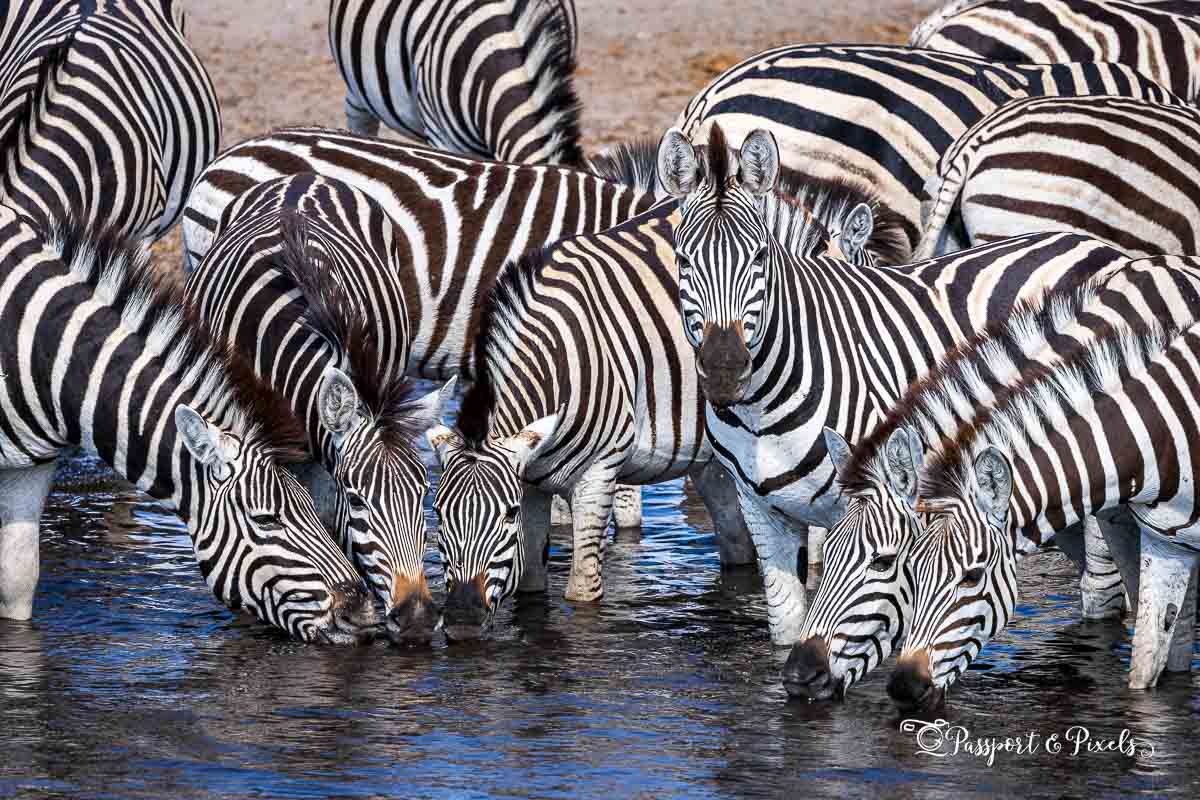
This means that, during the dry season, all the animals have to come to these few drinking spots to get water. Incredible wildlife viewing is guaranteed, with zebras, elephants, giraffes, wildebeest, hippos, crocodiles and much, much more, all jostling for position at the waterhole directly in front of the lodge. The noise of braying zebras and purring elephants can be quite overwhelming!

Another waterhole, which is home to about 30-50 hippos, is on the edge of the property just a short drive away. This means you can experience incredible wildlife viewing without leaving the lodge’s private land, and you can even watch animals wandering along the dry riverbed from the comfort of your room.
It really is sensational; no wonder I felt emotional the first time I saw it!
Read more: 32 Amazing African Safari Animals – A Photo Guide

Leroo La Tau’s incredible star attraction: the hide
But wait, there’s more! Leroo La Tau has a sensational ace up its sleeve. A feature that I wasn’t told about and didn’t discover until I arrived, at which point I was so overwhelmed I almost burst into tears. Not even joking.
If you walk out of the back of the lodge, past the pool, and head towards the river, you’ll discover the entrance to a tunnel. Inside, steps take you down to a covered viewing platform and photography hide built into the riverbank, right in front of the main waterhole.
There are seats so you can sit and photograph the wildlife for an entire afternoon if you like (of course that’s what I did), and a wide flat surface so you can rest your camera (or your drink!).
Read more: Birds In Botswana: 40 Stunning Species To See On Safari

On a hot, sunny afternoon when the waterhole is busy you can sit here for hours, watching the action as hundreds of zebras mill about, barking their high-pitched calls and scattering as a determined elephant barges in; meanwhile the occasional hippo wallows in the water and elegant giraffes amble past.
It was one of the most incredible wildlife spectacles I’ve ever seen – I loved it so much that I even skipped an afternoon game drive (the first time I’ve ever done that!) so I could stay put and watch the drama unfold.
Read more: Wildlife Hide Photography Tips For Safari Photos Like A Pro

Seeing the zebra migration at Leroo La Tau
As you can see from the photos, by far the most abundant animal I saw was zebras – thousands of them!
This is because Leroo La Tau sits on the route of the little-known zebra migration, Africa’s ‘secret migration’.
The Great Migration in Kenya and Tanzania is world famous, but scientists only discovered a few years ago that, in Botswana, about 30,000 plains zebras also make their own annual migration from the area around Makgadikgadi Pans National Park to the Chobe River and Okavango Delta and back again.

For some, it’s an annual round trip of over 600 miles (1,000 km) making it African’s longest mammal migration.
And they pass right by Leroo La Tau!
During the dry season the zebras stay close to the Boteti River, meaning you can easily see them around the lodge. But when the rains come, with more water sources everywhere, the zebras are free to travel further afield, and they all leave to travel back to the Okavango Delta and Chobe National Park.
When I visited in early December, there were still a lot of zebras about – though I was told many of them had already left and there weren’t as many as there had been the previous week. For two days there still seemed to be plenty about, but at the end of my second day it rained heavily, and on the third morning they had all vanished to begin their migration back to the Delta.
Read more: 40 Safari Photography Tips For Stunning Wildlife Photos

Drama at the waterhole
The day before they all left we witnessed some zebra drama – when one of my fellow guests spotted a tiny baby zebra that had become desperately stuck in the mud at the edge of the waterhole.
It had been there a while, and the mother had run away. The baby was stuck fast and in imminent danger of drowning, dying from exhaustion, or being eaten by a crocodile. Its chances of survival were non-existent unless the team from the lodge went down to help.
Normally they wouldn’t interfere in the natural circle of life, but since the waterhole is man-made, the mud wouldn’t be there if they hadn’t provided the water. Since it was a man-made problem, they decided to intervene.
You can watch my reel to see what happened.
Read more: 19 Easy Wildlife Photography Tips For Beginners

The rooms at Leroo La Tau
But despite all the action in the hide, at some point you’re going to want to go back to your room to relax or sleep – and Leroo La Tau’s got you covered there too.
The lodge has twelve thatched and glass-fronted rooms with beautiful en-suite bathrooms, each one raised on a wooden platform overlooking the Boteti River valley. Every room has an east-facing river view and a shaded veranda with comfy outdoor seating where you can watch the animals wander past on their way to the waterhole, or see the sunrise over the valley as you get ready for your morning game drive.

Each cabin has sliding glass doors which you can close when it’s chilly, and separate bug screens so you can keep unwanted visitors out while the windows are open. Some moths and beetles do seem to manage to find their way in anyway, but you have a lovely romantic mosquito net to keep them away from you while you sleep.
Most of the rooms sleep two people and can be made up as a double or a twin; there’s also a family room which sleeps four.
All the rooms are beautifully decorated in calming soft colours of light teal and sand, with soft cushions, understanted elegance, and tasteful African details.
Between rooms seven and eight is where the pipe is to supply the waterhole, and the elephants like to come here to drink directly from the source where the water is freshest and hasn’t been muddied by hundreds of zebras. So if you’re in one of those rooms, you’ll have elephants right underneath you!
Read more: Using The Canon R5 For Wildlife Photography: A Full Review

Amenities at Leroo La Tau
Air Con: There is no heating or air con in the rooms, only a ceiling fan. During the summer it can get almost unbearably hot (it reached 40 degrees when I was there), but it cools once the sun’s gone down. On the flipside, winter can be very cold at night, sometimes dropping close to freezing, but the kind staff will supply blankets, hot water bottles, and a campfire to keep you warm.
Electricity: Many of Desert & Delta’s lodges are solar-powered, but Leroo La Tau runs off a generator (though the wheels are in motion to convert the lodge to solar next year). The generator runs all day but is switched off at night between about 11.30 pm and 4.30 am. This does mean you need to make sure your devices are charged, and the fan will go off in the night too.
If you do need power in the night, the bedside lamps and bathroom lights are battery-powered, so don’t worry.

Drinking water: The water in the taps comes from a borehole, so it’s not safe to drink, and smells quite sulphurous (though it’s perfectly safe and actually good for your skin!). Water for drinking and brushing your teeth is provided in flasks from the lodge’s own reverse osmosis water treatment plant, and you’re also given a kettle with tea and coffee, and a small tin of biscuits in case you get peckish.
Bathroom treats: In the bathroom you get lovely shower gel, shampoo, hand wash and body lotion; there’s also a hairdryer and a laundry basket where you can dump your sweaty clothes in the morning and get them back the same day (weather permitting). Laundry is included in your room rate.
Wi-Fi: Like everywhere on safari in Botswana, Wi-Fi is a bit patchy. It was usually fine in the main reception area outside the office, but I couldn’t get it in my room.

Communal spaces around the lodge
It’s a short walk along a sandy path from your room back to the main reception, lounge and dining area.
Animals are free to roam around the camp which means you’ll frequently see kudu and bushbuck browsing on the trees by the side of the path during the day – but you’re not allowed to walk back to your room alone at night in case you run into something more alarming.
Elephants are kept away from the camp by a fence, but lions and buffalo have sometimes been seen. On my first night I heard lions roaring in the river valley below my balcony, so they are definitely around!

In the main building there’s a spacious dining room, a comfy soft seating area, a small shop selling lovely locally-made souvenirs, a bar with a fridge full of beers, wines, spirits and soft drinks which it’s free to help yourself from at any time, and above the bar there’s an upstairs library that’s well-stocked with books and games.
Outside there’s a deck with space for outdoor dining and views over the riverbed, a shady seating area, a small pool for cooling off on hot days, and of course that all-important feature, the hide!

The food at Leroo La Tau lodge
The day starts with an early wake-up call and breakfast, with eggs cooked to order, waffles, pancakes or Botswana ‘fat cakes’ (fried doughnut balls), as well as fruit, yoghurt and granola.
After your morning activity (which will also include a stop for tea and biscuits) you’re given lunch – usually a healthy selection of brightly coloured salads alongside meat, fish and vegetarian options, potatoes or rice, freshly-baked bread, and fruit.

Only a couple of hours later there’ll be tea and cake before you head out for your afternoon activity. This ends with sundowner cocktails and ‘bitings’ – savoury snacks – before you return to Leroo La Tau for a three-course dinner paired with South African wines.
All meals are served group style with everyone eating together, giving you a chance to get to know some of the staff and your fellow guests.
My best advice is to bring clothes with elasticated waistbands, because you will definitely be gaining weight during your stay at Leroo La Tau!
Read more: Which Is The Best Botswana Safari Lodge? My Favourites With Photos

The staff at Leroo La Tau
The food is obviously amazing, the wildlife encounters sensational, but like everything in life, experiences are made by the people we share them with. And the wonderful staff at Leroo La Tau will certainly help to make your stay memorable.
From the brilliant kitchen team who come out every evening to sing you a choral welcome to dinner, to the front of house staff – Zaza, Lesh, and Rose, to guides Conrad, T-Man, and the legendary Metal – all the staff were so warm and helpful, by the time I left they felt like friends.
No request was too big or small, and the guides are extremely knowledgeable. The only thing they can’t do is provide animals to order – while they certainly know all the secrets of tracking, if that lion or leopard you were so desperately hoping to see isn’t around, you will just have to come back another time!

Activities at Leroo La Tau Botswana
Makgadikgadi Pans National Park
The main activity at Leroo La Tau is a game drive in Makgadikgadi Pans National Park, which sits just across the river from the lodge. However even when the river is completely dry, you’re not allowed to drive directly across, meaning it’s a 25-minute drive along an unsealed track and through the village, to the park entrance where you have to sign in.
Once inside the park, there’s a huge expanse to explore. We were able to drive down into the river valley to get close to elephants, zebras and giraffes; we also saw vultures, buffalo, jackals, hippos, crocodiles and much more.
While game drives are always a thrill, one thing I would say about Leroo La Tau is that if there’s lots of activity going on at the waterhole, it really doesn’t get much better than this. I never thought I’d ever miss a game drive, but I skipped one on my first afternoon so I could sit in the hide, and would gladly have done so again if the zebras had stuck around on my last day.

Cultural Visits
Next door to Leroo La Tau is community land, on which sits the small village of Khumaga, home to about 2000 people.
Guests interested in learning more about Batswana culture can arrange a visit to the village to meet the chief and spend time with locals. The lodge also donates to the local school, which you can also visit if you ask in advance.
Read more: Chobe Safari Lodge In Botswana: A Complete Review With Photos

Boat safaris
As the Boteti River is currently dry, boat rides weren’t possible when I visited. But Leroo La Tau does have a jetty and a boat, so when the river is full, wildlife-watching river cruises are also an option.
Visiting the Great Salt Pans
Leroo La Tau sits close to Makgadikgadi Pans and Nxai Pans National Parks, which are part of the northern Kalahari and contain some of the largest and most spectacular salt pans in the world.
A salt pan or salt flat – in case you didn’t know – is a large, flat expanse of low-lying land that’s covered with salt. Some of them, like the famous salt flats at Salar de Uyuni in Bolivia, can be many thousands of square kilometres, and they’re usually all that remains of dried-up ancient seas or lake beds.
Some, like the ones at Makgadikgadi, are baked hard and lifeless during the dry season; dramatically white and featureless, they sparkle with billions of dried salt crystals. But during the rainy season they fill with water, turning into a shallow wetland that attracts huge crowds of wildlife including flamingos, pelicans, storks and more. Around them, the dry desert bursts into green life, attracting herds of herbivores and the carnivores that prey on them.
Although Leroo La Tau borders Makgadikgadi Pans National Park, the park is enormous and the salt pans themselves are a long drive away. However, it is possible to visit them on a full-day trip or, during the dry season, an overnight camping stay.
Read more: Top 34 African Birds: A Safari Photo Guide

Nxai Pan Day Trip
The closest salt pan to the lodge is the smaller Nxai Pan, pronounced ‘Nai’ to rhyme with ‘eye’, but with a tongue click between the N and the -ai. Which I don’t know how to write and absolutely couldn’t say, so I just stuck to saying ‘Nai’!
When the roads are passable (sometimes not possible in the wettest months), you can take a day trip out to see them – a journey of about four hours’ driving each way. Since it’s a long day, you’ll need to be staying at least 3 nights at Leroo La Tau in order to do it.
Near to Nxai Pan you can also visit the Baines Baobabs, a picturesque copse of huge, ancient baobab trees made famous by British landscape artist Thomas Baines, who painted them in the 1850s.

As you get further away from the Boteti River and into the more desert-like landscape of the salt pans the vegetation changes, the environment gets drier and more dusty, and you’ll start to see more desert-adapted animals.
It’s an interesting experience and fascinating to have a change of scenery and see a different part of Botswana, and we saw wildlife including oryx, springbok, ostriches, and even lions. However there wasn’t as much wildlife as we’d previously seen closer to the lodge.
If you don’t like too much bumping around on unsealed roads, and your priority is game viewing, you might be better off staying put.
But of course, no two days are the same when you’re on safari, and depending on the weather and the time of year you visit, you might get a very different experience! I’m definitely keen to go back during the wet season to see the flamingos.
Read more: 9 Tips For A Botswana Budget Safari Without Luxury Prices

Overnight sleepout and stargazing at Makgadikgadi Salt Pans
A new activity just introduced this year by Desert & Delta is the amazing Makgadikgadi Salt Pans camping experience. This is only available during the dry season when the pans are baked hard, so I didn’t get to do it – but it looks incredible!
The team fly you by scenic helicopter out to one of the largest salt pans, the huge and spectacular Ntwetwe Pan. Here, you get a dinner prepared for you over a campfire, and then you sleep under the stars where, with no light pollution, you can soak up the vastness of the heavens and the Milky Way, and the utter solitude of being in the middle of nowhere, miles from any roads or human habitation.
The next day, you can either ride back in the helicopter (at an extra cost), or travel back to the lodge by car, stopping to view wildlife en route.
Read more: What To Wear On Safari: My Detailed Safari Packing List With Photos

How to get to Leroo La Tau
To get to Botswana from the UK or USA, you’ll need to fly to an African hub such as Johannesburg or Addis Ababa, and from there take a connecting flight to either Kasane (for Chobe National Park), or Maun (for the Okavango Delta).
Maun is closer to Leroo La Tau. From here, if you’re driving, you can reach the lodge in about two hours by taking the main road to Francistown.
If you’re coming from another lodge or camp in Chobe National Park or the Okavango Delta, the easiest way is to take one of the many short-hop internal light aircraft flights that buzz visitors around the main safari locations every day.

I travelled from the Xakanaxa airstrip in Moremi Game reserve in a tiny 8-seater plane operated by Safari Air, with a flying time of about 1 hour.
You can book all your lodges and transfers independently, but by far the best way to visit Leroo La Tau is as part of a package. If you book a week, 10-day or two-week trip with any good safari travel agent, they’ll also organise all your flights and transfers making your safari holiday seamless and trouble-free, and you’ll get discounts too.
There’s more information about how to book at the end of this post.

How long should you spend at Leroo La Tau?
Most people stay two to three nights, as part of a bigger Botswana trip that will also include Chobe National Park and the Okavango Delta.
If you want to visit the salt pans you’ll definitely need to stay three nights, and frankly there was so much going on at the waterhole when I was there that I didn’t think three nights was enough; I would have liked to stay four!
Of course it always depends on how much time you have, your budget, and where else you’d like to go, but I’d recommend staying three nights if you can.

Who is Leroo La Tau for?
Children under six are not allowed at Leroo La Tau, but for anyone older it’s great!
The hide is perfect for photographers, and anyone who enjoys having the animals come to them. If you’ve already done a few days on safari with several morning and afternoon game drives, the chance to relax and watch the wildlife with a drink in your hand is not to be missed.
It’s also great for anyone with mobility issues or who struggles with the bumpy roads and bouncing around in a safari car for hours at a time. Instead, you can stroll down to the hide to watch the action, and head back to relax in your room any time you like.
Families with younger children may also enjoy not having to keep them sitting still and quiet in a car all the time – instead the adults can watch the wildlife while the children wander about.
Note that access to the hide is via a staircase, so you’ll still need to be able to manage some steps, but there are plenty of staff around to give you a hand if you need it.

What are the Leroo La Tau rates?
All of Desert & Delta Safaris properties cost the same. At the time of writing this was as follows (but do check with your travel agent as prices can and do change):
- In peak season from June to October, for a stay of 7 or more nights: $1009 per person, per night. That includes all meals, most drinks and activities.
- In shoulder seasons, April to May and November to December: $780 pppn.
- In low season, January to March: $561 pppn.
- During peak season, solo travellers pay a single-occupancy supplement of about 25% on tip, but there’s no supplement during shoulder and low seasons.
- Flights between camps range from $285 to $480 per person, depending on the distance.
- Desert & Delta also do great packages. For example, if you book a 10-night trip visiting four lodges, you get 10 nights for the price of 9, all internal flight transfers, and they even throw in a doors-off scenic helicopter ride. The all-inclusive rate in peak season for this is $10,451 per person.

When is the best time to visit Leroo La Tau?
There isn’t a simple answer to this as it depends on your budget and what you want to see. Or to put it another way, there’s no bad time to visit!
Peak season, from June to October, has warm days but chilly nights. As it’s the dry season there are plenty of animals at the waterhole, but it’s also more crowded and more expensive. This is the time to come if you want to do the Makgadikgadi Salt Pans camping experience.
There are fewer crowds and more availability in October, but the weather can be extremely hot.

Shoulder season in November and December is a good time to come as prices drop, but it’s still very hot, and at some point the rains will start and the zebras and wildebeest will start to leave.
During the low season from January to March prices are half what they are in peak season and it’s much less busy, but there are fewer animals around.
However, when I put this question to James Wilson, Desert & Delta’s marketing director, he told me that January to March is actually his favourite time of year because the rains clear the air, you get dramatic skies, it’s not dusty, and the landscape is full of new growth and colour.
I visited in early December, just before the rains fully arrived (they were a little late this year). Watch this reel to get a sense of what it was like when I arrived. But two days later it started raining in earnest, and overnight many of the zebras left.
How to book a stay at Leroo La Tau
The best way to book is directly through Desert & Delta Safaris. If you book a 10-night trip with them, visiting several of their gorgeous lodges, you get a great package discount.
You see more reviews and link to other deals on Tripadvisor here.
Alternatively, if you want to mix and match lodges from different operators, head to the excellent Safari Bookings comparison website to compare loads of options for your Botswana safari.
Tour operators that can book you into Leroo La Tau include:
- Wayfairer Travel
- Africa Collection UK
- Africa & Beyond
- Rainbow Tours
- Okavango Delta Explorations
- Premier Tours
Where to next?
Thanks for reading! This is the first of many Botswana and Kenya safari posts on the way, so if you liked it, make sure you subscribe to emails to get alerts when the new ones go live. And you can also follow me on Instagram to see more daily photos.
In the meantime, why not check out some of my other wildlife posts?
- 28 Brilliant Things To Do In Uganda
- How to See and Photograph Puffins in the UK: 20 FAQs
- Seeing Gannets at the Incredible Bass Rock in Scotland
- Gorilla Trekking In Uganda – The Real Inside Story
- Nature Vacations: 25 Amazing Places For An Outdoors Adventure
Buy me a coffee
Did you enjoy this website or find it useful? If you did and fancy showing your appreciation, that would be amazing!
A small token of support helps keep Passport & Pixels going, so I can carry on creating free content for travellers like you. Also, it makes my day! Thank you!
My favourite travel tools and brands
To help you organise your trip, here’s a short list of some of the brands and tools I use over and over again when I’m planning my travels. You can see more on my Travel Resources page.
- Booking.com: A huge range of hotels to choose from, often with free cancellation. If you book hotels regularly you can earn discounts. I’m on Genius Level 3 which gets me 20% off!
- Expedia: Another great place to find hotels and Expedia also sell flights, car hire, and loads more all in one place.
- Skyscanner: The only place I ever go to search for flights and compare prices.
- Flight Centre: Booking a more complicated route? Let Flight Centre organise it for you (and deal with the drama when something goes wrong).
- Priority Pass: I love having access to 1600+ airport lounges when I fly, allowing me to enjoy my time at the airport. Buy through my link and you get up to 20% off!
- Airalo: Say goodbye to ridiculous mobile roaming charges. Did you know you can now buy ane-SIM, install it in your phone before you leave home, and then use data abroad at local prices? Game changer. Get US$3 credit with code BELLA5735.
- TourRadar: If you prefer group travel and organised tours, TourRadar has a huge range of fantastic tours from respected operators. They’re very helpful and have 4.5 stars on TrustPilot.
- Viator: Part of the TripAdvisor brand, Viator is another great place to search for group adventures and day trips.
- GetYourGuide: A great place to find local tours and day trips in your destination.
- Wex Photo Video: The UK’s best camera gear store.
- Ellis Brigham: Looking for good quality backpacks, travel clothes and other gear? Ellis Brigham is where I buy almost all of mine.
- Rentalcars.com: Part of the Booking.com family and the world’s largest online car rental service, with 24/7 customer service.
- World Nomads Travel Insurance: I never ever travel without travel insurance and nor should you!
Liked this post?
Social shares help support my hard work! You can share via the buttons at the bottom, or pin this handy Pinterest Pin. Thank you!

