


I wouldn’t call myself a birder or birdwatcher. I don’t count species, and I don’t have a subscription to one of those apps that can play or recognise calls.
But when I went to Botswana, I became obsessed with the bird life – because it’s impossible not to!
Even if you’re not a birdwatcher, Botswana is a birding paradise, boasting over 600 recorded bird species.
Its diverse habitats, from the waterways of the Okavango Delta to the dry bushlands of the Kalahari Desert, provide a home to an incredible variety of birds, including rare and migratory species.
Whether you’re exploring wetlands teeming with waterbirds, woodlands echoing with the calls of songbirds, or open savannas where raptors soar, Botswana offers some of the best birding opportunities in Africa, and I defy you not to fall in love, even if you didn’t think you were a birder before.
In this guide I’ll introduce you to some of the most common or colourful bird species to look out for on safari, as well as a few personal favourites.

About this birds of Botswana post
I’ve been to Botswana twice, spending a total of six weeks in the country. During that time I’ve visited the Okavango Delta, Kalahari Desert, Chobe National Park and Makgadikgadi National Park, where I was led by experienced wildlife experts and safari guides.
Since then I’ve written about Botswana for Travel Africa Magazine, Luxury Travel Australia, Selling Travel, BBC Wildlife Magazine, Low Season Traveller, I contributed to the new Lonely Planet Joy of Birdwatching book, and of course I’ve written many posts on here!
Every bird photo in this post was taken by me during those two trips (but most of them were taken during my two trips in 2025).
As you can see, even for a non-birder like me, it was a fabulous experience. If you’re a serious birdwatching fan going on safari for the first time, you are going to have a blast!

Need help booking your dream safari?
If you’re ready to plan your dream African adventure but don’t know where to start, I can help.
I’ve travelled extensively throughout Africa and have a great network of personally-vetted and trusted safari operators.
Now I use those connections to help you plan your perfect trip.
Fill in my safari enquiry form and I’ll:
- Answer your questions personally
- Help you decide which options are right for you
- Match you with up to three trusted partners with decades of experience
- They will provide you with expert advice and FREE personalised, no-obligation quotes.
Simply fill out my safari enquiry form here to get the ball rolling.
Save time, avoid stress AND get a great deal by having an expert do the work for you!
Top 40 Botswana birds to see
So, without further preamble, let’s get stuck in. Here, in no particular order, are my 40 favourite Botswana birds, with interesting facts, and photos all shot by me.
You can click or tap the photos to enlarge them.
1/ African fish eagle
The African fish eagle is one of Botswana’s most iconic birds, with its striking chestnut body, white head, and piercing yellow eyes.
Often seen perched in tall trees near rivers and lakes, it lets out a distinctive screech that is often heard across Africa’s waterways.
As the name suggests, it primarily feeds on fish, snatching them from the water with powerful talons. Despite this, it is also known to steal catches from other birds like herons and ospreys.
Watching one dive with precision into the water is a spectacular sight on any Botswana safari.


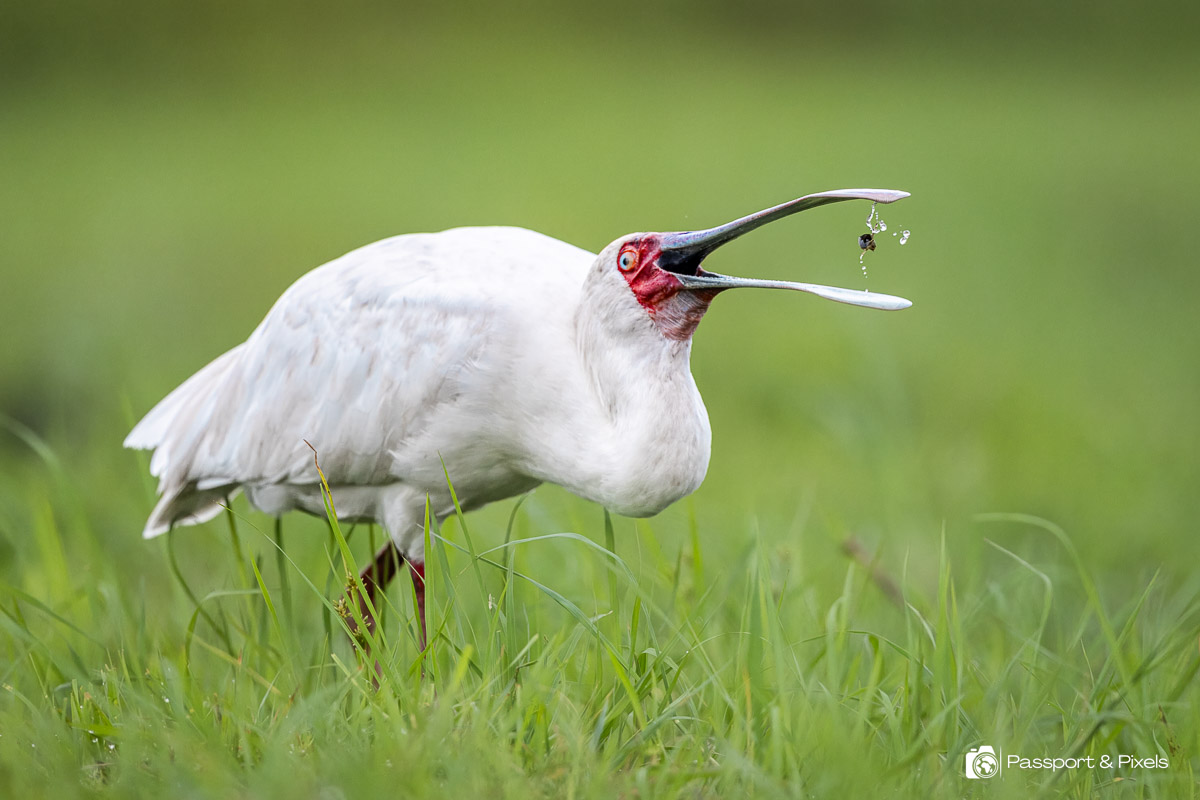
2/ African spoonbill
Easily recognisable by its distinctive spoon-shaped bill, the African spoonbill is a wading bird that sweeps its bill side to side in shallow waters to catch fish, crustaceans, and insects.
With its white body, long red legs, bare red face and pale blue eyes, it stands out in front of the green grasses of Botswana’s wetlands, and is great fun to photograph as it dips and dabbles.
These birds are often seen in groups, especially in the Okavango Delta and Chobe National Park, where they frequent floodplains and lagoons.

3/ Reed cormorant
This small, dark waterbird is commonly found in Botswana’s rivers and wetlands, and can often be seen perching with its wings spread wide to dry.
Unlike ducks, cormorants lack waterproof feathers, which helps them dive efficiently in search of fish.
The reed cormorant has a slender body, a long, slightly hooked bill, and fierce red eyes that give it a striking look. It often nests in colonies alongside herons and egrets, making it a frequent sight near water.

4/ African darter
Often called the ‘snakebird’ because of its long, sinuous neck, the African darter is an expert diver, spearing fish with its sharp beak before surfacing.
It has a dark brown body with a reddish neck and distinctive white streaks.
Unlike other waterbirds, it swims with only its head and neck visible above the surface.
It is commonly seen in the Okavango Delta and along the Chobe River, where it perches on branches drying its wings.


5/ Red-billed spurfowl
Also known as the red-billed francolin, this is a common ground-dwelling bird in Botswana, with a streaked brown body, a red beak, vivid yellow eyes and bright red legs.
It is often seen in pairs or small groups, foraging for seeds and insects along dirt roads and in open woodlands, or perched on a vantage point like a termite mound or log.
When startled, it bursts into the air with a loud, rapid wingbeat. The similar crested francolin and Swainson’s spurfowl are also commonly found in Botswana.
Read more: 9 Tips For A Botswana Budget Safari Without Luxury Prices

6/ Blue-cheeked bee-eater
A dazzling bird with bright green plumage, a blue face, and a black eye stripe, the blue-cheeked bee-eater is a striking sight.
As the name suggests, bee-eaters eat bees, but also other insects including flies and moths.
Unlike some bee-eaters, the blue-cheeked bee eater prefers open landscapes and savannas, often perching on low branches. It’s a migratory bird, arriving in Botswana during the wet season when insect activity is at its peak.
I took this image using a high-key technique to create this clean, minimalist look. If you’d like to know more about my safari photography, check out 41 Safari Photography Tips For Stunning Wildlife Photos.

7/ Carmine bee-eater
With its vivid pinkish-red body, turquoise head, and long tail streamers, the carmine bee-eater is one of Africa’s most beautiful birds.
It forms large colonies along riverbanks, nesting in tunnels dug into the sandy soil.
These birds are highly social and can often be seen perched in groups or swooping gracefully to catch flying insects. They can be fun but also challenging to photograph as they fly quickly from their perch, catch their prey in mid-air, and then return to the same perch to eat it.


8/ Little bee-eater
The smallest of Botswana’s bee-eaters, this delicate bird has green and yellow plumage with a distinctive black eye stripe and blue patch over its eyebrow.
It often perches on low branches, watching for flying insects before darting out to snatch them.
Unlike the carmine bee-eater, it does not nest in large colonies but instead forms small family groups. It is widespread across Botswana’s woodlands and savannas and is one of the more common bee-eaters you’ll see.

9/ Lilac-breasted roller
A favourite among African birders, the lilac-breasted roller is an explosion of colour, with a bright lilac breast, turquoise wings, and a greenish-blue back.
It is often seen perched on open branches, scanning for insects, small reptiles, and even scorpions.
During courtship, it performs spectacular aerial displays, tumbling through the air while calling loudly – which is how it gets its name, ‘roller’.
Rollers are quite challenging to photograph because they often perch for ages, surveying their territory. You can get very tired holding up your camera, waiting for it to fly – which of course it always does just after you’ve given up and put your camera down!


10/ African jacana
Known as the ‘Jesus bird’ for its ability to walk on water – or rather, floating vegetation – the African jacana has striking chestnut plumage, long legs, and exceptionally long toes.
These adaptations allow it to spread its weight as it steps delicately across lily pads, making it look as though it’s running across the water.
Males take on the unusual role of incubating eggs and raising the chicks, carrying them under their wings for protection.


11/ Malachite kingfisher
This tiny but vibrant kingfisher is a striking sight along Botswana’s rivers. With its iridescent blue back, orange chest, and bright red bill, the malachite kingfisher is charismatic and unmistakable.
It perches low by the water, watching for small fish and aquatic insects before darting down in a rapid dive. Despite its small size, it is an efficient hunter.
Unlike some other kingfishers, it does not hover but relies on sharp eyesight and quick reflexes to catch its prey.
Read more: Top 50 African Birds: A Safari Photo Guide

12/ Pied kingfisher
Easily identified by its black-and-white plumage and unique ability to hover in place before diving for fish, the pied kingfisher is one of Botswana’s most distinctive waterbirds.
It is often seen in pairs or small groups along rivers and lakes, where it perches on overhanging branches or reeds.
Unlike many kingfishers, it does not rely solely on perches to hunt but instead scans the water while flying. It is one of the few bird species that can swallow prey mid-air after catching it.


13/ Woodland kingfisher
With its dazzling electric blue wings and bright red beak, the woodland kingfisher is more often heard before it is seen. Its loud, trilling call is a signature sound of Botswana’s woodlands.
Despite having the word ‘fish’ in its name, it primarily feeds on insects. That makes it more adaptable to different environments, and is why you’ll often see in wooded areas away from bodies of water.
It often perches in open areas, waiting to swoop down on grasshoppers, beetles, and even small reptiles.

14/ Grey heron
A large, elegant bird with grey plumage, a long neck, and a sharp yellow bill, the grey heron is a common sight along Botswana’s waterways.
It is a patient hunter, standing motionless in shallow water before striking quickly at fish, frogs, or even small mammals.
Though primarily solitary, it nests in large colonies known as heronries, often alongside other waterbirds such as egrets and storks. When in flight, its long legs trail behind while its neck is pulled into an S-shape.

15/ Great egret
Elegant and graceful, the great egret is a tall, long-necked bird with pure white plumage and a sharp yellow bill.
It wades through shallow waters, using slow, deliberate movements to catch fish and amphibians. You’ll often also seen them following hippos and buffalo as they graze, feeding on the insects that are disturbed by the animals.
During breeding season, it develops long, delicate plumes on its back, once highly sought after in the feather trade. Don’t confuse the great egret, with its bright yellow bill and black legs, with the little egret and cattle egret, both of which share similar white plumage but are smaller in size.

16/ Slaty egret
A rare and beautiful bird, the slaty egret is an elegant wader with dark grey plumage, a chestnut throat, and bright yellow legs.
It is often mistaken for the more common black heron but can be distinguished by its lighter grey colour and more slender frame.
Found mainly in the Okavango Delta, this egret favours shallow floodplains and seasonal wetlands, where it hunts fish and amphibians. Unlike many other egrets, it is highly dependent on the availability of seasonal water, making it vulnerable to habitat changes.

17/ Black-crowned night heron
A stocky, medium-sized heron with a hunched posture, the night heron is most active at dusk and during the night. Its striking features include red eyes, a black crown, and grey wings.
Unlike other herons, which hunt in open water during the day, night herons prefer to wait patiently in the shadows before striking at fish, frogs, and insects.
In Botswana, the black-crowned night heron is the most common type of night heron, often found roosting in dense vegetation near water. You may also see the white-backed night heron, which has a white streak on its back and a pinky-brown throat and chest.

18/ Swamphen
The swamphen is much more attractive than its name suggests.
It’s a striking wetland bird, known for its deep blue and purple plumage, red legs, and bright red facial shield. It moves gracefully through reeds and marshes, using its long toes to grip vegetation.
Swamphens are omnivorous, feeding on aquatic plants, small invertebrates, and even bird eggs. Unlike most waterbirds, they are strong climbers and can often be seen perched on reeds.
They are also known for their loud calls that echo through the wetlands.

19/ Red-billed hornbill
With its long, curved red bill and black-and-white plumage, the red-billed hornbill is a familiar bird in Botswana’s dry woodlands and savannas. You might recognise it from the Lion King – the character of Zazu, Mufasa’s advisor, is a red-billed hornbill.
These birds are often seen hopping along the ground in search of insects, fruit, and small reptiles. These birds are highly social and can frequently be observed in pairs or small family groups.
A fascinating behaviour of this species is its unique nesting habit: females seal themselves inside a tree cavity with mud, leaving only a small slit through which the male feeds them until the chicks are ready to fledge.
Read more: 46 Amazing African Safari Animals – A Photo Guide

20/ Yellow-billed stork
A tall, elegant wading bird, the yellow-billed stork is easily recognisable by its white body, pinkish legs, and long, slightly curved yellow bill. It feeds by sweeping its bill through shallow water, snapping up fish, frogs, and crustaceans.
These storks often gather in large groups, particularly in the Okavango Delta, where they are frequently seen alongside egrets, herons, and spoonbills. They nest in colonies, often high in trees near water.
Read more: Wildlife Hide Photography Tips For Safari Photos Like A Pro

21/ Spur-winged goose
The largest waterfowl in Africa, the spur-winged goose is a distinctive bird with a dark body, white patches on its wings, and a red beak and face.
It gets its name from the sharp spurs on its wings, which it uses in territorial fights with other geese.
Unlike many geese, it is partially carnivorous, feeding on insects and fish. Some populations even eat blister beetles, which are highly toxic. The toxins stay in the birds’ flesh, making them poisonous to humans (so don’t eat one!).
Read more: Botswana Rainy Season: Here’s Why It’s A Great Time To Visit

22/ African openbill
Named for the distinctive gap between the upper and lower parts of its bill, the African openbill is a specialist feeder on freshwater snails and mussels.
Its dark, iridescent plumage appears black from a distance but reveals hints of green and purple in the right light.
The bird uses its uniquely shaped bill to extract snails from their shells with remarkable efficiency. It is often seen in wetland areas, wading through shallow water in search of food.

23/ Saddle-billed stork
One of Africa’s tallest and most striking storks, the saddle billed stork is instantly recognisable by its long, bright red and black bill, which features a distinctive yellow saddle-shaped shield.
Males and females look similar, but females have bright yellow eyes, while males have dark ones. These storks are skilled hunters, feeding on fish, frogs, and even small birds.
Unlike many other stork species, they do not nest in large colonies, preferring solitary or paired life in Botswana’s wetlands and floodplains.
Read more: What To Wear On Safari: My Detailed Safari Packing List With Photos

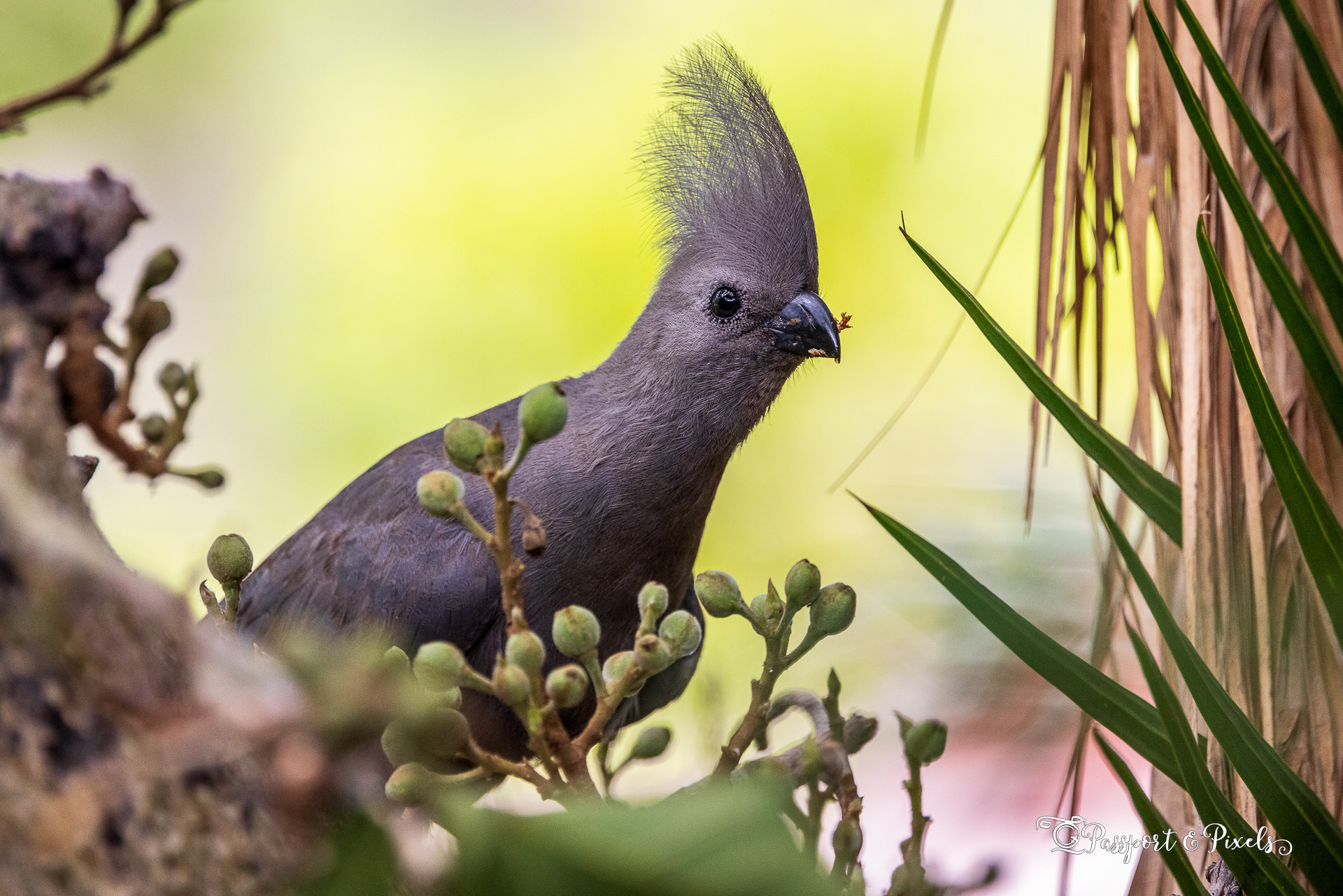
24/ Grey go-away bird
Known for its loud, nasal ‘go-away’ call, the grey go-away bird is a common resident of Botswana’s woodlands and savannas. With its soft grey plumage, long tail, and distinctive crest, it is often found in small groups, foraging for fruit and leaves.
These birds are highly alert and often act as an early warning system for other animals, calling loudly when they spot predators. Unlike many fruit-eating birds, they are also known to sip nectar from flowers.
The first photo is another high-key image, taken while I was on safari in Khwai River with Bushways Safaris. Find out more about that trip at Affordable Botswana Safaris: My Bargain Wildlife Trip Review.

Want to see more of my photography or travel writing? Have comments or questions? Come follow me on Instagram, Threads or Bluesky and share your thoughts!
25/ Wattled crane
One of Africa’s rarest and most elegant cranes, the wattled crane is easily identified by its long legs, white neck, and distinctive hanging wattles.
These birds thrive in Botswana’s wetlands, particularly in the Okavango Delta, where they feed on aquatic plants and small animals.
They are monogamous, forming lifelong pairs, and perform spectacular courtship dances involving leaps and loud calls. Due to habitat loss, they are considered a vulnerable species, making sightings particularly special.

26/ Water thickknee
A nocturnal wader with large yellow eyes, the water thickknee is well-camouflaged with its brown, streaked plumage. It’s said to be one of the few creatures whose eye is bigger than its brain.
It tends to be most active at night when it hunts insects, crustaceans, and small fish along riverbanks and floodplains. Despite being a wader, it rarely enters deep water and prefers the shallows.
During the day, it usually relies on its excellent camouflage to remain hidden, staying motionless when threatened – however I spotted this one during the day – I love how the background colours match the colours of the bird.

27/ Thick-billed weaver
A striking bird with a large, heavy bill, the thick-billed weaver is an expert nest-builder. Males are deep chestnut with a black head, while females are a more subdued brown with streaks.
Like many weaver bird species, they weave intricate, oval-shaped nests that hang over water to deter predators. When the nest is complete, the female will come and inspect it and decide if she wants to stay. If she doesn’t like the nest, she’ll reject the male and choose a different mate.
Other common weavers in Botswana include the southern masked weaver, known for its bright yellow plumage and elaborate nest-weaving displays, and the red-billed quelea, which forms some of the largest flocks of any bird species.

28/ Golden weaver
Another common weaver bird in Botswana, the golden weaver is known for its vibrant yellow plumage and impressive nest-building skills.
A dazzling bird, the golden weaver is often seen flitting among reeds and trees near water – which is where I saw this one, on the bank of the Chobe River.
Males are particularly vibrant during the breeding season – but unlike some weaver species that nest in large colonies, golden weavers often build their nests in small groups or alone.
Their loud, chattering calls can be heard as males work tirelessly to impress potential mates, ensuring their nest is both sturdy and aesthetically pleasing.

29/ Wire-tailed swallow
A small, sleek bird with a chestnut crown and long trailing tail feathers, the wire-tailed swallow is a master of aerial acrobatics.
It is often seen darting over water, catching flying insects in mid-air. These swallows prefer open areas near rivers and lakes, where they build neat, cup-shaped mud nests on cliffs, bridges, and buildings.
They are highly agile and can change direction instantly while flying. Their distinctive ‘wires’—two elongated outer tail feathers—give them a unique silhouette in flight.
I took this photo – and many of the other ones in this post, on a specialist photo safari. Find out more here: What Happens On An African Photo Safari: Are They Any Good?

30/ African barred owlet
This small, secretive owl is a master of camouflage, with brown-and-white barred plumage that blends perfectly into the bark of trees.
Unlike many owls, it is often active during the day, especially in the early morning and late afternoon. It feeds on insects, small rodents, and reptiles, using its sharp talons to catch prey.
Found in Botswana’s woodlands and riverine forests, its distinctive call is a rapid series of whistling notes.
Our guide spotted this one sitting on a low branch just outside the entrance to our lodge near Moremi Game Reserve where it posed happily for me for ages – what a delight!

31/ White-browed robin chat
A lively and melodious songbird, the white browed robin chat is known for its rich, varied calls that echo through Botswana’s riverine forests and gardens. It has a striking appearance, with a bright orange chest, a contrasting white eyebrow, and a dark grey back.
This bird is highly territorial and often responds to whistles and mimicry. It forages on the ground, feeding on insects, fruit, and small invertebrates.

32/ White-backed vulture
The white backed vulture is one of the most common vultures in Botswana, yet like many other vulture species, it is facing severe population declines due to poisoning and habitat loss.
It has a pale back, dark flight feathers, and a bald head adapted for scavenging. These vultures play a crucial role in the ecosystem by cleaning up carcasses and preventing the spread of disease.
Other vultures commonly seen in Botswana include the lappet-faced vulture, hooded vulture, and white-headed vulture.
Sadly, all of these species are under threat, making conservation efforts critical to their survival.
I photographed these guys on a visit to Makgadikgadi Pans National Park. Find out more in this post: Leroo La Tau In Botswana: See The Incredible Zebra Migration

33/ Pied wagtail
A small, energetic bird with black-and-white plumage, the pied wagtail is known for its constant tail-wagging behaviour. It is often seen around water sources, hopping along riverbanks and shorelines in search of insects.
In Botswana, it is a common sight in both natural and urban environments, frequently foraging near lodges and campsites. These birds are highly adaptable and can often be spotted in pairs or small flocks.

34/ Red-crested korhaan
A well-camouflaged ground bird, the red-crested korhaan is known for its spectacular courtship display.
Males will launch themselves high into the air before tumbling back down in a dramatic free-fall. This bird is also known as the ‘suicide bird’ due to its habit of suddenly flushing from the ground when disturbed, startling predators and safari-goers alike.
When not displaying, it blends seamlessly into dry grasslands with its mottled brown plumage.

35/ White crowned lapwing
This elegant wader is distinguished by its striking black-and-white wing pattern, yellow facial wattles, and bright yellow legs. It is commonly found along riverbanks and sandbars, where it feeds on insects and small aquatic creatures.
Unlike many other lapwings, it is not as noisy, preferring to rely on its cryptic colouring to avoid predators. It is often seen in pairs or small groups near the Chobe and Okavango rivers.
Read more: Affordable Botswana Safaris: My Bargain Wildlife Trip Review

36/ African hoopoe
A distinctive bird with a cinnamon-orange body, black-and-white wings, and a long, curved bill, the african hoopoe is best known for its striking crest, which it raises when alarmed or displaying.
It uses its bill to probe into the soil for insects and larvae, making it a valuable pest controller. Its soft, ‘hoo-hoo-hoo’ call is a familiar sound in Botswana’s woodlands and savannas.

37/ Rock pratincole
A small, agile bird often seen perched on rocks in fast-flowing rivers, the rock pratincole has a compact body, short legs, pointed wings, and a bright red beak and legs. It feeds on insects, catching them in mid-air with acrobatic flight manoeuvres.
It breeds on exposed river rocks, laying its eggs in the open, relying on camouflage and the swift-moving water to deter predators.
I photographed this one (and many of its friends) on the Chobe River.
Read more: 19 Easy Wildlife Photography Tips For Beginners

38/ Double banded sand grouse
Perfectly adapted to arid environments, the double banded sand grouse has speckled brown plumage that helps it blend into dry scrublands.
Males have two distinct black bands across their chest, while females are more subtly marked. They are most active in the early morning and evening, flying to waterholes in large flocks to drink.
Interestingly, males soak their belly feathers in water to carry moisture back to their chicks, a crucial survival strategy in dry regions.


39/ Copper sunbird
The copper sunbird is a striking little bird, with males displaying shimmering greeny-coppery-bronze plumage that glistens iridescent in the sunlight. Females are more subdued, with yellow and brown tones.
Like other sunbirds, it feeds primarily on nectar, hovering like a hummingbird as it sips from flowers. It also eats insects, especially when feeding young. It is commonly found in woodlands and savannas, flitting between flowering trees and bushes.
We spent a while watching this pair visit their nest on the Chobe River in Botswana. One of the bird-lovers in my group was very excited to see them as they can be quite hard to spot.


40/ Bateleur
One of Africa’s most spectacular raptors, the bateleur is a medium-sized eagle with striking black and chestnut plumage, a bright red face, and short tail feathers. It is often seen soaring effortlessly over the savanna, rocking from side to side as it scans for prey.
Unlike other eagles, it rarely perches for long periods. Bateleurs mainly feed on carrion but will also hunt small mammals, reptiles, and birds. Due to habitat loss and poisoning, their populations are in decline across Africa.

Where to see birds in Botswana
Botswana offers incredible birding opportunities, with the Okavango Delta being a top destination due to its vast wetlands and diverse habitats.
Chobe National Park, particularly along the Chobe River, is another great birding location, especially if you want to see large numbers of waterbirds, kingfishers, bee-eaters and raptors. It’s where I took a lot of the images in this post.
The Makgadikgadi Pans provide a different spectacle, especially when flamingos arrive in the pans during the rainy season.
Moremi Game Reserve and the Linyanti Swamps are also prime birdwatching locations, offering chances to see rare and migratory species.
So basically, pretty much anywhere is a great place to see birds in Botswana!

Need help booking your dream Botswana safari?
Parks, lodges, prices, operators… it’s easy to get overwhelmed before you’ve even started.
That’s where I come in.
Using my first-hand experience and trusted contacts in Botswana and beyond, I’ll help you cut through the confusion and find the right trip for you – at no cost.
Here’s how it works:
- You fill in my safari enquiry form.
- I review your plans and answer your questions.
- Then I pass your enquiry to up to three of my trusted, handpicked safari partners.
- They contact you directly to provide a free, no-obligation quote.
Get the ball rolling on your dream safari here!
Save time, avoid stress and confusion AND get a great deal by having an expert do the work for you!
When to go birdwatching in Botswana
The best time for birdwatching in Botswana is during the wet season from November to April. The lush landscapes and abundance of water attract a huge variety of species, and this is when migratory species arrive, and many birds are in breeding plumage.
It’s also when I visited and took all these photos – as you can see from the very green backgrounds!
But if you do visit in the dry season (May to October), don’t worry – you’ll still see plenty of resident birds, often close to shrinking water sources.
Whether you visit in the wet or dry season, Botswana promises a fantastic birding experience.
Read more: Botswana Rainy Season: Here’s Why It’s A Great Time To Visit

5 Top tips for photographing birds in Botswana
If you’ve come to this post looking for information about birding in Botswana, there’s a chance you’ll want to take photos of them too. So here are a few quick tips on how to take great photos of birds in Botswana.
1/ Take your biggest lens
Birds are often shy, so a telephoto lens (300mm or more) helps capture good shots without having to get to close and risking them flying away. A zoom lens like the Canon RF 100-500 mm offers flexibility for different distances and shot sizes. The one I’m using in the image below is a Canon 600 mm f/4 prime – borrowed, not mine, sadly!
Read more: Using The Canon R5 For Wildlife Photography: A Full Review
2/ Get up early
Birds are most active in the early morning, so getting out early gives you a better chance to capture dynamic behaviour. Early morning and late afternoon also often give you soft, golden light that enhances colours and reduces harsh shadows.
3/ Learn your camera’s autofocus
Today’s cameras have excellent autofocus – and many even have quite amazing bird eye detection AI that makes it so much easier to nail the shot. Use single-point autofocus or the camera’s eye detection and make sure it’s set up correctly and that you know how to use it.
4/ Be patient and observe
Learn bird behaviour before taking the shot. Wait for moments like take-offs, feeding, or interactions to capture more compelling images. Staying still and quiet increases your chances of a bird relaxing in your presence.
5/ Use a fast shutter speed
Birds move quickly, so set a shutter speed of at least 1/1000 to freeze motion. For birds in flight, increase to 1/2000 or more to capture crisp shots.
A higher ISO may be needed in low light, but don’t be afraid to use high ISOs – you can always use software to clean up any noise later.
For more wildlife photography tips, check out 41 Safari Photography Tips For Stunning Wildlife Photos.

Check out my Botswana birds videos on Instagram
If you’ve been inspired by this post and would like to see more, there are loads more wildlife photos and bird videos on Instagram. Here’s an example!
Buy me a coffee
Did you enjoy this website or find it useful? If you did and fancy showing your appreciation, that would be amazing!
A small token of support helps keep Passport & Pixels going, so I can carry on creating free content for travellers like you. Also, it makes my day! Thank you!
My favourite travel tools and brands
To help you organise your trip, here’s a short list of some of the brands and tools I use over and over again when I’m planning my travels. You can see more on my Travel Resources page.
- Booking.com: A huge range of hotels to choose from, often with free cancellation. If you book hotels regularly you can earn discounts. I’m on Genius Level 3 which gets me 20% off!
- Expedia: Another great place to find hotels and Expedia also sell flights, car hire, and loads more all in one place.
- Skyscanner: The only place I ever go to search for flights and compare prices.
- Flight Centre: Booking a more complicated route? Let Flight Centre organise it for you (and deal with the drama when something goes wrong).
- Priority Pass: I love having access to 1600+ airport lounges when I fly, allowing me to enjoy my time at the airport. Buy through my link and you get up to 20% off!
- Airalo: Say goodbye to ridiculous mobile roaming charges. Did you know you can now buy ane-SIM, install it in your phone before you leave home, and then use data abroad at local prices? Game changer. Get US$3 credit with code BELLA5735.
- TourRadar: If you prefer group travel and organised tours, TourRadar has a huge range of fantastic tours from respected operators. They’re very helpful and have 4.5 stars on TrustPilot.
- Viator: Part of the TripAdvisor brand, Viator is another great place to search for group adventures and day trips.
- GetYourGuide: A great place to find local tours and day trips in your destination.
- Wex Photo Video: The UK’s best camera gear store.
- Ellis Brigham: Looking for good quality backpacks, travel clothes and other gear? Ellis Brigham is where I buy almost all of mine.
- Rentalcars.com: Part of the Booking.com family and the world’s largest online car rental service, with 24/7 customer service.
- World Nomads Travel Insurance: I never ever travel without travel insurance and nor should you!
Where to next?
If you enjoyed this Botswana birdwatching post, why not try some of my other wildlife and photography posts?
- Using The Canon R5 For Wildlife Photography: A Full Review
- 60+ Awesome Antarctica Photography Tips
- The 8 Types Of Penguins In Antarctica: A Photo Guide
- The Big Five Animals: My Photo Guide And Favourite Facts
- Uganda Animals: The Amazing Wildlife of Uganda
- Chimpanzee Trekking In Uganda: A Complete Guide With Photos
- Visiting Koh Samui Elephant Sanctuary Thailand
- Gorilla Trekking In Uganda – The Real Inside Story
- Entebbe Zoo: Visiting The Uganda Wildlife Sanctuary
- A Magical Trip Whale Watching in Mirissa, Sri Lanka
- Visiting the Skomer Island Puffins in Wales
- Seeing Gannets at the Incredible Bass Rock in Scotland
Liked this post?
Social shares help support my hard work! You can share via the buttons at the bottom, or pin this handy Pinterest Pin. Thank you!

