


When you think of great wildlife photography destinations, the UK probably doesn’t top the list.
But you don’t need to fly halfway across the world and spend thousands on an Antarctic cruise or African safari to photograph wildlife. We’ve actually got some incredible animal and bird life right on our doorstep.
And one of the coolest British birds is the red kite.
If you’ve ever driven around Wales or Surrey, or along the M40 , you’ve probably seen them swooping and soaring overhead. With their forked tails, huge wingspans and acrobatic flight, they’re one of Britain’s most recognisable and beautiful birds to watch.

But photographing them is another matter. They fly high and they’re super-fast. Getting good photos of red kites is HARD!
That’s why I’m here to help.
I recently spent two days photographing red kites in Wales. Along the way I made mistakes, learned all about red kites and how to photograph them, and now I’m here to share those lessons with you.
So whether you’re an avid bird photographer or just fancy an interesting day out seeing UK wildlife, this post is for you!

About my bird photography experience
I’ve photographed birds in some incredible places: from fish eagles in Botswana to penguins in Antarctica, and bee-eaters in Kenya to puffins here in the UK.
My bird photography has been published in Travel Africa, Low Season Traveller, Selling Travel, Discover Britain and even BBC Wildlife Magazine.
So when I was offered the chance to try red kite photography under the guidance of top wildlife photographer Sean Weekly, how could I say no?!
I spent four days in mid-Wales doing a wildlife and nature workshop run by Wildlife Worldwide. As part of the trip, I spent two afternoons at the Gigrin Farm Red Kite Centre, watching the red kites being fed, and practising panning and focussing as they dived and soared.
All the red kite images you see in this post were shot by me over two afternoons in Wales.
I ended up with over 1000 photos!


Note: The trip was gifted by Wildlife Worldwide in exchange for social media content and an article on their site. I was not required to write this blog post but I’m doing it anyway because I wanted to share this amazing experience with you! I don’t accept freebies or payment in exchange for positive reviews. This post may contain affiliate links.
My five favourite facts about red kites
In wildlife photography, it’s important to understand your subject before you start photographing it. So before I get to the practicalities of where to see red kites in Wales and how to photograph them, here are few important things to know about red kites (in Latin, Milvus milvus):
1. Red kites are aerial show-offs
Red kites are masters of the sky. With a wingspan of nearly two metres and that distinctive forked tail acting like a rudder, they can twist, dive and glide with amazing speed and agility. That means you’ll need a fast shutter speed and a good panning technique to capture them.
2. Red kites are not great hunters
Despite their fierce appearance, red kites are mostly scavengers. They eat carrion, roadkill, worms, and discarded food, even leftovers from people’s picnics. That’s partly why they thrive near farms and towns, and why you can photograph them at places like Gigrin Farm.

3. They’re as light as a loaf of bread
They might look big and imposing, but adult red kites only weigh around 900 grams – less than a bag of sugar. That’s partly what makes them so fast!
4. Some red kites are white
Occasionally, a red kite is born leucistic, meaning it has pale or white feathers due to a genetic mutation. These ghostly-looking birds are extremely rare – only around 10 are thought to exist in Wales – so spotting one is a real treat. I was lucky enough to see one during my visit to Gigrin Farm.
5. They have a surprising call
For such a majestic bird, you’d think they’d have a powerful cry, but red kites make a sound that’s more like a squeaky toy. It’s a high-pitched “weeeooo” that’s surprisingly underwhelming considering their size and presence. But it makes them easy to identify if you hear them overhead, even before you see that unmistakable silhouette.

red kite conservation in the UK
Today you can easily red kites across Wales and Southern England, but there was a time when they were almost completely gone from the UK.
In the 18th and 19th centuries, red kites were seen by many farmers as vermin. They were wrongly accused of killing lambs and game birds, and were poisoned or shot, while their nests were targeted and eggs destroyed.
By the early 1900s, red kites had been wiped out across England and Scotland, with fewer than 10 breeding pairs clinging on in rural mid-Wales.

Then, in the 1990s, red kite reintroduction projects began in England and Scotland, using birds from Wales, Spain and Sweden. The success was extraordinary.
Today, there are over 10,000 red kites across the UK, with strong populations in Wales, the Chilterns, and parts of Scotland and Yorkshire. They’ve gone from national rarity to local celebrity in just a few decades, making this one of the UK’s greatest wildlife comeback stories.
However, as numbers have continued to increase, there are growing concerns that the red kites have become too successful, and that they now threaten songbirds and other small bird species. In some urban areas they’re even starting to be seen as a pest by some residents.

Read more: 13 Things To Do In Saffron Walden: A Local’s Complete Guide
Where to see red kites in Wales: Gigrin Farm
One of the places that contributed to this incredible success story is Gigrin Farm, a family-run sheep farm just outside the small town of Rhayader in mid-Wales.
In the mid 1990s it was home to a single pair of red kites. The farmer noticed them scavenging around the farm and began feeding them. As winter approached, the RSPB asked the farmer to carry on feeding these rare birds, helping support the species during its fragile recovery.
As more birds arrived, the cost of feeding them shot up, so the RSPB allowed Gigrin to open to the public as an official feeding station and charge an entry fee.
Today, it’s one of the best places in the UK to see and photograph red kites up close.
Feeding happens daily, attracting up to 500 red kites a day, all wheeling and diving in a spectacular aerial display.
Read more: 5 Great Places To Photograph Nature And Wildlife In Wales

The Gigrin Farm red kite photography experience
The clever folk at Gigrin Farm realised that their project was not just great for conservation, it was a draw for photographers too.
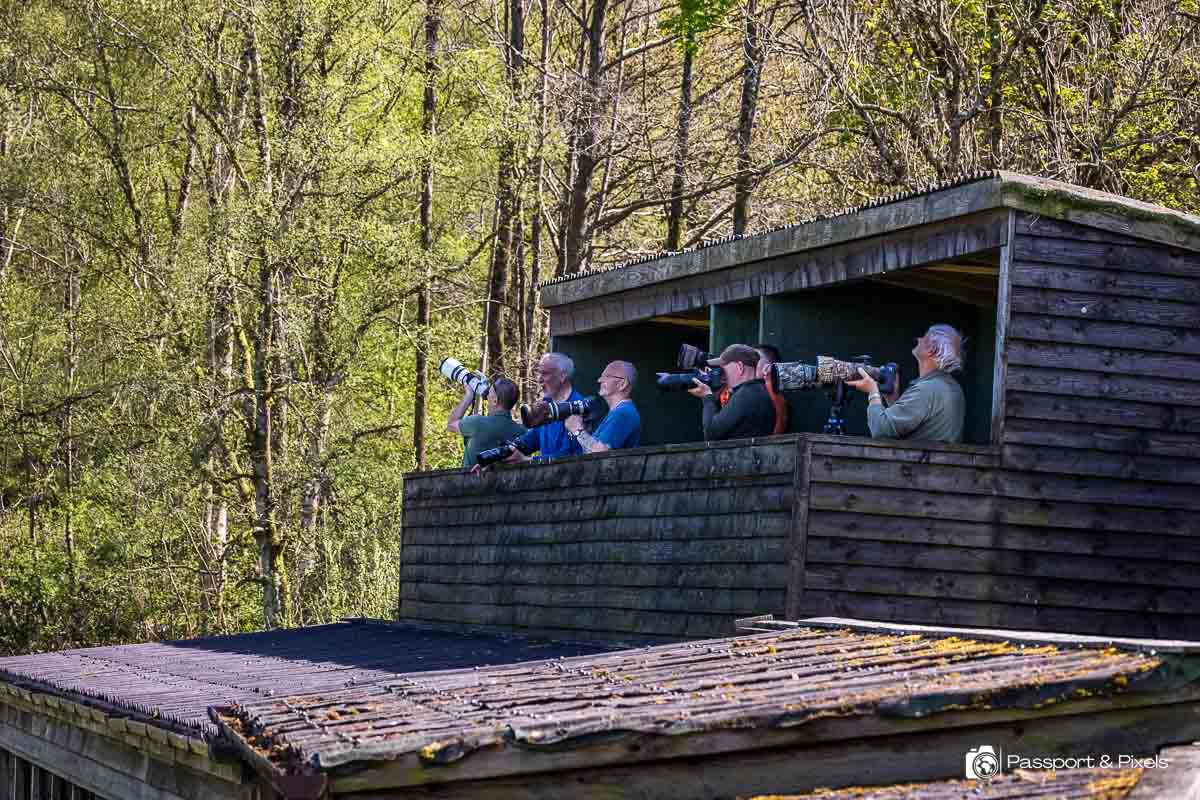
They’ve now built four hides specifically for photographers, offering clear views of the kites as they swoop down for food – making this one of the best places for wildlife photography in Wales.
There are also five standard low-level viewing hides, and an outdoor viewing area that’s a bit further away from the action.
Hides seat between two and 20 people and it’s a good idea to book in advance, especially if you want a specific hide.
The best ones for red kite photography is one of the two Tower Hides, which provide an eye level perspective on the kites as they swoop down for food.
Read more: Wildlife Hide Photography Tips For Safari Photos Like A Pro

Red kite feeding time at Gigrin Farm
Feeding takes place at 2 pm (or 3 pm during British Summer Time), when a farmer comes out with a tractor and shovels meat offcuts onto the ground.
Immediately, the red kites will start swooping and diving in a feeding frenzy, which will eventually tail off once most of the food has gone. But the birds will still stick around for a couple of hours, allowing plenty of time to practice your red kite photography.
Don’t leave after the first frenzy has ended – they will be back for more! Sometimes they may also perch in nearby trees for a while, or settle on the ground too.
If you’re lucky, you might even get to see one of the rare leucistic kites – we saw it on our first afternoon but not on the second – and it was a beauty!
Want to see some other wildlife in Wales? Try visiting the Skomer Island Puffins in Wales

The challenges of photographing red kites
Confession: when I signed up to my red kite photography workshop, I really didn’t think it’d be that hard.
I’m a pretty decent photographer and I have lots of experience photographing birds. I have pro gear with a great lens and animal AI focusing. So I wasn’t worried!
Turns out I should have been. Photographing red kites is HARD!
The birds are incredibly agile, diving and twisting mid-air, and they are super-fast. So fast that you can literally hear the whoosh of air as they dive.
There are also so many of them that it can be overwhelming. Trying to follow just one bird in the chaos is a real challenge.
I found that I’d follow one in hope that it would do something interesting, and end up picking one that just flew around in ever-increasing circles until my arm got tired from holding up the heavy lens and I’d have to take a break, at which point it would all kick off and I’d miss the action.
So here’s my pro tip: lift some weights in the gym before attempting red kite photography!
Read more: How To Make A Stunning Photo Gallery Wall: My 7-Step Guide

Want to see more of my photography or travel writing? Have comments or questions? Come follow me on Instagram, Threads or Bluesky and share your thoughts!
My top tips for photographing red kites
Rather than just ‘spraying and praying’, here are some tricks that will help you capture great photos of red kites.
1. Pick a bird and follow it
With so many birds overhead, it can get messy. For the best shots with just one or two red kites, pick a bird and follow it as it flies.
Doing this will help you get better at panning at the same speed as the bird, and if you’re lucky it may do something interesting.
It does take a while to get your eye in, and to get used to the speed and the way they move, but the more you practise, the easier it gets.

2. Put the camera down and watch their behaviour
As you watch them coming into feed, you’ll notice that the red kites circle round and round before diving down.
If you want to catch a bird mid-dive, or just after it’s grabbed some food, obviously this is the one you need to focus on.
You might get lucky by picking a random bird, but if you observe them, you start to spot the angle they fly at and the head movements they make when they’re getting ready to dive.
When you see a bird looking more interested in something on the ground as opposed to just circling in a relaxed manner – that’s the bird you want to go for.
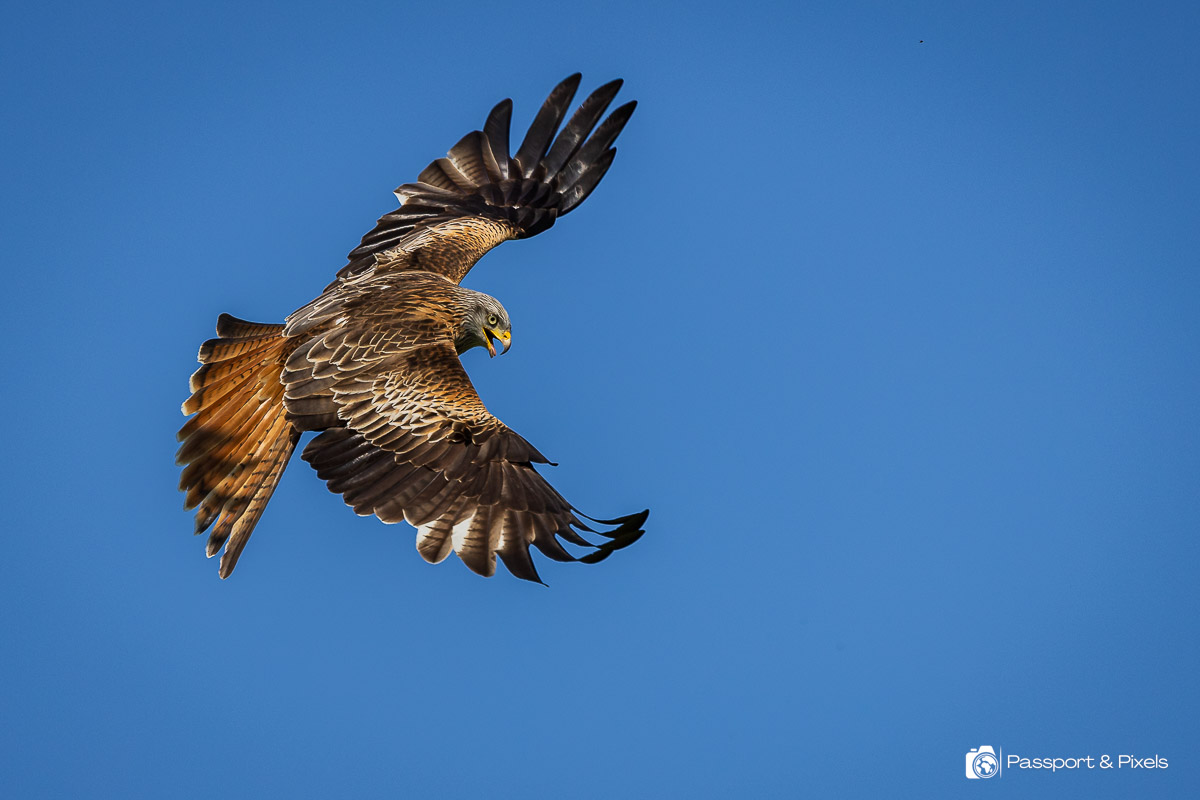
3. Wait for the dive bombing
After the initial chaos is over, the red kites settle into casual circling, and then every so often one will swoop down to grab a bit of meat off the ground and several dozen more will follow.
When this happens, you’ll notice that they all seem to target the same area and dive from more or less the same spot in the sky.

If you’re quick, this is a great opportunity to get diving shots. As soon as the first few dive, aim your camera in the area where they’re diving from as others follow suit.
It’s easier said than done as they’re still very fast and the activity doesn’t last long, but I got a few good diving shots this way.
Shooting in vertical orientation at this point can give you more of a chance of keeping the diving bird in the frame.
Read more: Using The Canon R5 For Wildlife Photography: A Full Review

4. Look for behaviours
When red kites grab the food off the ground with their talons, they then transfer it to their mouths mid-air to eat it. That’s a great moment to capture if you’re lucky!
Another thing I found interesting was that many of them were flying with their mouths open, making them look extra mean. This is actually because it was a hot day, and having their beaks open helps cool them down, much like a dog panting.

Best camera settings for capturing birds in flight
The precise camera settings you need to photograph red kites will depend on the light, the weather, and what you’re trying to achieve with the shot, but here are some basic starting settings.
- Use a fast shutter speed: Set your camera to a shutter speed of at least 1/2000th of a second to freeze the fast action of the birds.
- Use a wide aperture: Something like f/2.8 or f/4 will blur the background and help the bird stand out against the trees behind.
- Continuous autofocus: Enable AI Servo (Canon) or AF-C (Nikon) mode to maintain focus on the moving birds.
- High-speed burst mode: Shoot in continuous burst mode for a fast frame rate to increase your chances of catching the perfect moment (but be prepared to do a lot of deleting later!)
- Auto ISO: I prefer to use manual shutter and aperture settings and auto ISO – or you can also set your ISO manually by taking a few test shots and checking the histogram, but if you do this beware of changes in the light such as if the birds are in shadow or the sun goes behind a cloud.
Read more: Top 50 African Birds: A Safari Photo Guide


Best camera gear for bird photography
While you don’t need a super duper pro camera, having the right equipment can make a huge difference between just OK and really great bird photography. Here’s what I recommend you bring:
Camera body: A DSLR or mirrorless camera with fast autofocus (even better if it has animal eye detection) and a high frame rate, such as the Canon EOS R5.
Lens: A telephoto lens with a focal length of 300mm or more. A 100-500mm zoom lens offers versatility for tracking birds in flight.
Monopod or tripod: Could be useful for stability (and helping your tired arms!) during long shooting sessions, but I find that it does restrict your ability to pan and follow the birds.
Memory cards: Make sure you have good quality, fast cards to handle continuous shooting.
Read more: Best Camera For Wildlife Photography: Gear, Lenses And More
When’s the best time to see red kites in Wales?
Red kites can be seen all year round, but the different seasons offer different types of shots.
- Winter: The stark landscape and lower sun angle provide dramatic lighting conditions. If there’s snow it could make your shots extra beautiful – but make sure you wrap up warm!
- Spring: Breeding season brings increased activity and interactions among the kites.
- Autumn: The changing foliage adds vibrant backgrounds to your shots.
Want to see more birds in the UK? Try seeing Gannets at the Incredible Bass Rock in Scotland

Other places to see red kites in the UK
While Gigrin Farm is a popular destination, it’s not the only place where you can see red kites in the UK. Here are a few other options.
- Bwlch Nant yr Arian: Located in Ceredigion, this site offers daily feeding sessions and scenic views.
- Chiltern Hills: Another reintroduction success story, the areas around Watlington Hill, Cowleaze Wood and Stokenchurch are known for frequent kite sightings. There’s no official feeding though and feeding them is discouraged in the Chilterns.
- Harewood Estate: Near Leeds, this estate has become a stronghold for red kites in northern England.
Read more: 19 Easy Wildlife Photography Tips For Beginners

Where is Gigrin Farm
Gigrin Farm is located just outside the town of Rhayader in mid-Wales. By far the easiest way to get there is by car from the A470.
If you’re using public transport, the nearest train station is in Llandrindod Wells, approximately 11 miles away, and then you’ll need to get a local taxi the rest of the way.
Read more: My Perfect Pembrokeshire Itinerary: A 5 Day Coast Road Trip

How much does it cost to see red kites in Wales?
You can see red kites for free if you just drive around!
However, if you want a guaranteed, close-up experience, you’ll need to head to a feeding centre like the one at Gigrin Farm.
The feeding event isn’t open every day, so check the website for details of when you can visit.
Adult entry and a spot in one of the five standard hides costs £11.50 for an adult. The specialist photography hides cost from £30-£45 per person depending on the hide. This price also includes your entry to the farm.
It’s better to book in advance, especially during peak seasons, to secure your spot in the preferred hide.
Various local photographers offer photography workshops at Gigrin Farm – prices for these vary depending on the photographer and size of group.
My four-day tour with Wildlife Worldwide included loads of other activities as well as accommodation and all meals, and costs from 1,295 pp.

Want to see more of my photography or travel writing? Have comments or questions? Come follow me on Instagram, Threads or Bluesky and share your thoughts!
That’s all for now! Thanks for reading!
If you’ve enjoyed this post and would like to find out more about this trip, you can read the article I wrote for Wildlife Worldwide here.
Buy me a coffee
Did you enjoy this website or find it useful? If you did and fancy showing your appreciation, that would be amazing!
A small token of support helps keep Passport & Pixels going, so I can carry on creating free content for travellers like you. Also, it makes my day! Thank you!
My favourite travel tools and brands
To help you organise your trip, here’s a short list of some of the brands and tools I use over and over again when I’m planning my travels. You can see more on my Travel Resources page.
- Booking.com: A huge range of hotels to choose from, often with free cancellation. If you book hotels regularly you can earn discounts. I’m on Genius Level 3 which gets me 20% off!
- Expedia: Another great place to find hotels and Expedia also sell flights, car hire, and loads more all in one place.
- Skyscanner: The only place I ever go to search for flights and compare prices.
- Flight Centre: Booking a more complicated route? Let Flight Centre organise it for you (and deal with the drama when something goes wrong).
- Priority Pass: I love having access to 1600+ airport lounges when I fly, allowing me to enjoy my time at the airport. Buy through my link and you get up to 20% off!
- Airalo: Say goodbye to ridiculous mobile roaming charges. Did you know you can now buy ane-SIM, install it in your phone before you leave home, and then use data abroad at local prices? Game changer. Get US$3 credit with code BELLA5735.
- TourRadar: If you prefer group travel and organised tours, TourRadar has a huge range of fantastic tours from respected operators. They’re very helpful and have 4.5 stars on TrustPilot.
- Viator: Part of the TripAdvisor brand, Viator is another great place to search for group adventures and day trips.
- GetYourGuide: A great place to find local tours and day trips in your destination.
- Wex Photo Video: The UK’s best camera gear store.
- Ellis Brigham: Looking for good quality backpacks, travel clothes and other gear? Ellis Brigham is where I buy almost all of mine.
- Rentalcars.com: Part of the Booking.com family and the world’s largest online car rental service, with 24/7 customer service.
- World Nomads Travel Insurance: I never ever travel without travel insurance and nor should you!
Where to next?
If you enjoyed this, why not check out some of my other wildlife photography posts?
- 41 Safari Photography Tips For Stunning Wildlife Photos
- Wildlife Wonders on an Epic South Georgia Cruise
- A Canadian Safari Review: See Canada’s Big Five In Manitoba
- 10 Unmissable Wildlife Adventures In Africa – By Travel Experts
- A Kenya Safari Holiday: How To Plan The Perfect Trip For You
- Gorilla Trekking In Uganda – The Real Inside Story
Liked this post?
Social shares help support my hard work! You can share via the buttons at the bottom, or pin this handy Pinterest Pin. Thank you!

