


This trip to go hiking in Kenya’s Loita Hills was hosted by Walking Wild Adventures.
I don’t accept freebies or payment in exchange for positive coverage. This post may contain affiliate links.
For safari and wildlife, Kenya is hard to beat. In fact, it’s one of my favourite countries for wildlife photography!
But if you’re a lover of outdoors adventures like me, there’s another fantastic reason to visit Kenya: it offers some of the best hiking in Africa.
Whether it’s summiting Mount Kilimanjaro via the 8-day Rongai Route (while Kilimanjaro itself is in Tanzania, the trail starts in Kenya), or scaling the only slightly smaller Mount Kenya, the country has some big-hitting treks to attempt.

But there are also many really beautiful, less demanding and shorter Kenya hikes as well, such as the one I’m here to tell you about today: hiking in the Loita Hills with Maasai Trails.
This 4-day, 3-night journey not only lets you explore the little-visited highlands of southern Kenya, it’s also a fantastic way to experience the life and traditions of the Maasai people.
Here’s what you need to know about this unforgettable adventure.

About my Kenya walking safari
My experience hiking in the Loita Hills was part of a longer trip with a company called Walking Wild Africa.
It was a small-group trip for women, lasting 9 days and including some safari time before and after the hiking, making it the perfect combination of wildlife, adventure, and some luxury relaxation at the end.
Walking Wild Adventures also offer bespoke private trips for groups of any kind, in Kenya and Namibia.
The hiking part of the trip was subcontracted to a local Kenyan organisation called Maasai Trails who use guides from the local Maasai communities to lead visitors through the Loita Hills.
Read more: A Kenya Safari Holiday: How To Plan The Perfect Trip For You

Our Kenya Hiking itinerary
Our Kenya itinerary looked like this:
- Two days safari based at Speke’s Camp in the northern Maasai Mara where we did game drives and wildlife watching.
- Four days hiking with the Maasai in the Loita Hills – which I’m about to tell you all about.
- Two days relaxing at Shompole Wilderness including the option to spend a night in their incredible photography hide (which of course I did – and there’ll be a post about that coming soon).
- One day travelling to Nairobi with a visit to the Giraffe Centre.
It was an incredible trip with so many highlights – check out my reels, photo posts and story highlights on Instagram if you’d like to see more.
And don’t worry if you’re (a) a man or (b) have less time or budget to do this entire trip. You can either book a bespoke trip or do the hiking part separately.
I’ll put more information about how to do that at the end of this post. Now, let’s get into the details…
Read more: Shompole Wilderness Lodge In Kenya: My Complete Review

READY TO BOOK YOUR Dream SAFARI?
Want to save time, stress and money AND have the best safari experience of your life?
Maybe this post has convinced you, and now you’re ready to book?
Or maybe you’re still overwhelmed by choice and would like help designing your perfect safari?
With my extensive experience and network of trusted contacts, I can help – and it’s FREE!
Simply fill out my safari enquiry form here to get the ball rolling.
I will email you to answer any questions, and then pass your information to up to three of my handpicked, trusted safari partners.
They will then contact you directly to handle your enquiry and provide a free, no-obligation quote.
Where are the Loita Hills?
The Loita Hills are in Narok County in the far south of Kenya, near the Tanzanian border, east of the Maasai Mara and northwest of Amboseli National Park.
They sit on the edge of East Africa’s Rift Valley, stretching across a stunning landscape of high-altitude forests, peaks, valleys, and ridges.
Why you should go hiking in the Loita Hills Kenya
Known to the Maasai as the Forest of the Lost Child, this area is rich in both ecological and cultural significance.
Unlike the busy Maasai Mara or other Kenya national parks, the Loita Hills are rugged and untouched, which makes them ideal for a remote hiking adventure away from other tourists.
Out here, you’ll be truly off-grid – no other people, no electricity, no phone signal – a rarity in today’s busy and ever-connected world.
But the real magic here lies in hiking with Maasai guides who intimately know the land and share their insights into the local flora, fauna, and traditions as you walk together.

Loita Hills walking safari at a glance
- Location: About 120 kilometres (75 miles) southwest of Nairobi.
- Elevation: Ranges between 2,000 to 2,600 meters (6,560 to 8,530 feet) above sea level.
- Duration: Our trip was 4 days / 3 nights, but bespoke hikes can be up to 7 days.
- Length of day: On the first and last days you’ll walk about 3-4 hours (depending on your pace and fitness. Days 2 and 3 are usually about 6-8 hours of walking with plenty of water breaks and a long break for lunch.
- Terrain: Varies between trails through dense forest and more open shrubland with small trees and bushes. Lots of up and downhill, varying in steepness. The downhill on the last day is pretty steep but manageable. Some small river crossings.
- Accommodation: In mobile campsites, set up and taken down each day. Tents are spacious with comfortable camp beds. There are bush toilets and bucket showers. More on this below.
- Level of difficulty: Moderate to difficult, depending on your fitness and tolerance to altitude. There’s more detail about this to come.
Read more: Advantages Of Group Travel: 10 Reasons To Do Group Holidays

What to expect on your 4-day Kenya hike with Maasai Trails
Day 1: Departure
Your journey can start wherever is convenient for you. Pickups can be arranged from Nairobi or Narok, but the best option is to follow the same route I did and spend a few nights at the gorgeous Speke’s Camp in the northern Maasai Mara before you start your hike.
From there it’s about a five-hour drive along bumpy unsealed roads to the start of the trail in the Loita Hills. Here you’ll meet your Maasai guides and the donkeys who’ll be carrying your gear.
You need to sort your stuff into what you want to carry on the hike (very little, just your camera, some water, and a waterproof in case of rain), and what you want to give to the donkeys – you won’t see this again till you reach camp in the evening.


It’s a good idea to leave anything you won’t need for the hike (such as chargers, extra clothes and shoes) in your hotel to save weight on the donkeys. If you’re doing the same route I did, Speke’s Camp will arrange for your stuff to be transported to your final destination.
On the first afternoon you’ll do about three hours of fairly gentle walking with a little bit of uphill.
We passed through some community land, and had to cross a couple of shallow rivers before arriving at our first campsite, which was located in a grassy clearing by a river.

Before you get there, an advance party of Maasai staff and the donkeys (more on them later) set up camp.
Upon arrival, you’ll be offered a drink, some snacks, and a hot shower before dinner is served by the campfire.

Day 2: Into the forest
After a hearty breakfast involving bacon and eggs, fruit, yoghurt and granola, the adventure really begins.
You’ll spend much of the day hiking through the Forest of the Lost Child, following jungle trails made by elephants and buffalo.

You’ll see evidence of them along the trail in the form of their dung. If it’s fresh, keep an eye out – there may be one close by!
But don’t worry, they’ll get out of the way as soon as they hear you coming.
Along the way, your Maasai guides will share stories about the forest and the trees and plants you’re passing, including how they use native plants for medicinal purposes.
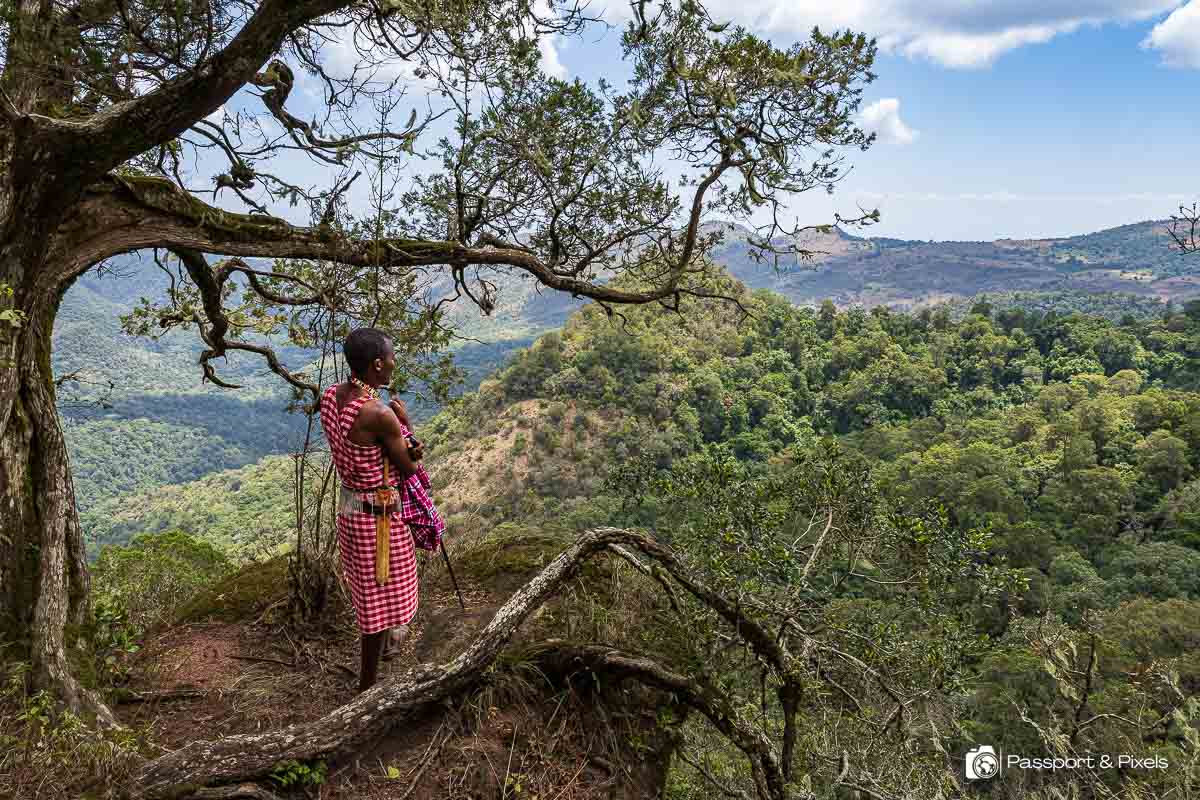
After about three hours of walking you’ll stop for lunch. We had a fabulous picnic lunch overlooking a view of the rolling Loita Hills.
If you’re making good time and your group are up for some extra hiking, you can take a 2-hour detour to see (and swim in), the Entasopia Falls, which are the most impressive and accessible waterfalls in the area.

The final hour took us downhill, along the valley floor for a bit, and then uphill again through farmland to the campsite, which was perched on a hillside overlooking a scenic plain with a couple of small lakes.
A beer (sadly warm, but you can’t have everything!) while we watched the happy donkeys rolling in the dust and the sun set over the lakes made an enjoyable end to the day.

Day 3: High altitudes
On the third day of your Kenya hike you’ll leave the forest behind and continue climbing, reaching some of the highest points of the Loita Hills.
There may be an opportunity to take another detour up to a viewpoint, offering panoramic views out over the Nguruman Escarpment, past Lake Natron, down across the Rift Valley and, on clear days, into Tanzania.

After crossing over the high plateau, you’ll start your descent through vibrant wilderness packed with fragrant plants and bright flowers in shades of orange and purple.
Walking through it was like wandering through an overgrown garden – I kept wanting to stop and smell things!

Our final camp of the trip was in a forest clearing next to another river, which was wonderful for cooling hot feet after a long day of walking.
On your final evening, if you’re lucky you’ll be treated to a joyful display of traditional Maasai singing and dancing, including the famous adumu, or high jumping dance.

Day 4: Descent and return
You’ll have an early start on Day Four, leaving the campsite just as the sun is rising to make your descent down the side of the dramatic Nguruman Escarpment, which you’ll have seen in the distance on previous days.

The Nguruman Escarpment
The Nguruman Escarpment is a natural boundary that forms the western edge of Kenya’s Rift Valley near the Tanzanian border.
Stretching around 50 km in length, this impressive ridge offers stunning views of sweeping plains, volcanic hills, and distant lakes like Lake Magadi and Lake Natron.
The valley floor lies about 900 meters above sea level, while the escarpment’s crest reaches 2300 meters, meaning you’ll have about 1400 metres of descent to do before you reach the bottom.

This should be about three hours of hiking, or more if you’re a bit unsteady on the downhill. Walking poles are supplied and your guides will help you, so don’t worry.
At the bottom you’ll reach a small village where your pickup will be waiting to take you to Shompole Wilderness camp or wherever else you’re headed, for some clean clothes and a hot shower.
Read more: What Happens On An African Photo Safari: Are They Any Good?

What are the campsites like on a Maasai Trails hike?
Maasai Trails have a network of 14 campsites that they’ve identified throughout the area, which they will choose from for your hike.
Each one has been hand-picked based on its location and suitability as a campsite, with a flat area to put the tents and staff quarters, and secluded areas for the toilet and shower.
They’ve negotiated with the landowners for permission to use the space, meaning the local farmer or community earns some money from your visit.

The tents and all the facilities are set up for your arrival, and then taken down again the next day. Nothing is left behind,
Which campsites they take you to in will depend on the length of your hike, the fitness of your group, the weather and state of the terrain, and the route your guides decide to follow.
This means you may not end up doing the same route we did – but the beauty of this is that the guides can create a bespoke trip for you, based your ability and preferences.
They’re constantly assessing how you’re getting on, and will adapt the plan as necessary to make sure that everyone can manage and is having a good time.

What are the tents like on a Maasai hike in Kenya?
I’m not a huge fan of camping, to be completely honest. I don’t like sleeping on the ground, I don’t like trying to get in and out of a tiny tent without getting mud over everything, and I don’t like having to search for stuff in a backpack in the dark.
OK, so you’ll still have to do that last part (tip: bring a headtorch), but the first two are not a concern on the Loita Hills hike.
The tents are spacious, two-person bell tents, high enough to stand up in and with thick canvas walls and air vents.
You’re given a comfortable camp bed with a pillow, proper sheets, a blanket and a hot water bottle for the chilly nights, and proper towels.
After a full day of hiking I found the bed very comfortable and slept pretty well.

Are there bathrooms and toilets on a Kenya hike?
In this case, yes! OK, they are ‘bush bathrooms’, so very basic and al-fresco, but much better than I was expecting.
What was the toilet like?
There will be one or two toilets for your group. The toilet is hidden in a clearing or behind a screen of branches and is just a hole in the ground, but there’s a seat to sit on, a roll of loo paper, and a basin of water for washing your hands.
Much cleaner and fresher than some of the disgusting toilets I’ve had to use in my time.
When you leave, camp staff fill in the hole, and your natural waste is left to fertilise the soil.

Are there showers when you go hiking in Kenya?
You can even have a hot shower at the end of your dusty day of hiking in Kenya!
Again, this is completely outdoors, hidden away behind the trees for privacy. The camp staff heat up water over the fire, put it in a bag with a shower head attached, and then hoist it up.
You simply open the lever, and gravity does the rest.
You don’t get much water, so you have to be careful to use it sparingly, but you get enough to wash and feel fresh after your hot day.
Overall, the camping experience is comfortable enough for a back-to-nature adventure, providing essentials without losing the feeling of wilderness.

What was the food like?
I was very impressed with how well we were fed on our Loita Hills hiking trip with the Maasai.
Our guides managed to produce delicious and fresh meals, despite the fact that they had to cook everything over a campfire and carry all the ingredients on donkeys.

Breakfasts are served in camp, with tea and coffee, cut fruit with plain yoghurt and granola, a hot breakfast of eggs, bacon and sausage, and toast and jam. Plenty to fuel you for a morning’s hiking.
Lunches were carried by the hiking guides and eaten picnic style halfway through the day. We were served fresh and colourful salads containing cabbage, lentils, tomatoes, olives and cucumber, alongside things like pizza slices, meatballs or cheese. There were also snacks of fresh bananas, dried mango or nuts to keep us going.
Dinners were eaten around the camp fire after dark. We were offered two courses, usually with vegetable soup and a roll to start, followed by dishes like spaghetti bolognese or beef stew with mash and vegetables. Vegetarians were also catered for.


Our Maasai guides
One of the highlights of trekking the Loita Hills with Maasai Trails is getting to know the Maasai guides.
They looked after us so well, setting up and taking down the camp every day, feeding us, answering our questions, telling jokes and sharing stories.
As you hike, they’ll tell you about Maasai history, their semi-nomadic lifestyle, and the uses of the different plants you pass, like the poison tree they use to tip their hunting arrows with, or one that can apparently cure infertility.
They’ll even introduce you to traditional skills like fire-making and tracking and hunting animals.

I loved walking alongside them and chatting to them, hearing their stories and sharing details about my own life. I learned about their culture of having more than one wife, while Daniel was curious to learn than in the UK men can only marry one woman at a time.
It was a truly wonderful and authentic cross-cultural connection.
I even learned some of the Ma language, like how to say ‘nice to meet you’ and ‘can I take a photo’ – very important in my line of work!


Hiking Kenya: Animal welfare on a walking safari
Each day, your camp essentials – including tents, food, supplies and your luggage – are transported by donkeys.
Naturally, when I heard about this, I was concerned about animal welfare. On my travels I’ve seen many animals overworked, beaten, abused or underfed and I don’t want to have any part in that kind of thing.
But that was not the case here at all.

Every day the donkeys were loaded just before we set off. They were not over-loaded, and there were even some donkeys not carrying anything.
When we arrived at camp they were immediately unloaded and left to roam freely around the camp, graze and roll in the dust. They looked very happy!
After dark, they were corralled into an enclosure to protect them from wandering off or getting eaten by predators.
Read more: Ethical Travel Photography: How To Capture With A Conscience

The Maasai and donkeys
When you think about it, it makes sense that the Maasai should look after their donkeys well.
The Maasai have used domesticated donkeys as pack animals for many generations – they are an integral part of their traditional way of life.
The ones that came with us were rented from local farmers who need them to work their fields. They don’t have machinery, so their animals are extremely valuable to them and must be well-looked after so they stay strong and healthy.
This also means that some of the price you pay for your Kenya hiking trip is also going directly back to the farmers, another way in which this experience directly supports and helps local communities.

What wildlife might you see on a Kenya walking safari?
This trip is not a ‘walking safari’ as you might imagine in that you are not heading out to look for animals in the same way as you might on a regular safari game drive.
We did see some fantastic wildlife before and after the hiking part of the trip, but while we were in the Loita Hills we didn’t see all that much.

While there are animals around, they are very shy and will likely run away as soon as they hear or smell your group approaching.
Of course that’s a good thing, because you don’t really want to run into a lion while you’re on foot!
That said, the Loita Hills are home to diverse wildlife, so there’s always the chance of spotting animals along the trail. You may come across elephants, buffaloes, baboons, and an array of bird species.
The area is also part of migration routes, so during certain seasons, you might see wildebeests or zebras passing through.
We saw the footprints and droppings of many animals including buffalo, impala, elephants, dikdiks, porcupines and more.
We even saw one buffalo, though it ran away into the forest when it realised we were there.
Read more: The Big Five Animals: My Photo Guide And Favourite Facts

Is hiking in Kenya dangerous?
This is something that concerned me a little before the trip, I’m not going to lie.
I worried about bigger animals like elephants, buffalos or even lions, as well as smaller things like snakes and scorpions.
On top of that, you have to remember that you are very far from civilisation with limited phone signal, so if anything happens to you – a broken ankle, a heart attack, an allergic reaction or whatever – it will take a long time to get help.
So it’s important to be aware that this trip is not without some risk.
If you’re not in good physical health, I don’t recommend it. If you manage a condition with medication, make sure you bring everything you need with you.

Overall though, I never felt in any danger.
While we saw plenty of evidence of animals including scary things like elephants and buffalo, they heard us coming and avoided us.
The Maasai guides are armed with spears, and are used to dealing with animals. When we did encounter a buffalo, they ran towards it to scare it off, and it scarpered.
If you’re travelling with Walking Wild Adventures, our tour leader Kim also carried a satellite phone in case of major emergencies, and we were insured for an emergency helicopter evacuation if necessary.
It’s also vital that you have your own travel insurance with good medical and repatriation cover, and check that yours covers you for hiking and remote camping in Kenya.
Read more: 40 Safari Photography Tips For Stunning Wildlife Photos

How hard is hiking in the Loita Hills?
Hiking in the Loita Hills isn’t a walk in the park.
The trails are often steep, rocky or uneven, especially in the forested areas. On some days you’ll be at altitudes of around 2000 metres, which may make you more breathless.
Daily hikes range from 6 to 8 hours, and you’ll need a decent level of fitness, though the guides were really great at adjusting the route and pace to suit the slowest member of the group.
One of the ladies in our group was 75, and she did amazingly!

That said, be prepared for some challenging sections and remember to break often and drink plenty of water.
Personally, I found it pretty easy, but I’m pretty fit and am an experienced hiker.
I found it much easier than climbing Kilimanjaro (extreme altitude), Acatanango volcano in Guatemala (lots to carry), Nyiragongo volcano in the DR Congo (steep and rocky) or Ol Doinyo Lengai in Tanzania (terrifyingly steep and long).
So based on my experiences I would say this is only moderately difficult, but we were going at an easy pace to accommodate the slower members of the group.
If you’re with a bunch of super fit people the guides will pick up the pace or take you up a different route, making it harder.

Is this Loita Hills trek sustainable?
I think this is a really important question that you should always ask before you book any travel.
We all need to play our part in protecting the planet, the environment and local communities.
But apart from the flight you take to get there, this trip is fantastically eco-friendly, carbon-low and sustainable:
- You’re walking and the gear is transported on donkeys, all very low-impact.
- All the food is locally-sourced with low food miles.
- All the guides and staff are hired from local Maasai villages, providing employment opportunities.
- The donkeys and campsites are rented or leased from local farmers, providing them with an income.
- The area is very under-visited, so you are not contributing to over-tourism.
- The lodges you stay in before and after the hike also support local communities and local businesses.

Who is this Kenya walking safari for?
I travelled with a small group of seven outgoing, adventurous women.
Although I’m a solo traveller, only two other women in the group were single; the others were married and had left their husbands at home.
So you don’t need to be a solo traveller, just someone who’s reasonably fit, and has a love of nature, wildlife and the outdoors.
You also don’t need to be a woman. While the trip I did was for women, Walking Wild Adventures also offers bespoke trips for any type of group, so grab your family or a bunch of mates and get booking!

When is the best time to go hiking in the Loita Hills?
I went in mid-October and we had sunshine and blue skies every day, making for wonderful hiking and great views.
I imagine that if it had rained a lot, the experience would have been pretty miserable.
So the best time to hike in the Loita Hills is during Kenya’s dry seasons, from June to October and January to March. This is when the trails are drier and more accessible, and the temperatures are comfortable, making for easier trekking.
Rainy seasons, which occur from April to May and November to December, can make trails muddy and slippery, as well as making the campsite experience quite difficult.

Packing essentials: what to bring for hiking in Kenya
Packing right is key to a comfortable trek in the Loita Hills. Here’s a list of essentials:
- Hiking boots or shoes: Trails can be rocky and uneven, so bring decent footwear. I hiked in my Asics Gore-Tex trail trainers because I prefer them to my heavier hiking boots, but you may prefer to have ankle support.
- Long trousers: Some days I hiked in shorts (these ones, I love them!) because it was hot, but my legs did get quite scratched from all the vegetation, so long trousers or leggings are a good idea.
- Warm layer: The high-altitude nights can be chilly, so bring a fleece or hoodie.
- Rain gear: Weather in the hills can be unpredictable, so a waterproof jacket is a must.

- Sun protection: Bring sunscreen, sunglasses, and a hat to protect against the strong equatorial sun.
- Personal hygiene items: A small pack of biodegradable wipes (cheeky panda ones are environmentally friendly) and hand sanitizer will be useful, plus of course your toothbrush, moisturiser, and a face cloth or flannel.
- Water bottle: Staying hydrated is crucial. The guides provide water, but you’ll need to bring a bottle. If you’re travelling with Walking Wild Adventures, they will give you one. If not, an insulated one to keep your water cool is a great idea.
- Small daypack: You’ll want a comfortable backpack to carry daily essentials while you put your main luggage on the donkey to be carried between the campsites. I always take this packable one with me.
- Head torch or head lamp: For moving around the campsite after dark. This is mine and it’s great.
- Camera or phone: To capture the landscape and wildlife moments.
- Portable charger: You won’t see electricity for nearly four days, so make sure you bring enough backup power. I have two of these which are really good.
Read more: What To Wear On Safari: My Detailed Safari Packing List With Photos

Hiking in Kenya: my final verdict
I’m a huge fan of Kenya, but my main passion is the wildlife. I love nothing better than heading out at dawn in a safari car and driving around all day looking for animals.
There is no greater joy in life for me than photographing an incredible wildlife moment.
So while I love hiking, fitness and the great outdoors, I wasn’t sure if I’d love this part of the trip quite as much as the safari part.
What surprised me was how much I did enjoy it.

After three days of game drives in the Maasai Mara, I was ready to do something different, get active, and stretch my legs.
I loved getting some fresh air and exercise (always a tricky thing to manage on safari), and I loved getting truly off the beaten track and out into the real wilderness, away from crowds, my computer, social media and my phone addiction.
The group were wonderful, and hiking was a great way to connect with other adventurous women.
But my favourite thing of all was bonding with the Maasai guides. They were all so lovely, and very happy to put up with all my questions and photo-taking.


Some of the younger ones were delighted by the attention, and it was a joy to photograph them and send them their images when I got home.
It’s often quite hard to connect properly with locals when you travel – it can be hard to meet people, especially if you’re on a rushed schedule.
So having four days to get to know these guys and learn about their life, beliefs and culture was a real treat.
If you’re ready for an off-grid experience that connects you to the land, its people, and a traditional way of life, then hiking the Loita Hills with Maasai guides might just be the adventure you’re looking for.

Ready to book your walking safari?
If you’d like to do a safari and walking adventure like this, or you just want more information… I can help!
Using my first-hand experience and trusted contacts across Africa and beyond, I’ll help you cut through the confusion and find the right trip for you – at no cost.
Here’s how it works:
- You fill in my safari enquiry form.
- I review your plans and answer your questions.
- Then I pass your enquiry to up to three of my trusted, handpicked safari partners.
- They contact you directly to provide a free, no-obligation quote.
Get the ball rolling on your dream safari here!
Save time, avoid stress and confusion AND get a great deal by having an expert do the work for you!

Buy me a coffee
Did you enjoy this website or find it useful? If you did and fancy showing your appreciation, that would be amazing!
A small token of support helps keep Passport & Pixels going, so I can carry on creating free content for travellers like you. Also, it makes my day! Thank you!
My favourite travel tools and brands
To help you organise your trip, here’s a short list of some of the brands and tools I use over and over again when I’m planning my travels. You can see more on my Travel Resources page.
- Booking.com: A huge range of hotels to choose from, often with free cancellation. If you book hotels regularly you can earn discounts. I’m on Genius Level 3 which gets me 20% off!
- Expedia: Another great place to find hotels and Expedia also sell flights, car hire, and loads more all in one place.
- Skyscanner: The only place I ever go to search for flights and compare prices.
- Flight Centre: Booking a more complicated route? Let Flight Centre organise it for you (and deal with the drama when something goes wrong).
- Priority Pass: I love having access to 1600+ airport lounges when I fly, allowing me to enjoy my time at the airport. Buy through my link and you get up to 20% off!
- Airalo: Say goodbye to ridiculous mobile roaming charges. Did you know you can now buy ane-SIM, install it in your phone before you leave home, and then use data abroad at local prices? Game changer. Get US$3 credit with code BELLA5735.
- TourRadar: If you prefer group travel and organised tours, TourRadar has a huge range of fantastic tours from respected operators. They’re very helpful and have 4.5 stars on TrustPilot.
- Viator: Part of the TripAdvisor brand, Viator is another great place to search for group adventures and day trips.
- GetYourGuide: A great place to find local tours and day trips in your destination.
- Wex Photo Video: The UK’s best camera gear store.
- Ellis Brigham: Looking for good quality backpacks, travel clothes and other gear? Ellis Brigham is where I buy almost all of mine.
- Rentalcars.com: Part of the Booking.com family and the world’s largest online car rental service, with 24/7 customer service.
- World Nomads Travel Insurance: I never ever travel without travel insurance and nor should you!
Where to next?
If you enjoyed this post, why not check out some of my other African safari posts?
- Kenya Vs Tanzania: Travel Experts Decide
- Which Is The Best Botswana Safari Lodge? My Favourites With Photos
- A Kazinga Channel Boat Cruise In Uganda: Is It Worth It?
- Awesome Things To Do In Sipi Falls, Uganda
- Instinct of the Mara Review: Exclusive Wildlife In Kenya
- Is Cardamom House In Vipingo The Best Beach Hotel In Kenya?
- Olderkesi In Kenya: The Maasai Mara’s Newest Conservancy
And here are some other hiking and adventure posts:
- Hiking In The Beautiful Knuckles Mountain Range, Sri Lanka
- 15 Things To Do In Huesca: Northern Spain’s Adventure Capital
- 4 Days In Jasper National Park: An Awesome Jasper Itinerary
- Hiking Mount Nyiragongo: The World’s Largest Volcano Lava Lake
Liked this post?
Social shares help support my hard work! You can share via the buttons at the bottom, or pin this handy Pinterest Pin. Thank you!

